Showing posts with label martin scorsese. Show all posts

Friday, May 14, 2021

Building a Pool Castle

In most careers or artforms, one must except an inevitable decline in prowess. Those who've reached the highest summit might expect the more terrible or humiliating fall, but perhaps the expectation in many cases exceeds the reality. This is the question that haunts Eddie Felson in The Color of Money, Martin Scorsese's 1986 sequel to 1961's The Hustler, both based on books by Walter Tevis. A film that focuses much more on the technical aspects of hustling than its predecessor, it's always engaging and fascinating. Some of the shots of pool cues striking balls are reminiscent of some of the visceral, inside-the-ring shots from Raging Bull but The Color of Money is far from one of Scorsese's greatest films and it's not quite as good as The Hustler. Still, it's pretty damn good.

We find Eddie, again played by Paul Newman, retired from playing pool and hustling, now sitting atop a lucrative counterfeit liquor racket.

It always amazes me how different Paul Newman looked and sounded when he was older. His voice is totally different--deeper and much more gravelly--and all his facial features seem harder edged and sunken. He looks old and very sharp so when he decides to mentor two young hustlers he certainly looks like an authority.
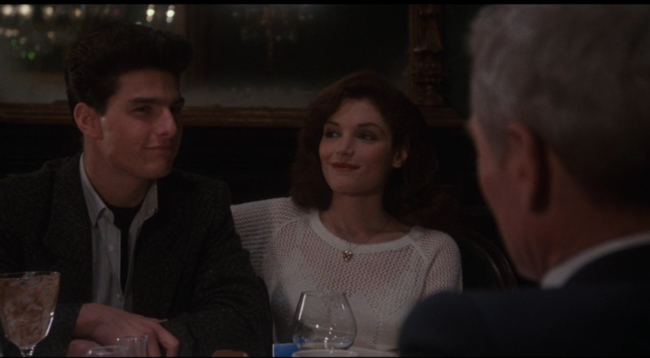
The two young hustlers are a couple of lovers, Vince and Carmen, played by Tom Cruise and Mary Elizabeth Mastrantonio, respectively. Cruise is such a vain doofus in this, constantly showboating or making obnoxious boasts. He's certainly credible in the role with that 10k watt grin of his, and also because Cruise trained hard to genuinely be able to pull off his pool feats. His girlfriend is also his manager and she and Eddie commiserate whenever Vince does something boneheaded, at least when Carmen isn't trying to seduce Eddie.

And here's another point where he seems a credible mentor--he won't sleep with her, he's more interested in getting her to employ her feminine charms strategically, which she finally does when she threatens to withhold sex from Vince if he keeps winning games he needs to lose in order to fix the betting odds.
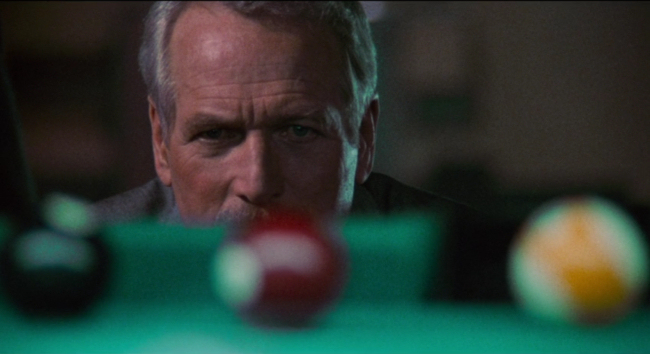
The trouble really starts when Eddie tries to play casually and finds he's not even a shadow of his former self. Watching him go through the humiliating experience of finding the student is well beyond the teacher--and inclined to be an obnoxious braggart about it--makes for some sharp, painful cinema thanks to Scorsese's unflinching vision and performances from Newman and Cruise. And then you really root for Eddie as he starts to slowly and carefully rebuild what he was.

The Color of Money is available on Disney+ in most countries.

Twitter Sonnet #1452

Abrupt, the end reminds a school to eat.
The biggest box was small across the pond.
In other realms, tomatoes count as meat.
The islands formed a fish and lemon bond.
For teeth, the tube prepared a minty paste.
Disliking labels, bottles sold for cheap.
But all the drinkers drank with ready haste.
By twelve o'clock from stools there's not a peep.
Except the second eye, we watched a play.
Suggestions drift beyond acknowledged sight.
A nose's shade became a show to-day.
Or paint to turn the stubborn visage right.
The singer sang a second time for words.
The steamy room compels a pair of birds.

Tuesday, December 10, 2019

The Only One

In the history of cinema, few killers have been as passive as Robert De Niro's Frank Sheeran. Oddly enough, it's completely credible and at the heart of what makes The Irishman so good. Seeing director Martin Scorsese team with Robert De Niro and Joe Pesci again, with the addition of Al Pacino, for a movie about gangsters, one might expect something like Goodfellas or Casino. In some ways it is--rhythm of the dialogue, the complexity of the characters. But while those other two films were analyses of the worlds of gangs and greed, The Irishman simply uses that world to tell another story. Scorsese couldn't really do otherwise in a world that now has The Sopranos. And the Irishman is a brilliant step in the evolution of the gangster film.

We meet Sheeran in a nursing home and he recounts his story apparently to thin air. The film was based on a non-fiction book called I Heard You Paint Houses consisting mainly of an interview with the real Sheeran. But the isolation of De Niro's Sheeran, the idea that he has to tell his story to an empty room, underlines his tragedy very well.

Working as a truck driver, the young Sheeran first meets Russell Bufalino (Pesci), a major figure in the Bufalino crime family. At that point, he's just a nice man who helps fix Frank's truck. Gradually, Frank falls into the sequence of reciprocal favours that makes him a hitman for the mob.

A flashback to World War II shows how he first became comfortable with killing, ordering two prisoners to dig their own grave, in retrospect only wondering why the prisoners did it since they must have known what would happen. No remorse, no horror. From obeying the orders of the U.S. government he goes to obeying orders of his friends.

It's sweet watching the relationship between Frank and Russ but Frank grows even closer to the man he's assigned to protect, union leader Jimmy Hoffa (Al Pacino). Hoffa gradually starts to confide in him, they share hotel rooms, and their families get to know each other. But we all know what happened to Hoffa--well, we all don't know, exactly.

The break between Russ and Jimmy introduces the first real conflict in Frank's life. When he tries to explain himself to his daughter later he's reduced to helpless stutters, not simply because the subject deals with matter he can't reveal but because it deals with things he can't articulate, truths he'd followed instinctively all his life. He's not equipped to talk to people who don't feel the same way, which inevitably leads to isolation for this man for whom friendships are everything.

The much talked about de-aging in the film isn't perfect but it certainly does a good enough job. If I can accept Steven McQueen in The Blob, I can certainly accept Robert De Niro here. And these really were the best actors for the roles. With so many movies to-day where the dialogue is endlessly simple and explicit, it's refreshing to see a movie that knows how silences communicate. How we can watch, without anyone ever saying it, Frank informing Jimmy his life's in danger and Jimmy's reaction, showing just the right level of hubris to miss Frank's point about a basic sense of loyalty which Jimmy mistakenly sees as a system of blackmail. A lovely film and a lovely showcase for these actors.

The Irishman is available on NetFlix.

Friday, October 25, 2019

Marvel at the Standard

Are Marvel movies cinema? Several media outlets have boosted this conversation since Martin Scorsese gently opined they aren't and Francis Ford Coppola more stridently called them "despicable". Semantically, I disagree with them but in spirit, for at least most Marvel movies, I have to agree, though I like several Marvel films.

For many people, the word "art" implies a level of quality along with describing a mode of human expression. I don't see it that way--I believe "bad art" is not a contradiction in terms. So I think it's perfectly possible to have "bad cinema", with cinema simply being movies. But Scorsese and Coppola are artists, not critics, so it's not incumbent on them to be precise with their critical terminology. They have the right, like Captain Marvel, to act on their feelings instead of their intellect, in fact it's part of their job, and it's a job many Marvel films won't do, like Captain Marvel.

Many Marvel movies don't feel like movies, they feel more like episodes in a long running television series. Ant-Man, Dr. Strange, and Infinity War don't really have distinctive visual styles or stories that stand alone outside the collective continuum of the series. Though I would argue the first Iron Man, the Guardians of the Galaxy films, and the first and third Thor movies, are all films with their own ideas, thematically and stylistically.

I guess I see the word "art" as being as neutral as the word "food". We'd be better off if we acknowledged most MCU films are junk food. One point a lot of people bring up in this debate is that, back in the 70s, genre films weren't seen as art, that arguably, as a gangster film, The Godfather was an example of how genre could not only be good art but high art. Of course, concurrent to this, in the 1970s, Deconstructionists were beginning the academic movement which has become an institution to-day, one that argues that good and bad are entirely subjective and meaningless when it comes to art. To a Deconstructionist, it's just as valuable to analyse "Manos" the Hands of Fate as it is to analyse Blade Runner. For everyone else, Star Wars posed a solid argument that great works of art could exist in the realm of genre fiction and so were worth attention and acclaim. But it's worth remembering that Star Wars is a better movie than Laserblast.

Of course, I'm pulling examples from Mystery Science Theatre 3000 for bad knock-offs, and unlike the standard Marvel gruel, these films were never popular. But I suspect most Marvel movies occupy the place Roger Corman movies once occupied in the 60s, a director with whom both Scorsese and Coppola worked early in their careers. Churning out cheap horror, science fiction, and exploitation films, Corman's films left a lot of space, a lot of blanks for the audience of teenagers to fill in. Into this void would be the opportunity for making out. To-day, instead of making out, the average teenager may be more likely to text. In any case, yes, most Marvel movies don't provide a full course meal to the mind and spirit but sometimes all you want is something cheap and greasy. Like popcorn, for example. Though I think Marvel movies could stand to include more grease.

Saturday, August 17, 2019

Here or Along the Way

Successive relationships with three men waylay Alice on her journey from New Mexico to Monterey, California. It's not always clear whether or not that's a good thing in 1974's Alice Doesn't Live Here Anymore, a Martin Scorsese film about a single mother scraping by in Arizona after the death of her husband. With great characters and performances set against beautiful, expansive location shots, it's a pleasure to accompany Alice on her journey.

Following a fascinating opening flashback, a 4:3 sequence drenched in red light showing a little girl dreaming of being a singer, we're introduced to a now adult Alice (Ellen Burstyn), discontent in a marriage to a taciturn truck driver (Billy "Green" Bush) with a bratty kid named Tommy (Alfred Lutter). This kid is seriously annoying and it's hard to believe he hasn't made Alice lose her mind yet. But I think Tommy mainly works in the film as a personification of Alice's own anxieties.

After her husband dies suddenly in a car accident, Alice decides to head back to the brief career as a singer she had before she married Tommy's father. So she and Tommy start heading west and we're treated to lovely shots of desert rolling by while Mott the Hoople and T. Rex dominate the soundtrack.

Alice seems to be doing well until Tommy starts complaining about the unlikelihood of her finding a job, about their rapidly depleting funds, and the utter absence of hope for the future. But once in Phoenix, Arizona, after some shopping for new clothes, Alice does manage to find a job singing in a bar, though she had to break down crying in desperation to a bar owner to get that job.

Burstyn has a sweet voice and gives some lovely, soft, distinctly 70s piano bar renditions of Rogers and Hart and George and Ira Gershwin.

The film can be looked at as two episodes following a prologue depicting Alice's life before her husband's death. There's the Phoenix episode and the Tucson episode. In Phoenix, Alice dates a younger man called Ben (Harvey Keitel) and works as a singer. In Tucson, Alice is forced to work as a waitress and she dates a farmer called David (Kris Kristofferson). The first episode ends in a scene of effective, raw violence. Ben turns out to have a temper in a very credible scene depicting a man who responds to discovery of his own guilt with fury aimed at everyone else. What can Alice do but skip town with Tommy?

In Tucson, she's accepted among a slightly oddball group of employees of a diner. Her fellow waitresses include a meek woman named Vera (Valerie Curtin) who, in a scene of subtle physical comedy, constantly delivers the wrong orders to the wrong people, and a loud woman named Flo (Diane Ladd) with a raunchy sense of humour. Meanwhile, Tommy befriends a spectacularly wardrobed tomboy who calls herself Audrey (Jodie Foster), though her mother calls her Doris.

David, man number three, starts hanging around the diner and flirting with Alice, eventually working his way into her life by befriending Tommy.

In contrast to the earlier parts of her story, Alice finds herself surrounded by people who consistently demonstrate real concern for her and one another. David turns out to be a pretty sweet guy though there are some aspects of the way he treats Tommy that would probably never fly in a movie or TV show to-day. But he comes off as a decent guy nonetheless. Still, the movie wisely leaves unsettled the question of what precisely Alice needs to find fulfilment. It's certainly a pleasant journey in any case.

Alice Doesn't Live Here Anymore is available on NetFlix.