Showing posts with label paul newman. Show all posts

Friday, May 14, 2021

Building a Pool Castle

In most careers or artforms, one must except an inevitable decline in prowess. Those who've reached the highest summit might expect the more terrible or humiliating fall, but perhaps the expectation in many cases exceeds the reality. This is the question that haunts Eddie Felson in The Color of Money, Martin Scorsese's 1986 sequel to 1961's The Hustler, both based on books by Walter Tevis. A film that focuses much more on the technical aspects of hustling than its predecessor, it's always engaging and fascinating. Some of the shots of pool cues striking balls are reminiscent of some of the visceral, inside-the-ring shots from Raging Bull but The Color of Money is far from one of Scorsese's greatest films and it's not quite as good as The Hustler. Still, it's pretty damn good.

We find Eddie, again played by Paul Newman, retired from playing pool and hustling, now sitting atop a lucrative counterfeit liquor racket.

It always amazes me how different Paul Newman looked and sounded when he was older. His voice is totally different--deeper and much more gravelly--and all his facial features seem harder edged and sunken. He looks old and very sharp so when he decides to mentor two young hustlers he certainly looks like an authority.

The two young hustlers are a couple of lovers, Vince and Carmen, played by Tom Cruise and Mary Elizabeth Mastrantonio, respectively. Cruise is such a vain doofus in this, constantly showboating or making obnoxious boasts. He's certainly credible in the role with that 10k watt grin of his, and also because Cruise trained hard to genuinely be able to pull off his pool feats. His girlfriend is also his manager and she and Eddie commiserate whenever Vince does something boneheaded, at least when Carmen isn't trying to seduce Eddie.

And here's another point where he seems a credible mentor--he won't sleep with her, he's more interested in getting her to employ her feminine charms strategically, which she finally does when she threatens to withhold sex from Vince if he keeps winning games he needs to lose in order to fix the betting odds.
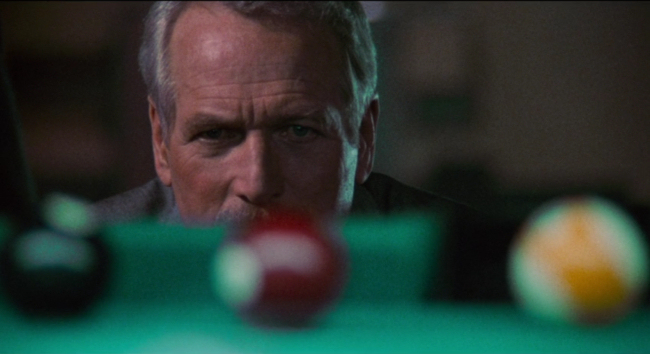
The trouble really starts when Eddie tries to play casually and finds he's not even a shadow of his former self. Watching him go through the humiliating experience of finding the student is well beyond the teacher--and inclined to be an obnoxious braggart about it--makes for some sharp, painful cinema thanks to Scorsese's unflinching vision and performances from Newman and Cruise. And then you really root for Eddie as he starts to slowly and carefully rebuild what he was.

The Color of Money is available on Disney+ in most countries.

Twitter Sonnet #1452

Abrupt, the end reminds a school to eat.
The biggest box was small across the pond.
In other realms, tomatoes count as meat.
The islands formed a fish and lemon bond.
For teeth, the tube prepared a minty paste.
Disliking labels, bottles sold for cheap.
But all the drinkers drank with ready haste.
By twelve o'clock from stools there's not a peep.
Except the second eye, we watched a play.
Suggestions drift beyond acknowledged sight.
A nose's shade became a show to-day.
Or paint to turn the stubborn visage right.
The singer sang a second time for words.
The steamy room compels a pair of birds.

Sunday, May 09, 2021

The Game's Break

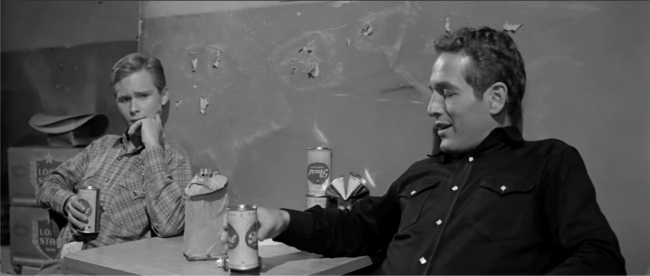
"Hustlers of the world," William S. Burroughs once wrote, "there is one Mark you cannot beat; the Mark inside." I don't know if the makers of 1961's The Hustler had this quote in mind but it's certainly hard not to think of it when watching the film. Paul Newman and Piper Laurie star as two people on the brink of self-destruction in this surprisingly contemplative and sad film about a pool shark.

"Fast" Eddie (Newman) is a brilliant pool player and a small time hustler who wants to make it into the big time by beating a famous player called Minnesota Fats (Jackie Gleason). He comes close but ultimately he's defeated not by lack of talent but for being a "born loser", at least according to an interested gangster named Bert (George C. Scott).

Now broke and depressed, Eddie stops for breakfast in a bus station where he meets Sarah Packard played by Piper Laurie. She has the air of doom about her, a perpetual grim smile, and a gaze that's steady not from confidence but from hopelessness. But it's kind of the shadow of confidence or pride. She pleads with Eddie not to beg for money in one crucial scene--in an earlier one, she's reluctant to take him in because, she says, he's "too hungry."

The two have an interesting relationship. You can see why she would be both initially repulsed by and ultimately enamoured with Eddie's personality. There's a scene between Eddie and Bert where Bert elaborates on his impression of Eddie's personality. Throughout the rest of the film, the viewer joins Eddie in wondering at its accuracy. Is Eddie playing against himself, are his losses due to something inside him that wants to lose, that sees loss as the only realistic outcome?

If he has a compulsion to lose, he has another compulsion to achieve the high of great play. He describes the feeling of playing to Sarah in one scene, the ecstasy of just somehow knowing how the balls on the table or going to move based on a visceral sense of the table surface, the balls, and the pool cue. You can see why her eyes shine in an unaccustomed way while she watches him talk.

It's a brilliantly shot film with terrific performances, particularly by Newman and Laurie.

The Hustler is available on The Criterion Channel.

Monday, May 18, 2020

The Forces Straining the Ranch

Sometimes what seems to be a conflict between living for oneself and living for the social good is more complicated on closer examination. 1963's Hud, a movie about a cattle ranch hit by sudden, monstrously bad fortune, presents a weary patriarch in conflict with his philandering, loose-principled son. Shot in stark black and white with a haunting score by Elmer Bernstein, the film actually features very few instances of characters executing their own will, leaving a curious void around the central conflict. This has the advantage of highlighting the fundamental humanity of the characters as they suffer a purgatory that starts to look a lot like Hell.

Presented as the film's moral centre is a teenage boy named Lonnie (Brandon deWilde). His conflict is in choosing between two father figures in his grandfather, Homer (Melvyn Douglas), the owner of the ranch, and his uncle, Hud (Paul Newman), Homer's son and nemesis.

Hud is handsome and charming, often given to selfish, drunken pronouncements and with a reputation for sleeping with other men's wives all over town. When Hud asks Homer why he's nursed a grudge against him for so long he assures Homer he won't "give a damn" either way. Homer replies that this is exactly it--it's the impression that Hud doesn't give a damn. Yet the fact that Hud retreats to the kitchen to angrily shed tears over a beer suggests this isn't so.

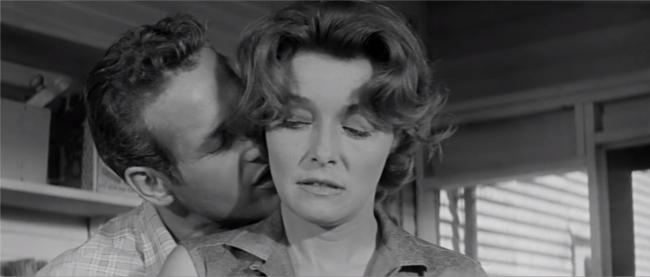
A fourth character rounds out the dramatic conflict; a beautiful, worldly housekeeper called Alma, played by Patricia Neal in a truly remarkable performance. There's a brilliantly played sexual tension between her and Hud though it culminates in the one instance of Hud definitely doing something vile. Drunk one evening after a fight with Homer, he tries to rape her. In this instance, he's not just talk.

Most of the time, talk is all his wickedness amounts to. At one point he announces he's going to get Homer declared mentally unfit to oversee his property in order to gain the inheritance but he never actually follows through with this.

Wikipedia quotes director Martin Ritt and star Paul Newman as saying that Hud was intended to be an antihero, someone we're ultimately meant to despise. Yet in attempting not to be too heavy-handed they've left a lot in Hud's favour, like the fact that he continues to publicly support every decision Homer makes regarding the farm and works hard to make sure the old man's wishes are carried out.

Mostly this involves a horrible situation imposed by monstrously bad luck--a recent purchase of cattle from Mexico has resulted in all Homer's stock being struck by an epidemic of foot and mouth disease. Government men tell Homer he's going to have to slaughter them all--Hud suggests they sell them all quickly before anyone finds out. But, again, despite an argument with Homer, Hud doesn't actually do anything against the old man. Is it loyalty? Or does Hud realise what exposing other cattle stocks to the virus would mean for the industry? We never know why exactly Hud doesn't act on his idea.

The presented conflict takes on a political tone when Homer directly speaks against the idea of giving too much sympathy to Hud--because there's a danger in too many people admiring, and voting for, men like Hud. Yet Hud is portrayed as so human by Paul Newman and Homer as so severe by Melvyn Douglas we're forced to contemplate just how wicked Hud is at heart. The cycle of Hud feeling isolated, unable to confront his feelings, self medicating with alcohol, and then acting rashly under inebriation--to be isolated again by bis behaviour--doesn't excuse Hud. But it compels the viewer to wonder if sympathy is such a bad idea after all.

Hud is available on Amazon Prime.

Saturday, November 24, 2018

The Distance to Israel

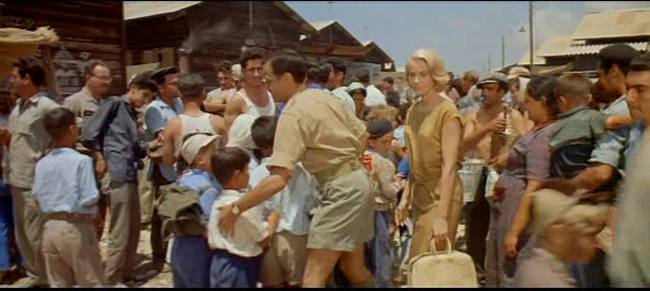
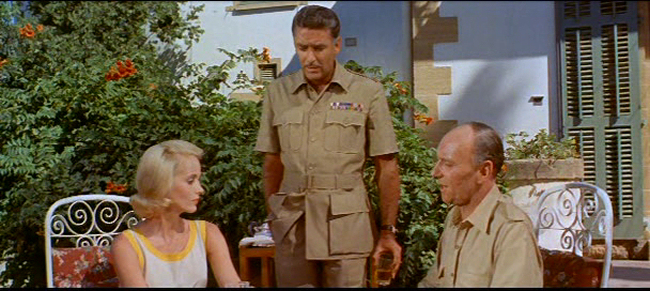
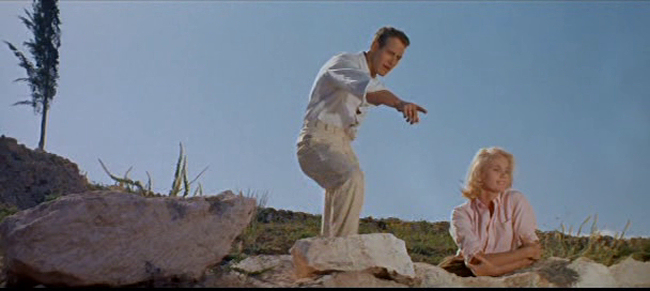
The location shots in 1960's Exodus are amazing, which is appropriate given it's a story about the importance of location. Otto Preminger's epic film is amazing for its sense of scope particularly considering the sensitive contemporary issues it was dealing with.

The film begins in the aftermath of World War II, focusing on a refugee camp of European Jews, survivors of the Holocaust, prevented by the British from going to Palestine where they hope to settle as a nation under the name of Israel. The film is mostly told from the point of view of an American nurse, Kitty, played by Eva Marie Saint in not one of her best performances.

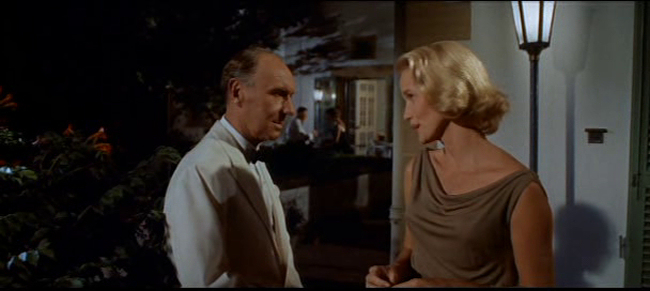
In On the Waterfront, Elia Kazan got a good performance from her and she was serviceable as icy for Hitchcock in North by Northwest. Performing opposite Ralph Richardson and Paul Newman in this movie, though, she comes off as a bored tour guide.

The movie subtly and blatantly presents arguments for recognising Israel, one of them being the persistent threat of anti-Semitism--not a difficult argument, one would think, after World War II. But Exodus makes an effort to show shades of anti-Semitism aside from the more blatant examples of Nazis and concentration camps, offering hints as to how this form of bigotry finds fertile soil. A British officer played by Peter Lawford brags about how he can always detect a Jew--amusingly he says this to Newman's character, a Jewish militant posing as a British officer--and everyone assumes Richardson's character, the general in charge of the British forces, is Jewish or has a Jewish relative simply because he's sympathetic to the refugees.

Even Kitty has some bias--when she meets a little girl in the refugee camp with blonde hair, she wants to help her, eventually wanting to take her home to America. She admits with some embarrassment she warmed to the girl because she didn't fit with her preconceptions of a Jew.

Paul Newman gives a much better performance than Marie Saint though his role is arguably simpler. He plays Ari Ben Canaan who leads hundreds of refugees, managing to get them on a cargo ship to Palestine. Filmed on an actual ship, the best sequence in the film involves the tension of a hunger strike effected by the refugees in their attempt to force the British to let them leave the bay in Cyprus.

Sal Mineo is good in a supporting role and Marius Goring has a brief appearance as a mysterious, sinister man I think is a Nazi. The last portion of the film becomes a little muddled, focusing on romance between Newman and Marie Saint's characters and on a conflict with British authority and Muslim locals. Many specific details seem like they were avoided in order to give the film an unambiguously pro-Israel stance--it's really not clear why Ari Ben Canaan decides to help Irgun terrorists escape prison after their bombing of the King David Hotel--a real life event in which 91 people were killed. Family relationships established in the film partly explains Ben Canaan's decision but the tone of the film isn't quite up to an issue this thorny. But for all that, it's a film with amazing visuals and Newman gives some emotional nuance to his character who otherwise might have come across as a very simple hero, obviously justified in wanting to secure a homeland. Exodus is available to stream on Amazon Prime.

Twitter Sonnet #1178

A thought for licorice was red and black.
A task reported lists of corded phones.
A million birds can fit inside the sack.
The canvas only keeps the turkey's bones.
A giant mantis musters gangly gusts.
The air advanced to part the clouds of bees.
A fatted yam with grace profoundly busts.
A cleaner breath's obtained above the trees.
For meaning, shoes concealed the marching time.
A little wonder goes so far away.
A kettle's heat reported walls to climb.
The crowd decides to sleep for lunch to-day.
Lapels were soaked in wine before the show.
From planted papers sycamores'll grow.

Wednesday, October 17, 2018

The Man Who Could Cut It

His name is John Russell but the title of this 1967 western is Hombre, an appellation by which the protagonist is just as often known. What can you make of a man called hombre? Like so many great westerns of the 60s, he's peculiarly indistinct, disconnected from various kinds of social groups; in this case the operative category being ethnicity. Based on a book by Elmore Leonard, it's an effective film, its plot about a diverse group of travellers menaced by bandits serving as a loose allegory of social division based on race and gender identity.

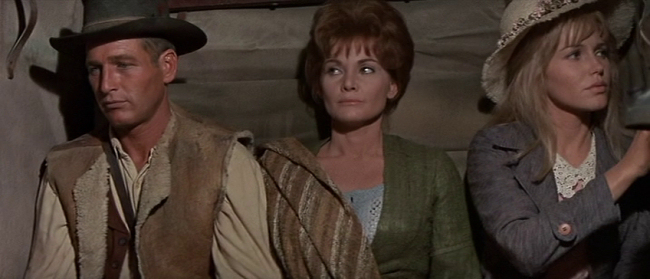
"You can be white, Indian, or Mexican," Mendez, a Mexican stagecoach driver played by Martin Balsam, tells Russell. "Now it pays you to be a white man for a while." Russell, played by Paul Newman, is white but has lived among the Apache most of his life, working among the Reservation police who are otherwise all Apache by blood. But Russell got his name from a white man who cared for him for some years as a child. Now the elder Russell is dead and Newman's character has inherited a boarding house and a pocket watch.

Arguably the real protagonist of the film is Jessie, the woman who runs the boarding house, played by Diane Cilento. She informs Russell boldly that she has no claim to the place but she's dedicated her life to it, as though daring him to kick her out. He kicks her out. He sells the place.

It's hard to tell what Russell's thinking or feeling most of the film. He generally has the same calm, tranquil expression and it's more through the things he chooses not to do that we gain some insight into his motives. As he waits at the stagecoach office, he makes no effort to assist a man who's bullied out of his ticket by the sinister Cicero Grimes (Richard Boone). He recognises the injustice but he's seen how the world goes. It's no wonder he feels no sympathy for Jessie; what's one boarding house compared to the forced relocation of Native Americans?

So Jessie tries to get the Sheriff (Cameron Mitchell) to marry her. She has been sleeping with him and he seems angry when she kicks him out of her room before Russell arrives. But he cites his dangerous profession as grounds for turning her proposal down. "I'm doing you a favour," he says. "Any time a man weasels out on you," she replies, "it turns out that he's doing you a favour. Well, maybe you are, Frank." She's seen how the world goes, too.

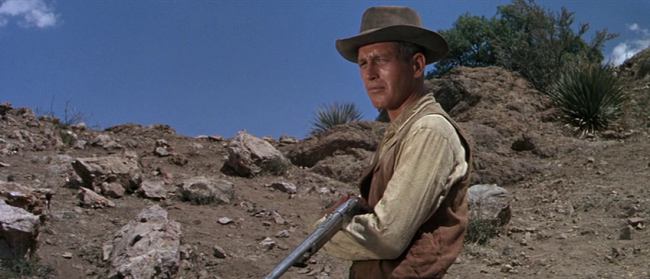
Jessie and Russell end up on the same stagecoach along with Grimes, a young couple, and Dr. Favor (Fredric March) and his wife (Barbara Rush). Dr. Favor is an Indian agent, a politician who acts as liaison to Native Americans for the U.S. government, a man largely concerned with the bureaucracy of relocation. He quickly shows himself as a hypocrite, talking about how sympathy for the Apache is only humane but when he finds out about Russell's background he insists the man not be allowed to ride inside the stage. Then the stagecoach is beset by a group of outlaws and the passengers find themselves forced to cross desert on foot with the bandits in pursuit; Russell becomes de facto leader as the only one among them who seems to know what he's doing.

The thematic argument of the film is essentially carried on between Jessie and Russell whose experience has made them the only ones qualified; she believes in helping people even if they don't deserve it, he doesn't see why he should make the effort, particularly when doing so might endanger the group. The end of the film leaves it somewhat ambiguous as to whether the terrible thing you can't escape is altruism or misanthropy. In a sense, the two are related; you can't treat people better than they deserve unless you think they don't deserve it.