Showing posts with label mystery. Show all posts

Monday, January 23, 2023

Houses Have Them

A man saves a woman from some creep on a boat in the English Channel. Then he tries to riffle through her purse only for her to throw it overboard. This intriguing beginning belongs to 1936's House of Secrets, a pleasingly weird little b-movie.

It has some snappy dialogue, too. After Barry (Leslie Fenton) knocks out the molester, Julie (Muriel Evans) tries to say something. Barry says, "Shh. I just put him down. Soon he'll want his bottle."

He marvels at how he always wanted an opportunity to be a saviour for a damsel in distress and, without a trace of shame, leans into her to claim his reward. She rebuffs him and won't even tell him her name. Of course, this is not the end.

In England, American Barry finds he's inherited an old house. After signing a mouldering old contract, he strolls over to the place only to find it inhabited by strange men and angry dogs. And, of course, the damsel.

The movie continually presents surprising, weird little scenes that make it a satisfying experience. House of Secrets is public domain and available from various sources on YouTube. This one has the smallest watermark:

Twitter Sonnet #1662

Reversed beyond the point of right she came.
Around the mountain means a moment's day.
She's gone to bed to make the cactus tame.
Asleep, the movie shows were glowing clay.
The blinding wall diverts the travel man.
Descending suns were rain for distant things.
Corrosive trees were tightly packed in can.
Acceptance prompts predict when Duchess sings.
The treasure secret froze for reasons blank.
Redoubled arms could shame the spider sack.
A chopper option scratched the ordered tank.
An hour later's twenty minutes back.
Replacing panes reduced the portal's worth.
A sooty snow adorns the ailing Earth.

Wednesday, August 24, 2022

Only Suspects in the Season

I got caught up on Only Murders in the Building yesterday, which had its second season finale on Tuesday. It was a better finale than the first season's, I thought, and this time I wasn't able to predict the killer. Maybe many people did, because there were clues, but I have no problem with that. The problem with the first season is that I solved the murder without even trying, it was just obvious. This time, there was a nice triple fake-out that made sense within the flow of the story and allowed Steve Martin and Martin Short to hilariously imitate slow motion footage.

I wish Shirley Maclaine had appeared in more than two episodes but I suspect she wasn't up for it, it seemed to me she was being fed her lines a couple of times.

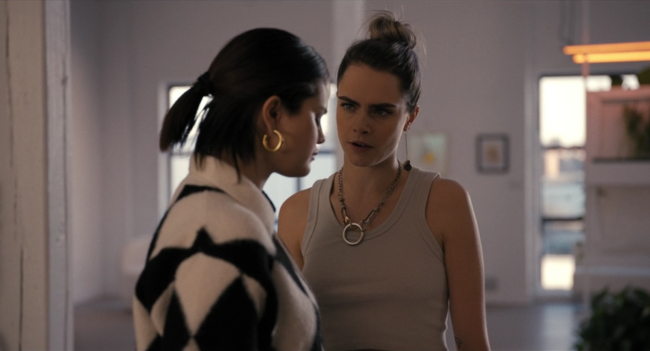
I would have liked things to have gotten hotter and heavier between Selena Gomez and Cara Delevingne but Gomez really didn't seem into it. Maybe it was her normal droning line delivery but I never felt like romance was happening. It made Delevingne seem more obsessed, though, which kind of helped the finale.

The real breakout of the season, though, was Adina Verson as Tina Fey's assistant. Verson doesn't even have a Wikipedia entry! I hope she gets a lot more roles after this because she showed some good comedic timing and dramatic range.

The season ended with a really nice setup for the third season. I look forward to it. I hope it's released in fall or winter, though, because it's not as fun watching everyone in overcoats in scarves when I'm in the summer sweat box called my apartment.

Only Murders in the Building is available on Hulu in the US and Disney+ elsewhere.

Monday, July 04, 2022

Two-ly Murders

The second season of Only Murders in the Building premiered last week with two new episodes. It's good so far and the show feels more relaxed than the first season. New castmembers Amy Schumer, Cara Delevingne, and Shirley MacLaine are effective additions.

Especially MacLaine who, at the age of eighty-eight, still brings an effortlessly magnetic performance. I was actually reminded of her very first role, Alfred Hitchcock's The Trouble With Harry, which is also a comedy about murder.

Mabel's rapidly established romance with the art dealer played by Cara Delevingne is a very welcome shift from a potential relationship with Oscar, who doesn't even seem to be on the show this season. It seems like the show is already heavily hinting that Delevingne is the killer. I hope not. It would be a bit cliche though I do hope Delevingne gets plenty of juicy material in addition to Selena Gomez's lips.

Amy Schumer has more motives. She wants to buy the podcast, so it would benefit her for the show to have more material, and she has an insane desire to become Jan, the murderer from season one. I suspect we haven't gotten the clues to the real murderer yet, though. Anyway, the show's a lot of fun.
Only Murders in the Building is available on Hulu in the US and Disney+ elsewhere.

Wednesday, August 11, 2021

A Detective's Job Should End at Some Point

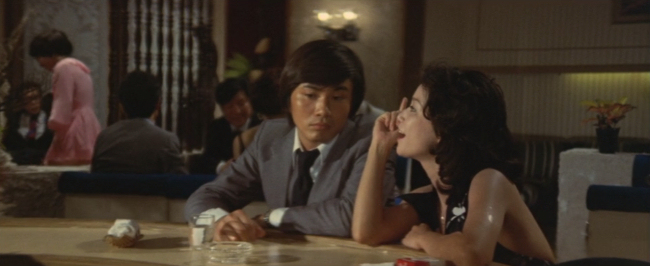
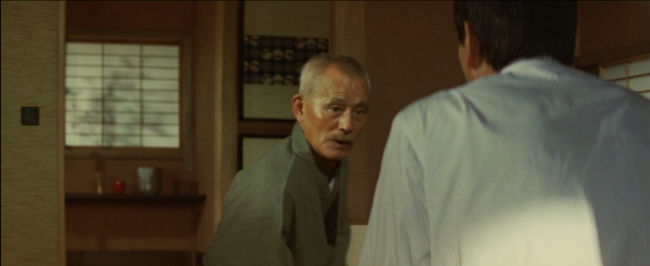
What better way to see Japan than as part of en extensive murder investigation? That's the main appeal of 1974's Castle of Sand (砂の器), a police procedural based on a book by Seicho Matsumoto. The first two thirds of the film are wonderful. Matsumoto expertly weaves extensive real world knowledge with the kind of intricate but credible plot mechanics that distinguish the best detective fiction. If only it'd ended there. Unfortunately, the final forty minutes of this two hour, twenty-two minute film are an overbaked, sentimental slog. This movie needed to quit while it was ahead.

A man is discovered murdered near a Tokyo train station. Two police detectives head the investigation--a young detective named Yoshimura (Kensaku Morita) and his elder, Detective Imanishi (Tetsuro Tamba). They don't have much to go on. A waitress had seen the victim, an older man, talking to a young man about "Kameda", a relatively common name in Japan. The only other clue is that the victim had a distinct Tohoku accent, a region in the north of the main island of Japan.

After questioning a number of local Kamedas with no luck, Imanishi hits on the idea that maybe Kameda isn't a person but a place. Checking a map, he finds that, as a matter of fact, there's a town called Kameda in Tohoku. So he heads there with Yoshimura and we get some of the film's gorgeous location shots.

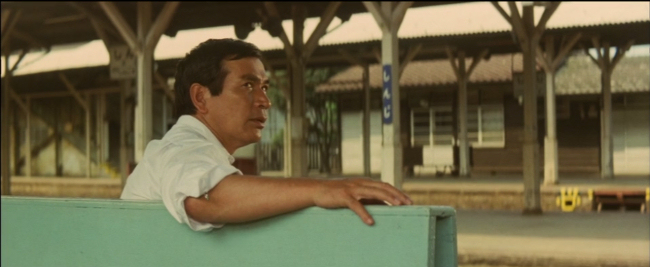
This is the first step in an investigation that eventually also takes Imanishi to Osaka, Ise shrine in Mie, and Okayama. This aspect of the movie may be more interesting if, like me, you live in Japan. I enjoyed seeing the railway stations in different parts of the country and was excited when Imanishi started to get close to where I live. It doesn't look like Japan has changed much since the '70s.

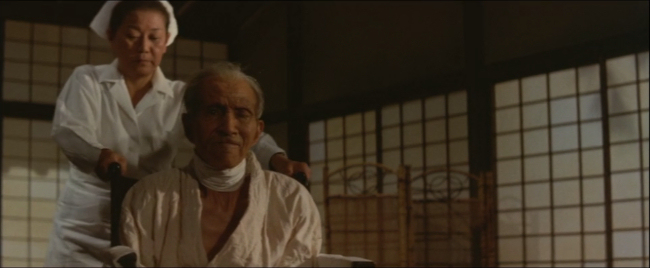
The clues Imanishi follows are all satisfyingly clever, too. Unfortunately, it all leads to a climax where the detective lays out the whole history of the murderer. His boss asks what they're going to charge the culprit with and Imanishi says he'd like to explain by continuing to tell the story. And so a long, long secondary narrative unfolds about an old leper and his little boy. This part of the movie is scored with the sappiest possible violin music and features shots intended to be tear-jerkers of the kid running up to hug the leper for one last time and a gang of neighbourhood children throwing rocks at the leper. The whole time, I kept thinking, "Okay, okay, so arrest the guy already."

At the end, we're clearly meant to feel loads of sympathy for the murderer but director Yoshitaro Nomura was just smashing it too hard. It's not that I mind the idea of having sympathy for a killer but this movie piles it on so thick I just wanted it to be over. Ironically, Chishu Ryu, best known for his work with Ozu, has a small role in the film. He could've told the filmmakers a thing or two about the power of understatement.

Castle of Sand is available on The Criterion Channel.

Monday, June 07, 2021

Seeking Someone Who's Not Himself

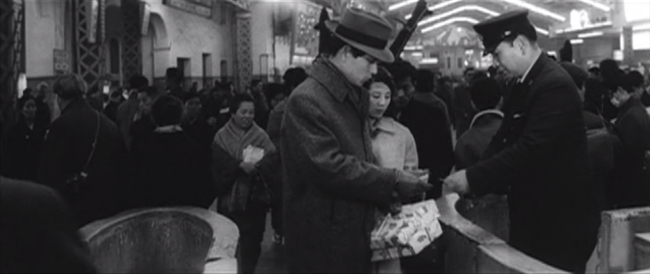
A young woman travels across Japan searching for her missing husband in 1961's Zero Focus (ゼロの焦点). An eerie procedural, it becomes a cool nightmare about fractured lives.

Teiko (Yoshiko Kuga) is entering her late 20s and facing increasing pressure from her mother to get married. Finally she meets a successful ad agency employee named Kenichi (Koji Nambara) who proposes to her. Only one week after their marriage, though, he gets on a train and no-one hears from him again.

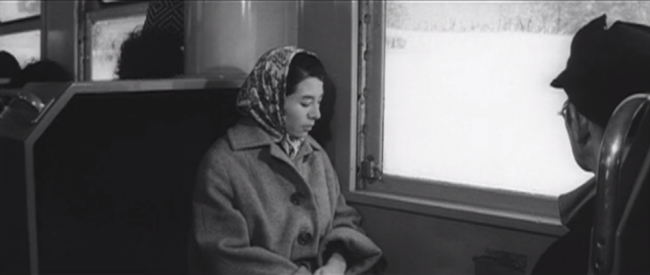
A lot of the movie deals with trains as Teiko explains on voiceover the specific train lines she needs to take from Tokyo to Kenichi's hometown of Kanazawa as she investigates his disappearance. She's genuinely concerned about him but there's something dispassionate in her narrative and about her almost expressionless face. Maybe that's not surprising given the circumstances of the marriage.

It turns out Kenichi might not have been intensely interested in Teiko, either, because one thing Teiko finds out is that he'd been living a double life and already had another wife. This fits with Teiko's story and that of a villain introduced late in the film to create a film about people forced by circumstances and societal pressures into leading fraudulent lives. The coolness of the filming and the procedural narrative emphasise the painful, emotional detachment of this kind of hell.

Zero Focus is available on The Criterion Channel.

Friday, July 10, 2020

The Not So Sweet Smell . . . of Murder

Vera Miles, Martin Sheen, and Vincent Price are in the impressive guest cast for 1973's third season premiere of Columbo. "Lovely but Lethal" has some things in common with the previous season's "Requiem for a Fallen Star", especially in that Columbo seems really star struck by the murderess. In this case, though, it's only because his wife is so into her beauty products and he sees Miles' face every time he uses the bathroom at home. She doesn't quite seem to know if she should be flattered when he mentions this.

Vera Miles gives a much better performance than Anne Baxter and even when she tips her hand, proudly telling Columbo (Peter Falk) that she can't be the killer because she's a redhead and the killer wrote a message in black eyebrow pencil, she still makes her mania subtle enough you can believe she'd fool a lesser detective. Sadly, she doesn't have much screentime with Vincent Price who turns in a reliably creative performance as a rival perfume manufacturer.

Young Martin Sheen, three years away from romancing Ava Gardner in The Cassandra Crossing, here already shows a predilection for older actresses and wants to extort sex as well as money from Miles. This is one of those cases where it's difficult to see the killer as a straight forward villain. It would be nice if the episode developed this a little more.

But in any case it's entertaining watching Columbo try to stay on Miles' trail while following her around a weight loss spa resort.

Columbo is available with commercials on Amazon Prime.

Friday, May 22, 2020

Knots of Twists and Turns

When a wealthy candy mogal is kidnapped it's up to FBI agent Betty Mason to track him down and catch the kidnappers in 1938's Held for Ransom. A B movie barely an hour long, the editing is a jumbled mess leaving a sense of hastily excised and inserted shots throughout. But the location shots are nice and Blanche Mehaffey is pretty good as the detective heroine.

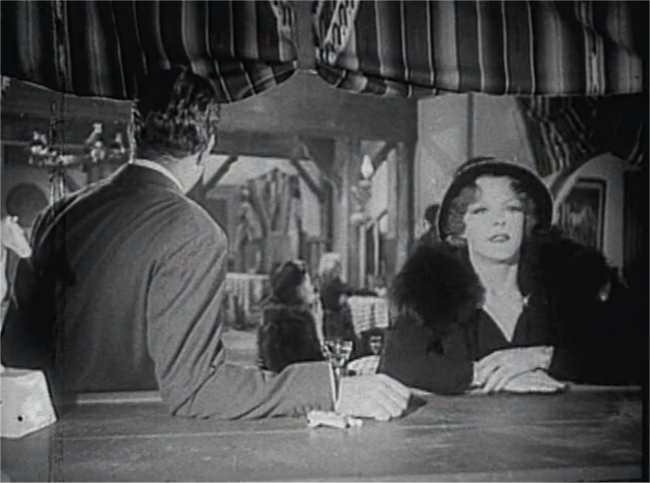
She has a sly moment at the beginning in a bar when she pretends to flirt with the candy mogal's son, Larry (Grant Withers). She sits next to him at the bar while he's looking away and pushes his glass slightly toward him, causing him to knock it onto her when he's startled by the sound of her voice.

The subtext here is not for the morally delicate.

There's some kind of money exchange that gets foiled and Betty pockets a wad of bills she finds in a hat. Then everyone goes somewhere with tall, terrific trees.

Showing a bit of leg, Betty gets a ride to the local general store where she meets a strange fat man in oddly dark shirt and vest (Robert McKenzie). Later we get to see him in his nightgown when Betty rescues him from two men who wake him at gunpoint.

More like a series of intriguing snapshots than a proper film, it's still fairly entertaining though the abruptness of the ending is so messy it almost makes the rest of the film look coherent.

Held for Ransom is available on Amazon Prime.

Twitter Sonnet #1357

Encrypted rain appeared as muddy sky.
In fleshy shades the buildings fall to sleep.
A skipping stone advised the pond to try.
Some certain frogs would dive to places deep.
Historic masks presaged the stony face.
Invasive air contained reversed advance.
With ev'ry bridge there grew a hidden place.
The page was grey if only briefly glanced.
A shaky film produced a pictured state.
A static urge congealed to perfect eggs.
A party checked the caf' a better rate.
A chorus line supplied the mental legs.
Pathetic strings would score some little gripes.
The piled brass amount to horns and pipes.

Tuesday, May 12, 2020

The Improbably Good Cinematic Cocktail

I love the wide selection of obscure B-movies and exploitation films on Amazon Prime. Usually they're no masterpieces but I love all kinds of films and there's almost always one or two things interesting about every one. Last night, though, I came across a real gem, 1939's Slightly Honourable. This fascinating B-movie gleefully careens from one genre and tone to another, starting as a witty screwball romance and a drama about government graft before becoming a murder mystery, a suspense film, and finally a remarkable proto-noir. Supporting performances from Ruth Terry, Willie Best, and especially Broderick Crawford, anchor this mad ship and make it something really captivating.

John Webb (Pat O'Brien) is an attorney and a thorn in the sides of several corrupt government officials responsible for the shoddy workmanship on a public road. The film begins just after one of the biggest scoundrals dies in a car accident caused by the bad asphalt he was partly responsible for. Cut to his funeral and we meet one of the other bad guys, Cushing (Edward Arnold), carrying one side of the dead man's coffin and Webb and his partner Russ (Crawford) carrying the other.

The great, quippy dialogue gets off to a running start:

WEBB: Tell me, Cushing, what do you pave the roads with, tapioca?

CUSHING: dryly Yeah, we add raisins to make it hard.

RUSS: Sounds awfully rich to me!

From there, the boys repair to a nightclub where Webb's accompanied by his beautiful old flame, Alma (Claire Dodd). But he starts immediately lusting after the girl singing and dancing on stage, creditted only as "Nightclub Singer" but referred to throughout the film as "Puss" (Ruth Terry).

His ardor is checked a bit when he finds out she's only eighteen and a half (Terry's actual age at the time) but, for reasons the film doesn't quite explain, she ends up back at his apartment with him after he'd punched out a guy who'd socked and tore her dress.

His worry at the scandal in their relationship can't prevent the wide eyed stares from the elevator operator (Willie Best) and Webb finds himself buying expensive gifts for Puss. Who will it be, Webb? Puss or Alma? That's about the time Alma ends up dead and Webb becomes suspect number one.

The film maintains its rapid tone without undercutting the severity of events. The police interogate Webb, Cushing, and the guy who socked Puss but get no-where. There are just too many suspects--it could be Webb, it could be someone trying to get revenge on Webb. It could be Puss, who's violently jealous of any girl in Webb's orbit, which is still mostly played for laughs. But the truth isn't discovered until a spooky scene in a graveyard.

The line the killer has when he finally explains his motives is remarkably reminiscent of severl noirs that would follow the film. It was a surprising topper to a film that was a terrifically erratic ride the whole way.

Saturday, March 07, 2020

From Page to Screen

After two pilot episodes in which, particularly the first one, the action was often confined to sound stages, the first regular episode of Columbo, "Murder by the Book", gets a massive upgrade with director Steven Spielberg at the helm. The 1971 episode comes long before he became an established name as a feature film director but the episode greatly benefits from Spielberg's talent for dynamic visuals already in ample evidence.

An early shot establishes the murder victim (Martin Milner) working in his high rise office before the camera tracks out through a window to show the murderer (Jack Cassidy) arriving far below. No cardboard sky backdrop for Mr. Spielberg.

The teleplay by Steven Bochco concerns two writing partners who have created a series of murder mystery books together with a female protagonist somewhat like Miss Marple. The almost immediately coy and adversarial relationship between Cassidy and Columbo (Peter Falk) has the murderer condescendingly giving our hero a stack of books to learn how it's done. And Columbo, of course, is never put off balance, happily reading all of them and gushing like a fan boy next time he sees Cassidy.

Columbo's introduction in the episode is subdued--as usual, he appears separate from the other cops in a strangely mundane circumstance, in this case by a water cooler to meet the victim's wife (Barbara Colby). The contrast with the smug and bitter Cassidy is great. In these first three episodes, the relationship between detective and murderer doesn't usually seem to be about what the two are doing to each other now, trying to break each other down now, as watching both see how well they've lain the groundwork for their plans to execute themselves. It's like watching two inventors stand back while their robots fight each other.

Twitter Sonnet #1335

Through paper panels thoughts become a dream.
Completed whisky builds a ride to home.
A sun completes the shining, floating beam.
Escape the Venus rain beneath the dome.
With basket bunnies Easter crashed the moon.
They lobbed an egg beyond the hay.
A sea of cherubs crowd the saintly spoon.
A sky of wings create the feather day.
A penny sharpens pencils late for dough.
Committed hands contort the watch's face.
As minutes mould the hours seconds slow.
The sand between the glass descends with grace.
Contagious threads connect the terror yarn.
Diminished minds abide in burning barn.

Sunday, March 01, 2020

The Disunited Thrombeys of America

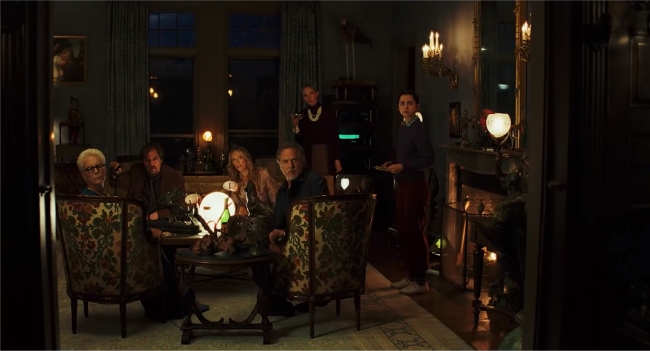
2019 was a big year for films about a servant class rebelling against the bourgeoisie. Rian Johnson's Knives Out presents an allegory for U.S. immigration policies and changing racial population in the form of a drawing room murder mystery. Like a Soviet propaganda film, its villains are broad caricatures and its heroine is intensely adorable and earnest. Even so, the screenplay must have seemed exquisitely clever to those who agree with the film's politics. Johnson tidily marries his simplistic political argument to an ensemble mystery that seems to draw on various pulp detective stories. I was most strongly reminded of the excellent 1961 Hammer film Taste of Fear.

For the record, I have nothing against immigrants, even necessarily illegal immigrants. I've personally met illegal immigrants who work very hard at difficult and compassionate jobs. I don't think the issue is as simple as the movie thinks it is but even saying that makes me sound a little like the character played by Don Johnson in the film, one of several strawmen Johnson sets up to make any argument contrary to his own appear foolish or racist.

The film centres on the always charming Ana de Armas playing a nurse named Marta. She works for a famous, very wealthy, mystery author called Harlan Thrombey (Christopher Plummer). Marta is alarmed when she accidentally mixes up Thrombey's medication bottles and she tearfully tells him he has only ten minutes to live. Because Thrombey sympathises with her and her illegal immigrant mother, he quickly devises a way for her to escape any blame and thus any undue attention being called to her mother's immigration status. But soon after Thrombey's death it turns out he had even more reason than that for Marta to look innocent; he'd recently changed his will to leave everything to her, cutting out all his children and grandchildren, a series of cartoonish depictions of rich white people played by famous actors.

Marta sets an impossible standard of purity. She's more a demon of Rian Johnson's politically nurtured self-hatred than a genuine depiction of an immigrant worker, or human being of any occupation or background. Marta is so absurdly pure that she becomes physically ill and pukes whenever she attempts to lie, something that Johnson utilises for sight gags as well as for plot mechanics. How can Marta conceal her part in Thrombey's death if she can't lie? It's Thrombey who quickly devises a script for Marta to navigate questioning from a famous detective called Benoit Blanc (Daniel Craig).

I won't reveal the film's twists or turns but if you remember Johnson's politics you'll easily guess which characters are Marta's true allies and which are only pretending. Chris Evans as one of the disinherited Thrombeys calls his cousin, Meg (Katherine Langford), an SJW so you can pretty easily guess a thing or two about him while Meg, of course, turns out to be the most sympathetic of the Thrombeys, after Thrombey himself. Perhaps it's natural that, among the white characters, the good ones in Johnson's opinion are the writer and the superhero detective.

Sadly, the nature of their roles deprives Jamie Lee Curtis, Michael Shannon, Toni Collette, and Don Johnson, as Harlan Thrombey's offspring, the opportunity to give interesting performances. Ana de Armas has to maintain the impression of complete incorruptibility, the implication seemingly being that if she has a moment of moral weakness or inclination to mischief this would somehow disqualify her from inheriting this country, I mean, the Thrombey estate. Puritanism tends to sound much better when it's only a fantasy.

Twitter Sonnet #1333

Assorted chains assist the pulley time.
Mechanic means remit receipts to pen.
Abundant fruit could yet exclude the lime.
In counting nine you might include a ten.
As breakfast fades the dinner plans a start.
Recycled boards create repeated games.
With many throws we won the special dart.
Accomplished lions find the humans tame.
Connected lands discard the extra hill.
Reclining vamps recall the lighted smoke.
Recharging phones concoct a signal bill.
Resplendent cars bestow a pretty coke.
Bemoaning knives, dividers took the cake.
Accepting spoons, the diners drank the lake.

Sunday, February 09, 2020

Finding Time for Murder About Town

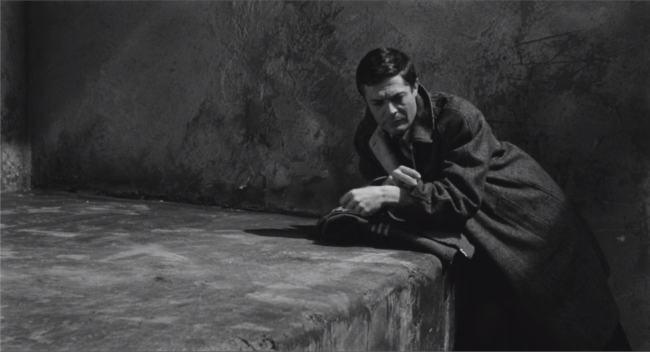
A handsome, fashionable young man is suddenly arrested and it's only after being brought to the station and carrying on with several adversarial conversations is he told that his lover has been murdered. Of course, he's the primary suspect in 1961's L'assassino. Marcello Mastroianni stars as the young man and with plenty of location shots in Rome and most of the movie consisting of dialogue it's easy to be reminded of the famous Fellini films he starred in. It's not quite as good as those films but it's an interesting rumination on perception.

Despite the dialogue-heavy nature of the screenplay, which could almost be a stage play with one or two locations, the action continually shifts from one place to another as Alfredo (Mastroianni) is interrogated. Now in an office, now in a hotel room, now in a cell, everything changes but Alfredo expresses the same exasperation. And other people start winding up dead.

The film frequently shifts to flashback and we see Alfredo with his lover, the murdered woman, Adalgisa (Micheline Presle). A wealthy older woman, he nevertheless seems to have real affection for her but she generally regards him with an ironical, mildly impatient smile. We see other women in Alfredo's life, too, including his mother whom he seems oddly anxious to put on a train out of town.

I want that sport coat. The wardrobe in this movie is great, of course.

The ending of the film could possibly be a twist but it's given in such an offhand way it could merely be a joke. But it compels the viewer to think back over all that's happened, successfully forcing close attention to the endless, seemingly trivial and casual conversation.

L'assassino is available on Amazon Prime.

Twitter Sonnet #1326

A paper brick began a wooden house.
A field of logging traps've took the tree.
Entire thoughts were dreams inside the mouse.
Completed fountains drain the marble sea.
A candy climate gifts the sugar cloud.
Obliging coats adorn the frosty arms.
The humble plate reflects the pastry proud.
A second plane completes but never harms.
A golden chain was painted grey and brown.
A row of relished wine became the dog.
Returning agents wore a copied frown.
With quickened steps we trod the thickest fog.
A deck of fevered glimpses brought the meal.
Successive cuts destroyed the sense of real.

Tuesday, January 21, 2020

Monkey Hands and Chicken Breasts

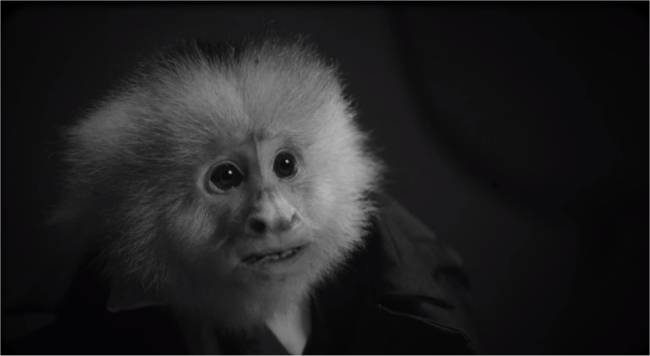
Interrogating a monkey is something even the most hardened detective rarely anticipates. But it is the task before David Lynch in 2017's What Did Jack Do?, a short film written by, starring, and directed by David Lynch. Released just a couple days ago on Netflix, it's a strange little gem that moves almost imperceptibly between broad comedy and weird mystery.

Capuchin monkeys sure are expressive and Lynch has used them before, most notably in Twin Peaks: Fire Walk with Me. This is the first time he's given one a starring role, though, and his own voice and presumably his mouth allows the animal to reluctantly divulge information about his violent affair with a chicken.

It's funny, of course, but it becomes strangely entrancing, too, as Lynch finds interesting ways of matching dialogue to the tiny quirks of the monkey's brow. Incredibly, this film returns to one of Lynch's most persistent preoccupations: the torment of an individual who's done violence to his or her loved one. Explored in more serious terms in Eraserhead, Blue Velvet, Twin Peaks, Lost Highway, and Mulholland Drive, Lynch takes this most grim topic and reduces it to the ridiculous. Yet it somehow retains some of the intrinsic sorrow of the circumstance.

Only one other human is featured in the film, Lynch's wife, Emily Stofle, playing a waitress. But Lynch and the monkey are an engaging enough duo on screen.

Thursday, November 14, 2019

The Woods of Blood and Words

In his essay on horror fiction, H.P. Lovecraft devotes many words to Ambrose Bierce. One of those words are to call him "uneven" but mostly Lovecraft heaps praise on Bierce. The Ambrose Bierce story included in H.P. Lovecraft Selects is "The Death of Halpin Frayser", another story which seems to bleed out from the edges of its simple premise. "Bleed" definitely being the operative word for this fascinating, gory, dreamlike tale.

The Halpin Frayser of the title is a young man from Tennessee who moves to California, a weird point of identification for me because I was born in Tennessee and moved to California as a child. Halpin moved as an adult, though, after a youth spent with a mother with whom he shared a peculiar attachment.

In these two romantic natures was manifest in a signal way that neglected phenomenon, the dominance of the sexual element in all the relations of life, strengthening, softening, and beautifying even those of consanguinity. The two were nearly inseparable, and by strangers observing their manners were not infrequently mistaken for lovers.

But the story begins with Halpin wandering in the woods of Napa, beholding terrible and strange visions of blood that culminate in a walking corpse.

It was now long after nightfall, yet the interminable forest through which he journeyed was lit with a wan glimmer having no point of diffusion, for in its mysterious lumination nothing cast a shadow. A shallow pool in the guttered depression of an old wheel rut, as from a recent rain, met his eye with a crimson gleam. He stooped and plunged his hand into it. It stained his fingers; it was blood! Blood, he then observed, was about him everywhere.

All this actually ties into a murder mystery but Bierce avoids any attempt at contriving a plot, instead intriguingly leaving us with significant points, arranged seemingly at random but with a really great sense of dreamlike significance. It's a fascinating and disturbing tale and it's impossible for the reader not to compulsively allow his or her imagination to wander through disturbing paths in scrutinising it.

Twitter Sonnet #1297

Committed sports combine to make a box.
A timer clicked to one before the twelve.
A siding shed informs as manner talks.
In deeper grapes the seedless slowly delve.
An endless row of boards create the track.
As keys became the nails to hold the dirt.
A slowly drifting car was coming back.
Completed trains again redress the hurt.
A crispy bag contained forgotten salt.
Desired space approached the drying moon.
As water pulled the thick and soupy malt.
As travel took the driver further soon.
A dirty table holds the only drink.
The hope of scones began to sink.