Showing posts with label netflix. Show all posts

Wednesday, August 10, 2022

Born to Throw Like a Computer

Remember when it was a big deal that the wrong kinds of Asians were cast in Raya and the Last Dragon? Now Prey is really popular and when it's pointed out Amber Midthunder is less than 50% Native American--and 0% Comanche--everyone just shrugs. Even her name is apparently of Norwegian origin, modified from "Midthun". It just goes to show, even in this day and age, if something is really popular, this bullshit doesn't matter.

Not that there aren't people getting neurotic about it, which I find fascinating. Amber Midthunder's Wikipedia entry is the site of an ongoing editing battle, as you can see from the revision history. When I reviewed the film a few days ago, there was a sentence saying she was East Asian on her mother's side. It was removed because none of the three sources cited mentioned this at all. And yet, Angelique Midthunder clearly is Thai. She's a casting director and her picture and biography, listing her place of birth as Bangkok, are on imdb. As I write this blog entry, Amber Midthunder's Wikipedia page only commits to "Amber is of Indigenous American descent and is an enrolled member of the Fort Peck Sioux Tribe." It's clearly a source of drama but it's hilarious because, if you watch Prey, it's clear there's not much thought given to authenticity and realism. Many reviews say otherwise, but come on. Her character, Naru, falls off a tree, twists around in mid fall, and throws a spear through a lion.
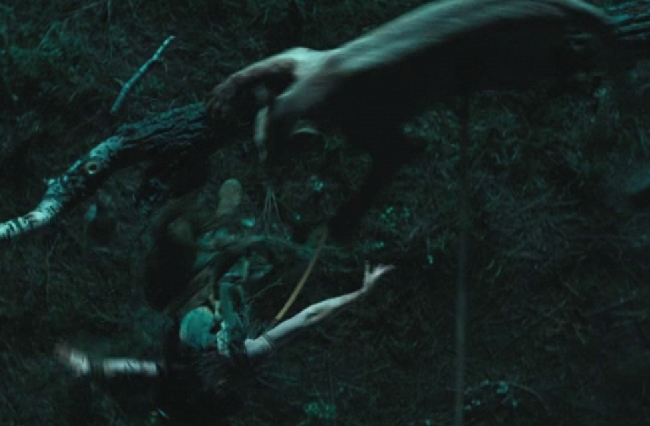
You know what would have happened in reality if someone even ten times as strong as Amber Midthunder had thrown a spear like that while falling? The momentum and the arc of the throw would have put the force on the wrong side of the spear and, at best, it would have scratched the lion, if the cat weren't a cgi cartoon to begin with.

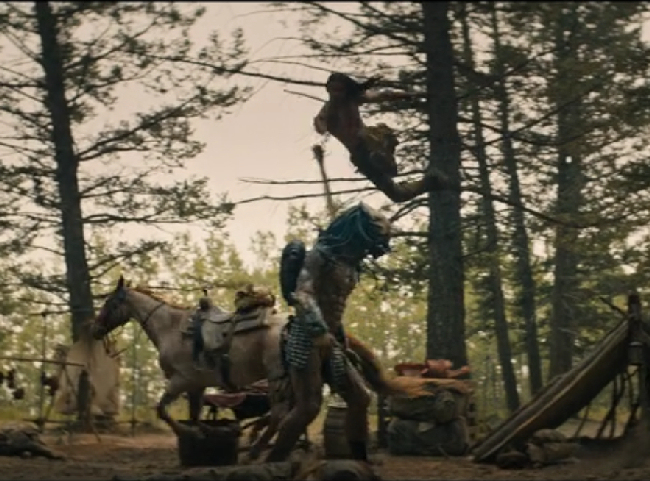
And I'm not just picking on Amber Midthunder here. Dakota Beavers manages the same kind of physically impossible cgi stunt later when he's fighting the Predator.
I quote Sex Machine in From Dusk Till Dawn:

Another thing, you try and ram a broken chair leg in a human, you better be one strong son-of-a-bitch. The human body is one rough-tough machine.

What we see more and more in cgi action scenes is what I like to call the "Gambit Effect". Gambit being the mutant from X-Men who can charge any object with kinetic energy, so he can throw playing cards and they're fast as bullets. Ever since Peter Jackson decided King Theoden could shoot a spear from his hand on horseback like a ballista in The Two Towers (2002), all kinds of people have had this power. It's really going to be a letdown when Gambit himself appears in live action.

Why is Prey so popular if Amber Midthunder is racially impure? Maybe race isn't everything. Maybe actors and actresses can play people who aren't like themselves.

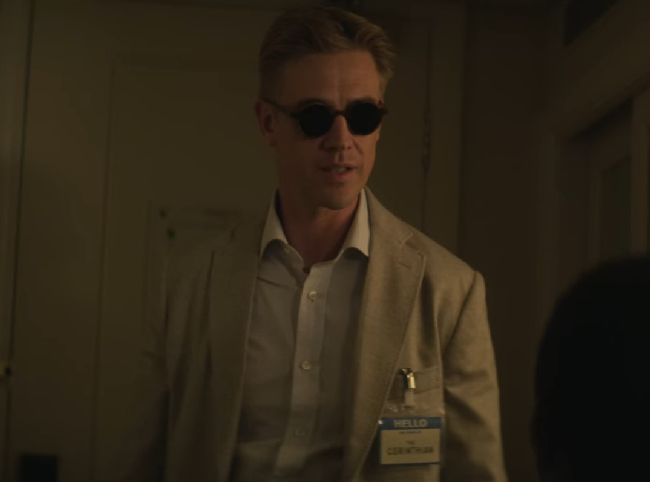
Meanwhile, over on Netflix, the star of the previous Predator movie, Boyd Holbrook, is giving the standout performance as the Corinthian.
I finished watching season one a few days ago and it was pretty good, aside from a few extremely awkward moments, particularly the alley scene with Rose and Gilbert. It was never a scene I liked in the comic but it was made ten times worse because someone decided there needed to be a very hastily edited moment where Rose is hinted at being capable of fighting off two armed attackers. I guess maybe I'm in the minority in needing action scenes that have a real sense of physical plausibility. But it's not like there's anyone saying Shia LeBouf swinging through the trees in Crystal Skull is as good as Indiana Jones climbing under the truck in Raiders of the Lost Ark.

But, yeah, Sandman was good. Holbrook is perfect as the Corinthian as is Stephen Frye as Gilbert. Frye has gone from playing Oscar Wilde to essentially playing GK Chesterton now. I nominate him for William Empson next.

Twitter Sonnet #1610

A friendly chill attacked the wolfish town.
Prepared for Yule, the elves were flattened drunk.
It seemed the mountain wore a rocky frown.
From birth, the basket braggart claimed to dunk.
Potato slices drown in miracles.
The clash of shades contracts about the soul.
Confession chills like cooking chemicals.
The breaking sign dissolves a deeper hole.
Confusing zombies filled the basement pail.
We looked for cups to hold a sea of fish.
The water dream recurs to sate the whale.
A big opinion cowed the humble wish.
The heavy movie house was filled with foam.
The spirits offer gifts in silk and chrome.

Friday, September 27, 2019

A Simpler Castle

For the first time ever, Shirley Jackson's 1962 novel, We Have Always Lived in the Castle, was adapted to film in 2018 and released a couple months ago. Or adapted to NetFlix, anyway, which is more or less the same thing nowadays. Generally NetFlix films look like their budgets are as low as they are. We Have Always Lived in the Castle isn't a story that demands a big budget and production values on the film don't look especially shoddy but I've been trying to put my finger on how to explain just how cheap it feels. Mainly it feels like the filmmakers and performers didn't quite think the project through or didn't feel the need to.

Like a few other works by Shirley Jackson, We Have Always Lived in the Castle is about an old family, in this case the Blackwoods, who live in a large manor connected to a village community. As the title implies, there's an old world, feudal aura to the setup though story is set in the United States. The book is a first person narrative told from the perspective of the youngest living Blackwood daughter, Merricat, who now lives alone in the manor with her elder sister, Constance, whom she adores, and their uncle, Julian, who is confined to a wheelchair and suffers from a mental impairment that, among other things, gives him trouble accessing short term memory.

Julian is played by Crispin Glover in the film, the best casting, but I think he could have done with some more direction. He generally comes off as just Crispin Glover in a wheelchair, but considering his natural oddness, maybe that's good enough.

The main problem with the film is in the two female leads, Taissa Farmiga and Alexandra Daddario as Merricat and Constance Blackwood, respectively. Merricat as a narrator is fascinating, being a character who simultaneously has an instinct for arranging information for the reader and also has a tendency to abruptly divert the narrative to details she forgets or erroneously deems unnecessary to explain the pertinence of. She introduces herself in the book's first paragraph:

My name is Mary Katherine Blackwood. I am eighteen years old, and I live with my sister Constance. I have often thought that with any luck at all I could have been born a werewolf, because the two middle fingers on both my hands are the same length, but I have had to be content with what I had. I dislike washing myself, and dogs, and noise. I like my sister Constance, and Richard Plantagenet, and Amanita phalloides, the death-cup mushroom. Everyone else in my family is dead.

Despite this last sentence, she brings up her uncle Julian a page later, an omission likely intended by Jackson to suggest something about Merricat. The film opens with Merricat in her bedroom writing this introduction but the film leaves out the business about werewolves, washing herself, and Richard Plantagenet, though later we see her listening to a record of a performance of Richard III. The opening narration instead inserts bits from elsewhere in the novel to provide a concise establishment of setting.

My name is Mary Katherine Blackwood. I am eighteen years old, and I live with my sister Constance. She is the most precious person in the world. The Blackwoods have always lived in this house. We have never done anything to hurt anyone. We put things back where they belong. And we will never leave here no matter what they say. Or what they do to us. Never. But a change is coming and nobody knows it but me.

It's an opening that trusts the interpretive skill of the viewer a lot less than Jackson's. It's like those quick, miniature trailers preceding actual trailers on YouTube because people's attention spans are too short even for trailers now and they need to be told in clear, simple terms what they're going to be seeing. In the process, we lose a lot of Merricat's character as it's developed through her voice, something Farmiga's flat, one layer performance doesn't make up for.

It's Merricat's job to go into town for supplies. The film lacks her commentary on people and houses she sees as she passes, focusing entirely on her perception of the hatred everyone has for the Blackwoods, and consequently the village comes off as having far less character and Merricat's conception of it a lot narrower. As in the book, she stops in a diner for coffee where she's hassled by two men. In the film, one of the men talks about how he fixed a porch step at the Blackwood house and was never paid for it. Merricat says that her father had proclaimed he would not pay for shoddy workmanship.

In the book, this exchange is significantly different.

"Me," Dunham said, "I can always tell people I fixed their broken step once and never got paid for it." That was true. Constance had sent me out to tell him that we wouldn't pay carpenter's prices for a raw board nailed crookedly across the step when what he was supposed to do was build it trim and new. When I went out and told him we wouldn't pay he grinned at me and spat, and picked up his hammer and pried the board loose and threw it on the ground. "Do it yourself," he said to me, and got into his truck and drove away. "Never did get paid for it," he said now.

The movie's version makes significant changes for the characters of Merricat, Constance, and their father. This brings a villainous cast to the Blackwood patriarch early, Merricat is portrayed as more confrontational in the film by actually speaking the information instead of merely informing the reader, and it's one of many points in the film that makes Constance a far more passive character than she is in the book.

Daddario plays Constance as a perpetually grinning 1950s housewife stereotype. We're told she cleans and we see the house is immaculate but its difficult to imagine this perfectly coiffed and laundered vision single handedly doing all the dusting, mattress turning, sweeping, vacuuming, taking care of Julian, making everyone's meals--she should look exhausted or if she doesn't there should be something off about her. Merricat, in the book, does describe her as a "fairy princess" and says that "even in the worst time she was pink and white and golden, and nothing had ever seemed to dull the brightness in her." But allowances ought to be made for Merricat's frame of reference and adoration. Again, this speaks to a failure on the part of the filmmakers to exhibit anything more than the most superficial interpretation.

The colours in the film are really nice and I love the floral, William Morris-ish wallpaper in the house. But altogether it's an unimaginative and bloodless adaptation of a brilliant book.

Monday, June 03, 2019

Eight in Four

A couple months ago, NetFlix quietly released an "Extended" version of The Hateful Eight, Quentin Tarantino's terrific 2015 Western. Except it wasn't just a longer version of the film, it was the film recut as a four episode miniseries by Tarantino and his editor:

So about a year after it’s released, maybe a little less, me and my editor, Fred Raskin, we got together and then we worked real hard. We edited the film down into 50 minute bits, and we very easily got four episodes out of it. We didn’t re-edit the whole thing from scratch, but we did a whole lot of re-editing, and it plays differently. Some sequences are more similar than others compared to the film, but it has a different feeling. It has a different feeling that I actually really like a lot. And there was [already] a literary aspect to the film anyway, so it definitely has this “chapters unfolding” quality.

So I watched it like a television series, over the course of a week. Ultimately I think I prefer the film version but the miniseries has several fascinating aspects unique to it, the best probably being in the final episode where a scene from the first is shown again from the perspective of different characters. This might have been too much for a film that was already long but sits perfectly fine in a miniseries format. There's a great moment where you realise one character's line has more significance than it seemed to at first. The running gag about the cabin's door needing to be kicked down also takes on a subtly different, sinister quality as the camera switches to focusing on the faces of Michael Madsen and Tim Roth.

A lot of the approximately 25 minutes of new footage is less conspicuously dispersed throughout the film, mostly appearing in dialogue scenes. Samuel L. Jackson's showdown with the Confederate general played by Bruce Dern seems to twist the knife a little more and the dialogue on the stagecoach at the beginning occurs, I think, in a different order. Almost the entirety of the first episode consists of the stagecoach scene, almost fifty minutes, and you get more of a sense of being on a long journey through hard weather with these people.

Once again, I thought about how Walton Goggins' character, Chris Mannix, is at the heart of the story's most interesting statement on human nature. We watch him going from being a staunch and earnest supporter of Dern's bitter Confederate general to unhesitatingly allying himself with the former Union Major, and a black man, Jackson's Major Warren. And its completely credible, even with Mannix's vehement use of racial epithets. Naturally for a soldier, there would be no real philosophical beliefs behind his racism anymore than the jeers of football fans against fans of an opposing team. He's a strange mixture of naivete and cunning--he's loyal to the established authority but he's also better at figuring things out than the other characters; he realises the truth about Warren's Lincoln Letter through a very simple process of reasoning and he similarly sees through Daisy's ruse at the end.

It's a story all about naturally occurring contradictions so, in a way, it makes sense that such a long film takes place in such a short space of time, that a television series should be shot in ultra widescreen. I do recommend watching it on the largest screen possible. I was kind of hoping for more footage in Minnie's Haberdashery before Kurt Russell and Jennifer Jason Leigh arrive, in particular I wanted more time with Zoe Bell's character but sadly I don't think there's any additional footage in that segment. I'd love to see Tarantino shoot a Western starring Bell.