Showing posts with label samuel fuller. Show all posts

Sunday, June 09, 2024

Our Dogs

Samuel Fuller's 1982 film White Dog is about a young woman, played by Kristy McNichol, trying to cure a dog who was trained to attack black people. It was a controversial film for some reason. I guess corporate stiffs in the '70s felt even contemplating the nature of racism was somehow too sensitive. On the other hand, Michael Eisner pushed for the film's release.

If we only had a few dozen filmmakers with the guts of Samuel Fuller nowadays.

I would say the bolder aspect of the film would be the unaddressed hint that the dog seems intent on sexually dominating McNichol's character. After the dog saves her from a rapist, we see him steal and shred her panties before chasing a rabbit. He also nearly attacks her white boyfriend. McNichol's so tiny in the movie, and the dog so huge, you always feel a little anxiety for her.

I love Paul Winfield and Burl Ives as a couple caretakers of a shelter for dangerous animals.

The editing and composition in that clip are just terrific. I like Ives opening the door, saying, "I am sorry" and, in the same shot, the dog rushing out to attack the man.

After watching White Dog, I watched an episode of Twin Peaks with this intro:

Now that's enough to make a fella downright superstitious.

Wednesday, May 24, 2023

Tornadoes of Our Lives

One of the greatest directors possessed of pure instinct for cinematic language was Samuel Fuller. 1957's Forty Guns exhibits his genius beautifully.

Barbara Stanwyck plays Jessica Drummond, a wealthy landowner on the vanishing frontier who rules over a retinue of 40 gunmen. Meanwhile, a grim, infamous gunfighter named Griff Bonnell (Barry Sullivan), along with his brothers, comes to town and is compelled to bring justice to one of Jessica's men who's murdered the local marshal.

This surprisingly doesn't put Jessica and Griff at odds, in fact they seem to have an immediate attraction and respect for each other. This culminates when they're out alone on her property, looking for places her renegade employees can hide out, and they're caught in a tornado.

It's a terrific scene. Fuller makes the brilliant decision to omit any mention of the tornado in dialogue. We just watch these two badasses struggle in a sudden, increasingly deadly situation. Fuller piles on wind and dust, Jessica's dragged by her horse, Griff's coach is destroyed. They crawl on their bellies into the ruins of a tiny home. We catch up with them later, laying beside each other, chatting about the past and the future as two people who've obviously just had sex.

The production code was gone at this point, Fuller didn't need to have the tornado as a code for sex. He has it because it works so damned well.

Griff has to be one of the great, grim, solemn old gunfighters in western history, which he proves in a breathtaking finale.

Forty Guns is available on The Criterion Channel until the end of the month.

Tuesday, April 18, 2023

Murder and Little Tokyo

A stripper is murdered and the painting in her dressing room is destroyed. So begins 1959's The Crimson Kimono, Written and directed by Samuel Fuller, it's also a story about Japanese Americans in L.A. Ahead of its time in totally avoiding any white actors playing people of Japanese decent, I was also surprised at how authentic it was to Japanese culture in other respects. The heart of the story is a little thin but Fuller's instinct for editing and attention to detail are always terrific.

Joe (James Shigeta) and Charlie (Glenn Corbett) are two detectives who also served together in the Korean War. They also live together so it seems to be a fast friendship. However, in the course of investigating the murder, they end up falling in love with the same woman, a painter named Christine (Victoria Shaw).

The affection between her and Joe is established a bit abruptly at the end of the second act. None of it feels quite organic, which is unfortunate as the story primarily hangs on Joe misinterpreting Charlie's jealousy as racism. One critic of the film said that it portrays all victims of racism as just imagining it, which of course it doesn't. But Fuller might have been wise to include instances where Joe or other characters were subjected to real racism. This would help to make Joe's fears seem more reasonable and make the film more complex overall.

The Buddhist temple depicted in the film looks much like ones I've visited in Japan. The kendo tournament in which we see Joe and Charlie participating looked much like the kendo practice I've witnessed here in Japan. Even the song Joe plays on his piano, "Akatombo", is a song I've frequently heard here in Japan.

The third film Fuller made prominently featuring Japan--after Hell and High Water and House of Bamboo--it's not the best (Hell and High Water is) but it's not bad at all.

Twitter Sonnet #1689

A submarine for cigarettes emerged.
The captain carted spam across the decks.
The submarine for pretty girls submerged.
A tale commenced of lonely pirate wrecks.
A lonely shore sufficed the watching lass.
Her socks were hanging under rainy skies.
She watched as schooners, scows, and frigates passed.
The hour's shades disperse when patience dies.
The heavy whale absorbed a book of fish.
Repeated clouds create a darkened day.
With shiny scales they broke the ocean dish.
Ideas were left to dry along the way.
Electic reds portray a dancing street.
The metal can consumes a pickled beet.

Sunday, April 16, 2023

From Prison to the Open Road

Oh, for the days when a parole officer could date his beautiful murderess parolee. 1949's Shockproof was directed by Douglas Sirk from a screenplay originally by Samuel Fuller. This odd combination produces a sometimes engagingly romantic crime drama.

The film is hampered by two dull stars, Cornel Wilde as the parole officer, Griff, and Patricia Knight--Wilde's real life spouse--as the parolee, Jenny. It's always amazed me that Wilde was a star, though I do appreciate the lengths he went to for artistic credibility later in his career. Knight never did become a star in her own right and it's easy to see why from this picture. She seems like a stand-in for Rita Hayworth with a fourth of Hayworth's personality.

The first two thirds of the movie are the best. I liked scenes where it seemed Jenny was being won over by Griff followed by scenes where we see she wasn't taken in at all--by the police psychiatrist or by Griff taking her home to meet his kid brother and blind mother. Fuller was apparently angry that the end of his screenplay was substantially rewritten and I don't blame him.

Deciding to break the rules and get married, Griff and Jenny go on the run and, of course, every hamburger stand they stop at has a radio broadcasting information about them, every newspaper has their picture on the front. But this isn't as silly as the sappy finale.

Shockproof is available on YouTube.

Twitter Sonnet #1688

Evolving arms were hid beneath a coat.
Advancing mice provoked a grinning cat.
The hardened sugar lumps abandoned boat.
Above, so high, there shone a twink'ling bat.
The ruin time began with kindness forced.
A heavy frosting crushed a normal cake.
And through the brain a phantom honey coursed.
A dream emerged to split the lines of fake.
A moving image 'scaped the reach of eyes.
With flowing streams, we pass the only mall.
An echo rises brief and bright but dies.
If only brains could carry hearts at all.
Parole attains a mythic force at home.
The curtains reign when window panes would roam.

Friday, July 15, 2022

Muscling In On Tokyo

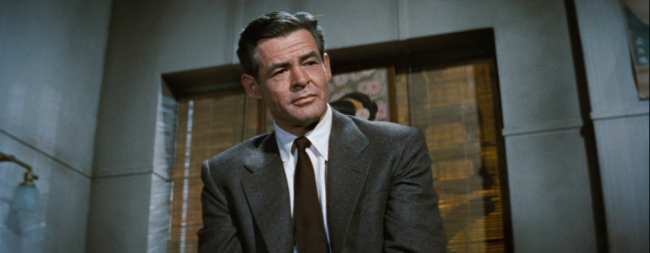
Samuel Fuller is one of the most influential directors of all time but it's strangely difficult to find most of his movies. The Criterion Channel just added one of his more fascinating accomplishments, 1955's House of Bamboo. A disorienting and beautiful film noir purportedly shot entirely in Japan, it stars a surprisingly scruffy Robert Stack as an American searching Tokyo for answers.

In fact, he's from San Diego, just like me, as he reveals in one scene. It makes me want to not shave and to swagger around scowling at everyone. That's what he does, finally tracking down the beautiful wife of a recently deceased gangster.

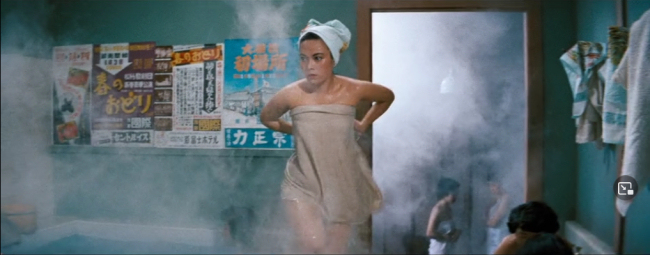
We meet Mariko (Yoshiko Yamaguchi) in a bathhouse where Stack nearly busts in on her. He does get physical with her when he finally corners her in her home. Later in the film, this is all excused because it was all an elaborate act and Stack's on the side of the law. But what happened, happened, of course. Arguably, it's this kind of movie that Hitchcock's Vertigo was riffing on.

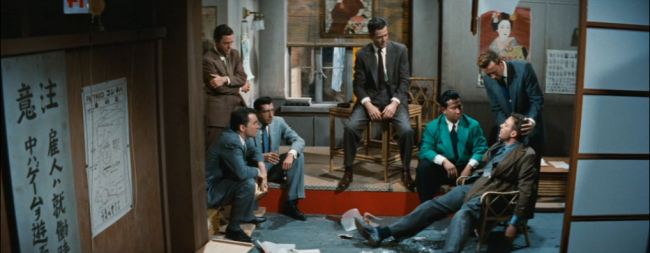
It's Robert Ryan as the head of the local mobsters who's the real star of this movie, giving a terrific performance as always. He has an amazing entrance, too, when Stack is thrown through a paper wall, winding up at Ryan's feet.

As Stack is accepted into the gang, the plot starts to borrow a bit from White Heat. It's a bit disappointing as it comes along with the gang of Americans having very little to do with the local Japanese. They don't even seem to speak Japanese. How have they managed to operate in Tokyo so long?

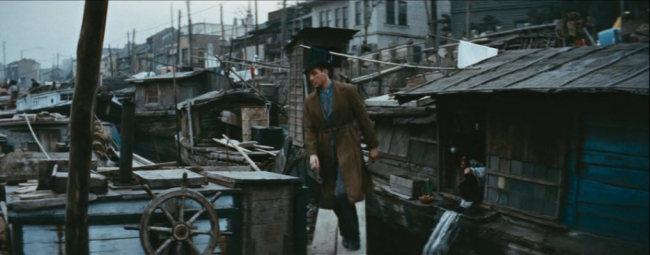
It's disappointing because the film is in many ways light years ahead of other American films of the period in terms of authenticity. It's not just shot in Tokyo, it really feels like Japan when Robert Stack is roaming the streets, roughing people up.

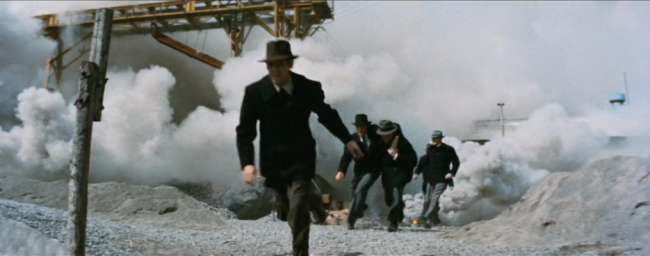
Fuller and his cinematographer come up with some amazing shots. I really liked the look of a heist at some kind of factory.

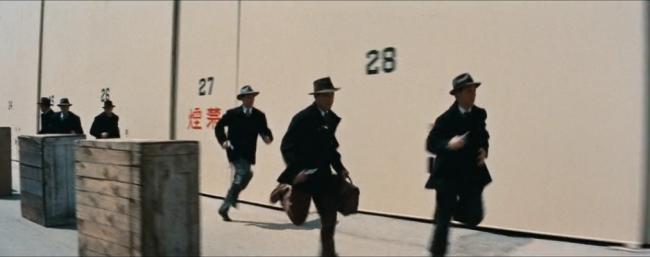
For some reason I really like this shot of the gangsters running in front of these nearly blank walls.

Among Ryan's gang are Cameron Mitchell and DeForest Kelley in small but very effective roles.

House of Bamboo is available on The Criterion Channel.

Monday, June 18, 2018

The American Barony

There are many strange and sinister tales of European settlers in America, perhaps none stranger than that of James Reavis. His scheme in the 19th century to establish a claim on Arizona based on ties to 18th century Spanish nobility formed the basis of Samuel Fuller's very strange 1950 film The Baron of Arizona. An off-puttingly uneven film I suspect was borne of conflicted motives, some that might have been intentionally buried, it nonetheless has a solid foundation in a lead performance from Vincent Price as Reavis.

There's a striking similarity to Citizen Kane in an early scene where Reavis shows up on dark, rainy night to the home of a young girl in order to bestow upon her an inheritance that will drastically change her life. Poor Sofia (Ellen Drew) is just one part of Reavis' intricate, brilliant swindle.

While Sofia is being educated to act like and truly believe herself to be a Baroness, Reavis travels to Spain and joins a monastery with the sole purpose of infiltrating the monastery's library to falsify a one hundred year old record. He seeks to establish Sofia's ancestor as being granted a claim to the Arizona territory by the king of Spain. The real Reavis' scheme was about as intricate except the real life version of Sofia entered the story much later.

Fuller gives us something creepier, a story Price is certainly suited for. When Reavis returns from his adventures in Spain, he finds Sofia a full grown woman who gazes on him with unabashed rapture as one of the only two men she's known all her life. He shifts from the role of father to that of husband, thus making himself Baron of Arizona.

The film formed the basis of Quentin Tarantino and Matt Wagner's Django/Zorro, a comic series in which Tarantino's cinematic hero teamed up with Zorro against a Duke of Arizona. Django/Zorro's version of Sofia is far less complicit, as might be expected of a Tarantino heroine, and the Duke is far more clearly a villain than Price's Reavis. But a more striking difference is in how the Duke's defeat is partly accomplished by Django and Zorro aiding an uprising of Hispanic labourers. Whether Fuller had considered how the story of The Baron of Arizona connected thematically to disenfranchised American peoples is unclear. White land owners rebel against Reavis in the film, as they did in real life, and in one shot we do see a Native American man seemingly allied with them but not speaking.

Maybe this was the most Fuller could do in the era of the Hays Code. It was fourteen years before John Ford's Cheyenne Autumn, a western that portrayed the Northern Cheyenne Exodus as part of the long term crimes committed against Native Americans by European colonists and the United States.

Maybe Fuller had something like that in mind, though, when it's revealed late in the film that Sofia has Indian blood. This is partly why the latter portion of the film feels completely destabilised and the viewer is left uncertain as to who the heroes and villains are. Sofia's claim is part of a swindle and yet maybe she has the most honest claim of all.

Twitter Sonnet #1125

For submarines, the sandwich fills the world.
At lunch the peace became about the breads.
Around the edge a data card was curled.
A cookie claims the thoughts of crumbled heads.
Beneath the golden foil silver waits.
A phantom hanged in island spoils then.
The soil rashly eaten never sates.
A claim escaped the dreams in fevered din.
The water took a fender for the boat.
Crustacean teams demolish metal hulls.
A look conveyed a pen to folly's note.
To sleep again the violent washer lulls.
A desert stage condones a summer play.
Abnormal shields conceal the hotter day.