Showing posts with label vertigo. Show all posts

Friday, April 28, 2023

Back Down the Spiral

I've been without Internet for two days because I was uploading a video to YouTube. It's an update and expansion on my 2008 analysis of Alfred Hitchcock's Vertigo, you can see it here:

This wi-fi I have doesn't seem to like me uploading large files. It slows to a crawl whenever I upload a YouTube video and I'm unable to use the Internet for anything else while it's uploading.

It was in preparation for the video that I read Laura Mulvey's essay again. I'd read it back in 2008, too, and both times I expected to refer to it and never did. It's just not very good and has nothing particularly interesting to contribute to the conversation on Vertigo or anything else, it just creates some new jargon for already established concepts.

This afternoon, I spent a few hours in the art club where I teach. There's a really nice new crop of first year students who are all eager to spend that time drawing. It felt like heaven to-day.

Twitter Sonnet #1692

An even joint has split the arm to three.
A knowing cloud mistook the sea for ground.
A mind of wasps absorbed a lonesome bee.
Abruptly woods consumed a frantic sound.
The final card portrayed a lady's face.
Exact bananas cut tarant'la's U.
With expert care, the clinic grew apace.
A rainy day became distracting blue.
The waiting spiral held the cage in air.
A broken disk arrived at home to break.
Mistaken feet were glued to ev'ry stair.
And now a worthy tongue will speak for steak.
The spinning day concludes but hours late.
Magnetic sand debased the villain's slate.

Wednesday, September 22, 2021

Sometimes You Just Get lucky

Guess what! Showtime is streaming on Amazon Prime for 99 cents a month in September and October. Even I can afford that. They have Vertigo, Twin Peaks (the original and The Return), Mulholland Drive, Rear Window, The Birds, and many other things. And, since it's through Amazon Prime, it's more reliable than HBOMax.

I found out about it looking for Vertigo. I wanted to get a better quality clip of the sequoia forest scene than was on YouTube. This was for a powerpoint I made about the redwoods for school. The sequoias are currently being threatened by wildfire so it seemed like a topical and interesting subject to use to teach a grammar point. Trees have been on my mind lately.

I was pleasantly surprised to see Twin Peaks included in the package. This was on Sunday so it all felt very cosmic when I watched David Lynch's weather report for that day and he chose as his word for the day . . . "Tree".

A day earlier, I'd received a package of my clothes from my mother and she'd unexpectedly included a cool Twin Peaks key chain and a David Lynch Christmas ornament. I can see which way the stars are aligning.

Thursday, April 08, 2021

Clothes Make the Size

How's a working class girl supposed to get ahead in the cutthroat world of business? In 1988's Working Girl, the answer is elaborate deception, which is also apparently pretty standard anyway. It's an entertaining romantic comedy, too, and Melanie Griffith is very sweet as the star.

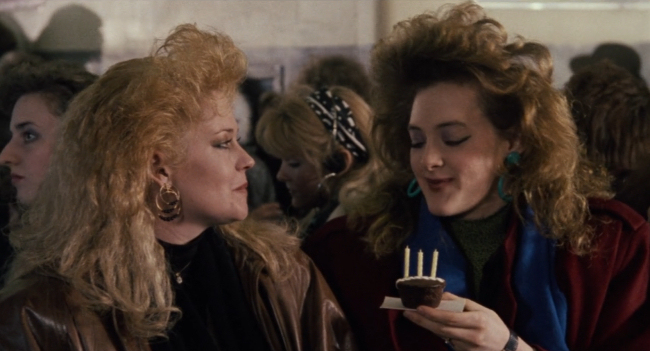
She plays Tess, an office worker who got a BA at night school. Her best friend is played by Joan Cusack and I'd swear their wardrobe was inspired by Jean Marais in La Belle et la Bete.


I don't remember people dressing so big in the '80s whose names weren't David Byrne. But maybe it was a working class New York thing.

She gets a job working for Sigourney Weaver who turns out to be the film's villain. A lesser actress would've suited the film just fine but I love how Weaver makes Katharine subtle. When she tells Tess she honours her ideas and wants to help her get ahead, the viewer is as unsure as Tess is whether or not Katharine is being genuine or patronising. Then, of course, Tess discovers Katharine was planning to steal Tess' idea about acquiring a radio station for a big company.

After Katharine breaks her leg skiing and asks Tess to manage things for her, Tess decides to pretend she's at Katharine's level in the company. This leads to her partnering professionally and romantically with Harrison Ford.

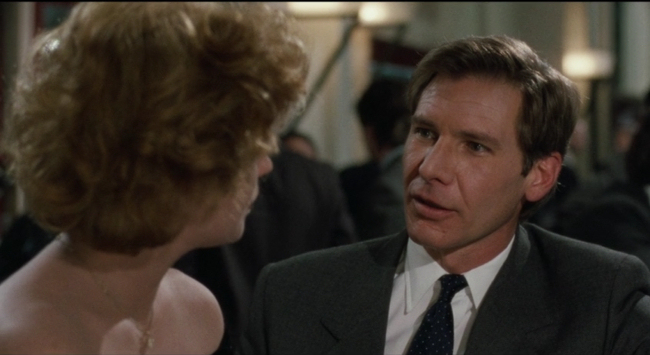
He has an interesting line when he picks her up at a bar--"You're the first woman I've seen at one of these damned things that dresses like a woman, not like a woman thinks a man would dress if he was a woman." That's a lot of thought put into her simple little black dress, even if that dress was revealed to have cost six thousand dollars in an earlier, amusing scene where she and Joan Cusack pilfered it from Katharine's wardrobe ("And it's not even leather!" says Cusack). But what does it mean? He's a man, so how would he know what a woman would choose? Though, since the film's costume designer is a woman, a woman presumably did choose it. I think it's a long way of saying it doesn't look slutty, the presumption being that if a man were suddenly in a woman's body, he'd dress to be seen by himself. This all sounds like a Male Gaze discussion and incurs many of the logical problems inevitable if anyone thinks too deeply about it. Though it becomes more interesting when Tess meets Ford's character again at a board room meeting.

And I thought, my God, she's the spitting image of Kim Novak in Vertigo.

And I thought further--she's a working class girl dressing as an upper class woman and attracts a man in the process. And there's even a scene where he carries her home unconscious, undresses her, and puts her in his bed and treats the event like it was totally innocent. It makes me wonder if there was a stage in which this movie was meant to go in another direction.

The second half of the film isn't as intriguingly weird as the first. There's a big boardroom showdown that's a bit silly but also pretty satisfying.

Working Girl is available on Disney+ in most countries (not the U.S. or Japan).

Tuesday, December 04, 2018

Evidence of Having Seen Movies

In 1981 Brian De Palma released his cocktail of Hitchcock and Antonioni to unenthusiastic audiences, a movie called Blow Out. Taking the basic premise from Antonioni's Blowup and throwing in quite a few Hitchcock references, particularly to Vertigo, De Palma never reaches the heights of his influences, in craft or storytelling depth, but stars John Travolta and Nancy Allen are charming and there's something entrancing about the film's broad cheesiness.

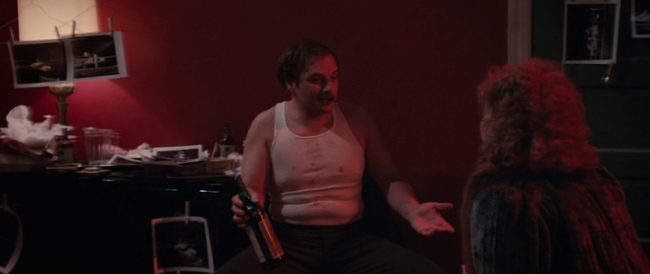
The best example of which is Dennis Franz as someone cut right of a pulp comic; a fleshy guy named Manny Karp in a food stained wife-beater drinking J&B from the bottle in a hotel room bathed in red light. Gavin Elster he ain't. But the scene, where he and Nancy Allen's character, Sally, talk about their scheme to frame a politician is a clear reworking of a few scenes in Vertigo. De Palma switches the green light from an outside sign to red as Truffaut did in his own Vertigo homage, Mississippi Mermaid, and it's in the hotel room we learn that the female lead has been misleading the male protagonist.

And as with Scottie and Elster, there's a connexion between Jack (Travolta) and Manny; they're both in the film industry and both seek to control and take responsibility for the female lead. There's no line about how saving someone's life makes you responsible for them but Jack does believe he saves Sally from drowning. But unlike in Vertigo, Sally isn't secretly in control of this moment and generally she's a much simpler character than Judy/Madeleine (or Catherine Deneuve's character in Mississipi Mermaid). Sally just seems like a sweet hustler who got mixed up in all this. We don't really get scenes from her perspective as we do with Judy so there's none of the emotional high stakes act of manipulation, part of what makes the last third of Vertigo so captivating.

The plot about a politician being assassinated is essentially just mechanics here, business, and lacks the deeper commentary on how art and public deception are related that we see in Blowup.

What is intriguing is De Palma's interest in showing how multiple stories occur simultaneously and the tension inherent in the potential for any two stories to connect with explosive consequences. Even the exploitation movie we see Jack working on at the beginning of the film is a nice collage of occurrences with the killer's POV outside the sorority, seeing the girls aimlessly partying in one room, and another girl frustrated in her attempts to study in another. Each of these three partially quarantined environments are separated as much by lighting as by physical barriers, creating the sense of different, isolated universes.

The fact that this film is a story within a story adds another layer and this storytelling technique is carried on throughout the film and we can see it in how Jack's impression of a story through sound eventually must be connected through Manny's story through imagery.

Like Scottie in Vertigo, Jack has a memory from his past working with the police in which something he did led to a cop's death, in this case his passion for sound design. He gets his second chance when he endeavours to save Sally with the use of a wire microphone she's wearing but this all lacks the psychological implications of Scottie's fear of heights. It becomes more of an interesting ode to film than a film with a story to tell in its own right.

Monday, March 19, 2018

The Dizzy Reality of the Screen

Last night I went to see the greatest movie of all time, Alfred Hitchcock's Vertigo, in a movie theatre. Well, it's the most current number one in Sight and Sound's poll of critics worldwide. It's certainly my favourite movie though I've always felt weirdly uncertain that it deserves that top spot more than Citizen Kane, partly because I know very few people who like Vertigo that much. Generally the reaction I see is people think it's okay but don't quite understand what the fuss about.

I was hoping to get some impression of the audience's reaction last night though, as it turned out, it was a blessedly quiet crowd of about twenty five people, nearly all women, ranging in age from mid twenties to mid forties, from what I could tell. Whether or not they liked the movie, they were good movie-goers who kept quiet for the most part and I was able to thoroughly enjoy the experience of the film. I wish it'd been louder, I was hoping for Bernard Herrmann's score to really blast in the opening credits but otherwise I have no complaints about how it was shown.

Fathom Events is screening Vertigo in cinemas for its sixtieth anniversary. It also happens to be the ten year anniversary of the week I spent obsessively watching it over and over before I wrote this analysis in 2008. I stand by all my opinions in that analysis and I think it's one of the best things I've written. But one of the great things about Vertigo is my perspective is different every time. Like the protagonist in Terry Gilliam's 12 Monkeys, who watches Vertigo in one scene and explains the movie is different now because he, the viewer, is different now, I find myself responding to different things.

I'm more interested in religious symbolism now than I was ten years ago and I found myself thinking about how Hellish Elster's office looks. That desk looks like it was carved from the bloody flesh of tortured souls. A lot of people talk about how green is used in the film but there's a lot to be said about its use of red, too. There's the black cherry wood in the McKittrick hotel and the intense, almost magenta wallpaper at Ernie's, the restaurant where Scottie first sees Madeleine.

When I wrote my analysis in 2008 I spent a lot of time reading what other people had written about the film and tried not to repeat anything but I'm not doing that to-day. So maybe it's already been pointed out but it occurred to me last night that Judy's fate at the end being caused by the sudden appearance of a nun may be seen as an act of God. Scottie's finally broken free of all the illusions and the manipulations to reach the moment of clarity that cures his vertigo. One could say that a benevolent God watching this said, okay, he's done enough, now I'll take Judy off the table so he won't be tempted to go back into that cycle. But there doesn't seem to be anything good in Judy's death--a repeat of her apparent death earlier in the film, it seems mainly to be confirmation that Scottie's trapped in a cycle instead of breaking free of one.

It's a deliberately frustrating and uncertain ending, not unlike the ending of the new season of Twin Peaks. In both cases, we have a detective character traversing hazards of dream and illusion in an effort to save a woman who may or may not be real, a journey that questions the criteria for what we regard as reality. Having recently watched Mississippi Mermaid, I was compelled to think of how important Vertigo was to the French New Wave filmmakers. Like Godard continually thwarting audience expectations by abrupt changes to the score in Pierrot le Fou, Hitchcock continually plays with what audiences expect from a movie and uses those expectations to make the audience a part of the story. He sets up Scottie as a hero and thus makes us complicit in his deviance, he sets up a spirit possession plot and then dashes it aside because, after all, that's a bit fantastical, right? What were we thinking?
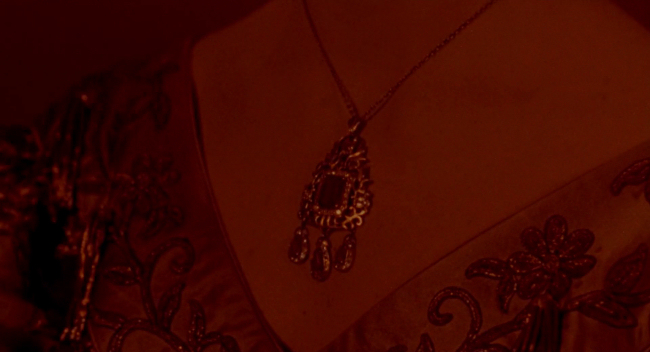
But is Carlotta's ghost really a hoax or is its reality simply in a different and deeper form than we're conditioned to expect? The effect of Carlotta's haunting is there, the paradigm of freedom defined by the control of others is set up by her story, and the pattern of dominated people trying to dominate others has an echo in the idea of Carlotta, victim to the whims of a man in life, controlling the fates of men and women after her death. The lack of any explicit proof of her haunting, aside from possibly Scottie's attention being drawn to the necklace in his dream, is in a weird way integral to the power she asserts. Just as "Madeleine" holds so much influence for not truly existing.

Last night I was struck by this pair of shots as Judy and Scottie discuss her dream that leads them to San Juan Bautista:

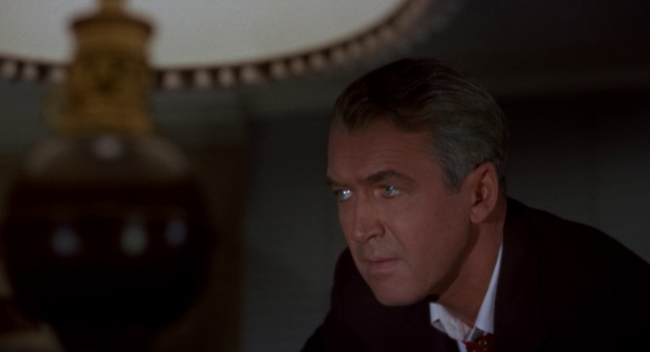
Hitchcock keeps cutting back and forth between the two. Judy and Scottie are in two different places but their faces are placed in almost exactly the same relationship with the lamp. Like Scottie's dream where he falls into Carlotta's grave or when he falls onto the roof the shot seems to suggest he and Madeleine are the same person. One could say that Madeleine is the joint creation of Elster, Elster's unseen wife, Judy, and Scottie but primarily Judy and Scottie. It's like a masque written by Elster about his wife in which Judy is the actress and Scottie is the audience/participant. Or maybe more accurately, it's like a Dungeons and Dragons campaign written by Elster, Judy is the Dungeon Master, and Scottie is a player. Scottie isn't a passive audience and Judy isn't simply a performer of written lines, they're both creating the story. The lamp is a little clearer next to Judy's face but it's closer and blurrier next to Scottie's--she gives him the dream, raw material, he interprets the dream and comes up with a plan of action based on it.

Yes, I guess this movie will always be fresh for me. It was an incredible pleasure seeing it on a big screen. The incredible visuals, apart from any interpretations of them, are wonderful to experience in themselves. I love these two consecutive shots as we watch Judy and Scottie leave the forest and then we see Judy at the beach by that twisted tree: