Saturday, December 22, 2018

Christmas Alien Love

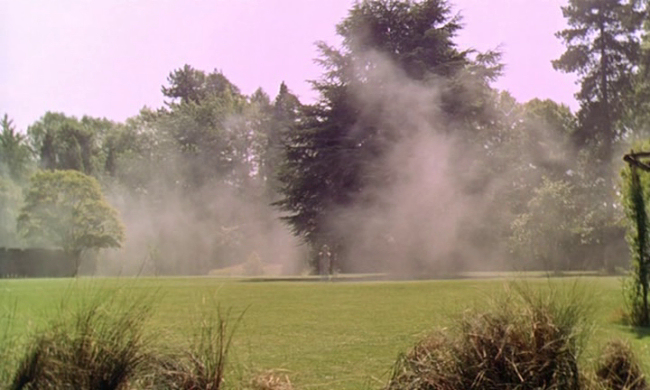
For a series renowned for its weirdness, Urusei Yatsura's first Christmas episode, 1981's "Pitter Patter Christmas Eve" (ときめきの聖夜), has a pretty simple, straightforward plot. The tenth episode of the television series, the show was still finding its footing but it's still an entertaining and sweet episode.

Ataru (Toshio Furukawa), a lecherous high school student, is still in the early days of his forced marriage to the excessively affectionate alien girl, Lum (Fumi Hirano). It's not that he doesn't love the green haired beauty who always wears a tiger striped two piece swimsuit, as he explains in this episode, it's that he also loves "Shinobu, Sakura, Oyuki . . ." He wants to be able to play the field, which in this case, as in most cases, manifests in uninvited groping and pathetic pranks, as we see when he practices a yo-yo trick that causes skirts to fly up.

There's also the fact that Lum gives Ataru electric shocks whenever he misbehaves (which somehow has no effect on reforming him) that keeps him from wanting to settle down with her. Most of the other guys at school think Ataru is a fool not to appreciate what he has with the gorgeous Lum so, in this episode, a group of them have concocted a scheme to finally demonstrate to Lum what a scoundrel he is and convince her to leave him. A quixotic quest to be sure since witnessing Ataru doing something horrible every twenty seconds has yet to cause her to waver in her affections.

The guys create a fictional woman who writes a love letter to Ataru, asking him to go out with her. In a typical example of the show's use of puns (one of the things that made it a hard sell for English speaking audiences), the guys call the fantasy woman they've created "Kumino Otoko", or "Boy(s) of the Group". Ataru amusingly never suspects anything even as he lusts for "Miss Otoko" or "Miss Boy".

Lum applies her usual corporal punishment when she learns Ataru plans on going on the date but when she finally realises his resolve is unshakable she starts to cry, a moment that has only the faintest hint of a beginning of sentiment before the next piece of absurd physical comedy intrudes. I like the way her hands are animated in this moment. She looks like Alice in the 1951 Disney film.

There's also an interesting moment where Lum's in the mall, feeling lonely, and she's walking alone against a tide of blue shoppers.

In case you're wondering what this story has to do with Christmas: not a whole lot. But lots of Christmas music is used throughout the episode, there are lots of Christmas decorations, and it's snowing. The episode's currently available on YouTube:

Friday, December 21, 2018

It's d'Abo, it's de Lancie, it's Delovely, it's De Unlimited Power

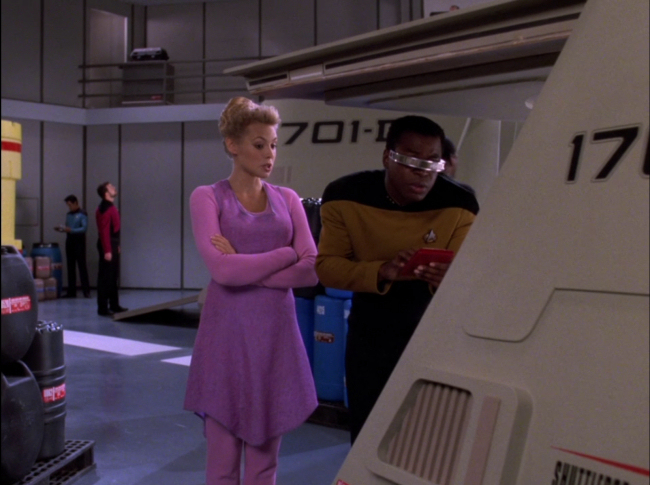
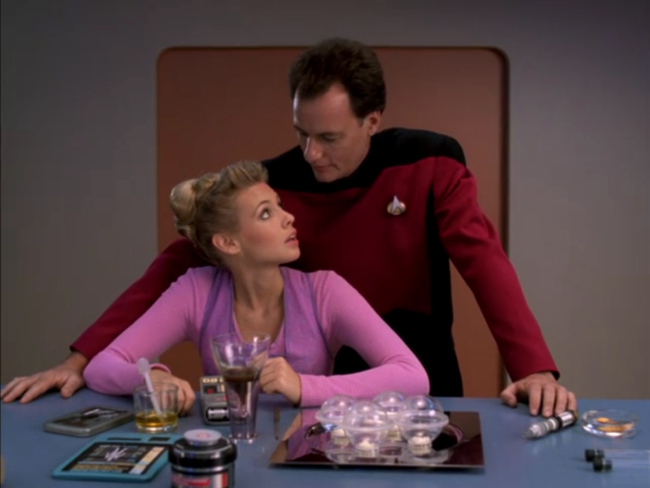
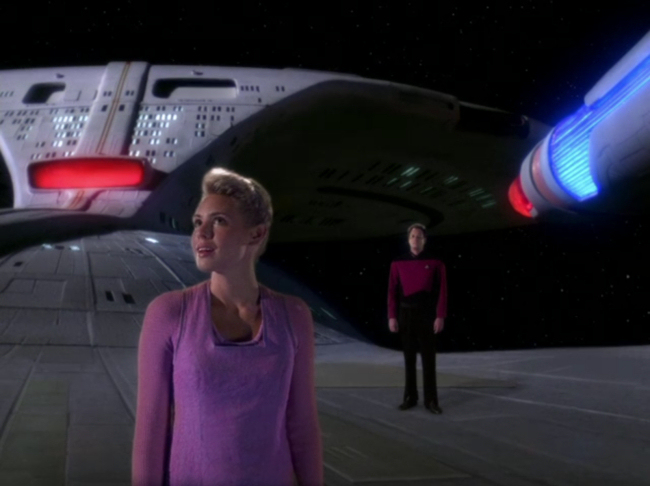
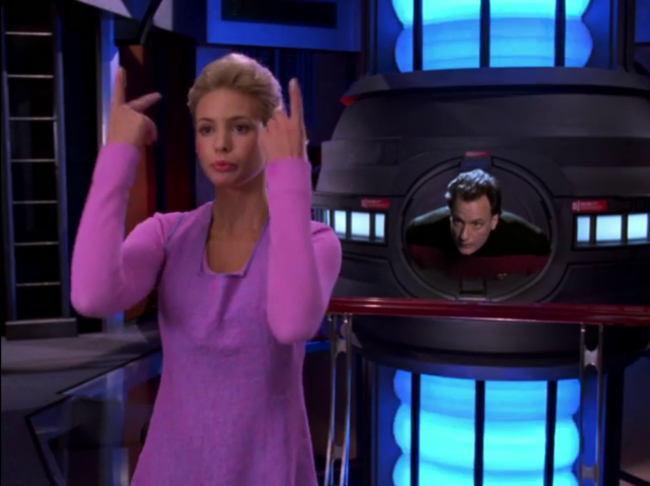
It's my naive belief that I'd enjoy being omnipotent but it's all kinds of trouble for a young woman in the 1992 Star Trek: The Next Generation episode "True Q". Guest starring Olivia d'Abo, one of the stars of the best Conan movie, Conan the Destroyer (search your feelings, you know it to be true), it's an episode I enjoyed as a kid, liked somewhat less as I grew older, and now I've gone back to appreciating, but for different reasons.

Q (John de Lancie) is one of those characters kids are more likely to enjoy than adults. To a kid, what could be better than a character who shares their poor understanding of and impatience for adult concerns but also has the power to override the adults at any time? But "Deja Q" and "True Q" reveal Q's people, the omnipotent beings known collectively also as Q, are governed by laws, which is inevitable, if you think about it. A race of childish, capricious beings exercising unlimited power at every whim would make existence impossible.

So the premise of the episode is that Amanda (d'Abo), upon discovering herself to be Q despite having lived as human all her life up until now, must choose between living among humans and suppressing her powers or going off with Q and to live as the Q. The rules are a little fuzzy, though, because it's implied she can come back and visit whenever she likes.

The idea seems to be that the Q have their own version of the Prime Directive. It makes me think about the purpose of the Prime Directive in the first place. I think there are two justifications for it--one is that, as peoples and societies evolve, they create a particular story or identity that would be shattered if interrupted or "sped up" by other cultural and technological influences. The other reasoning is that, however good or benign the intentions of the interfering culture of superior technology, problems would inevitably result due to the imperfections of the interfering culture. This latter would be the reason that might have tied the conception of the Prime Directive with the Vietnam War, the former reason being how it generally seems to manifest after the Original Series.

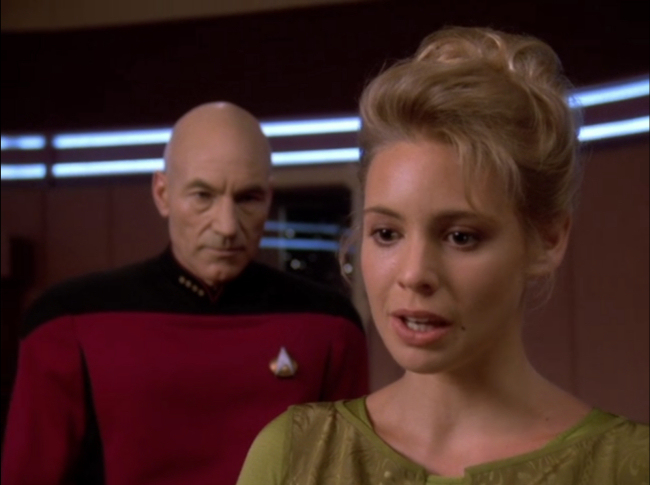
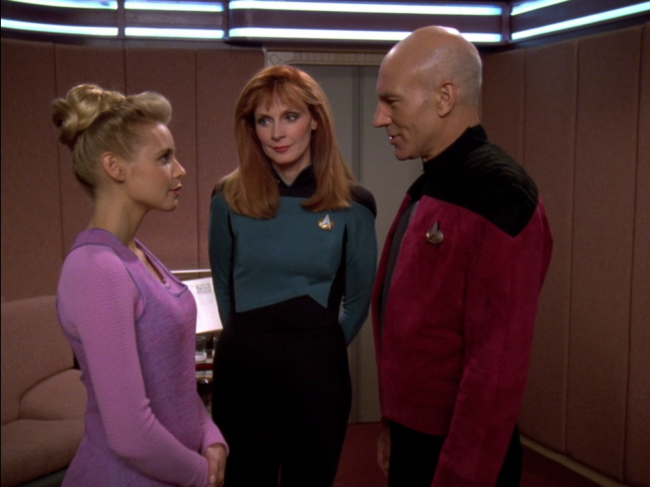
It's hard to see what's wrong with Amanda fixing the polluted atmosphere of the planet in the climax of this episode from either line of reasoning, and the show doesn't even attempt to explain why she shouldn't have interfered. But there's a subtler idea that kind of gets lost by the end and it's introduced in the beginning, when Amanda thinks she's just a very gifted human student who won an internship on the Enterprise. Picard (Patrick Stewart) tells her to keep in mind what a rare opportunity she's been given and Crusher (Gates McFadden) takes her under her wing. This is the culture that would be interfered with, the value system of advancement that's been impressed on Amanda throughout her academic career, and the responsibilities of mentorship Picard and Crusher feel.

It's never really addressed that way, though. The first conflict comes when Amanda's use of her powers interferes with an experiment Crusher's performing because Amanda doesn't understand the point of the experiment was to record developments over time rather than to reach an end point as quickly as possible. Of course, with omnipotent power, Amanda could conceivably reproduce the same effects of the passage of time or even travel back in time to perform the experiment properly and return at the same moment. This is a flaw in the plot's reasoning that detracts from the point the writers may have intended to make. When writing about omnipotence, you can't rely on the limitations of omnipotence, only on the limits of the imagination of the omnipotent. Which presumably are only as great as the omnipotent being allows them to be.

The interesting idea that for some reason isn't quite developed is that limits are required to give achievement any meaning. But on the other hand, to use unlimited power properly would be a pretty impressive achievement, too.

Twitter Sonnet #1187

A light was sep'rate stuff from metal tubes.
Encouraged spirits keep a gleaming tree.
To travel ice was put in melting cubes.
Beyond the timberline was naught to see.
A candy star could burn the package out.
If Barf or Del could trade the seat to kings.
As plaid or tartan marked the border route.
The strange inverted siren ever sings.
The comments cover sense to make an ink.
The empty pen expressed a vanished thought.
A liquid book was found beneath the sink.
But gloves and cleaning spray were all they sought.
The clocks we hid in eggs emerged at Yule.
A galaxy resides in worsted wool.

Thursday, December 20, 2018

Caught Between a Corey and a Mitchum

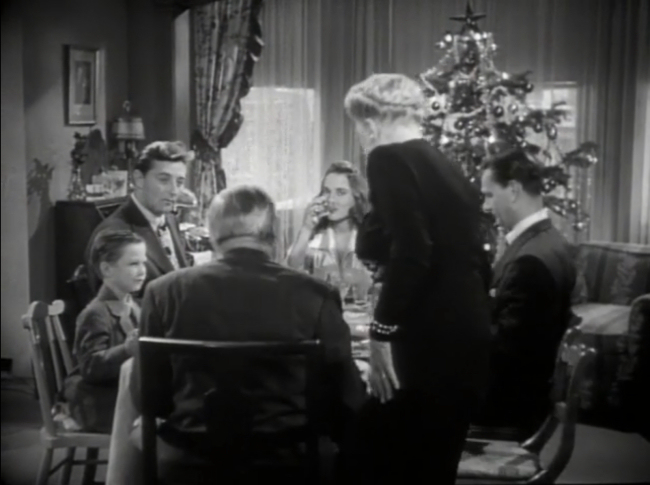
According to Wikipedia, 1949's Holiday Affair was a failure on its original release but, thanks to Turner Classic Movies broadcasting it over Christmas decades later, it became a minor classic. I'm going to have to side with 1949 audiences on this one; this is not a good movie. It has its moments--good stars in Robert Mitchum and Janet Leigh. But the screenplay quickly turns charm into mean tedium.

Robert Mitchum plays Steve Mason, a World War II veteran who now works as a department store clerk. He meets a pretty young woman named Connie Ennis (Leigh) one day when she impatiently buys an electric train set from him. Turns out she's a comparison shopper, which he sniffs out immediately, but he feels sorry for her when he learns she's a war widow, a single mother supporting her little son, Timmy (Gordon Gebert).

At first, the film is kind of cute, even the little boy isn't bad. Steve and Connie have a sweet enough first date in central park where they feed the seals before Steve decides to help her out on her job, posing as her husband when she goes to department stores to buy things. But there's a complication in that Connie's long time boyfriend, Carl (Wendell Corey), wants to marry her and already feels like he's part of the family.

The latter two thirds of the movie consist mostly of Carl and Steve taking turns telling Connie how she feels and thinks and what she should do. Steve gives her some lame psychoanalysis about how she's trying to turn her little boy into her husband while Carl insists marriage is just the thing to do. I wanted them both to go away. By the time Harry Morgan turns up in a small role as a police lieutenant, I was unwilling to meet the film halfway and grew irritated as Morgan played up an incredulous reaction to the circumstances of Steve's arrest in the park.

Robert Mitchum has such natural coolness and contentedness about him, it's almost a fascinating experiment to see how long it takes before that loses ground to obnoxious dialogue. Unfortunately it wasn't that long.

Wednesday, December 19, 2018

New Animation for Old Years

Firsthand experience of the Holocaust is hard enough to imagine as an adult, but how strange it must have been for a child in a concentration camp, in addition to horrifying. Yesterday I finally got a chance to see the 2011 short film Ingrid Pitt: Beyond the Forest, the final project of Ingrid Pitt before her death. One of my favourite actresses, she's best known for her work in British horror films in the 70s, particularly the great The Vampire Lovers and the decent Countess Dracula. When she was a little girl, she and her mother escaped from a concentration camp in Poland near the end of World War II; the short recounts this experience. It's so short it's a bit hard to judge, but something of her experience is translated in a fascinating way by the decision to let a ten year old boy named Perry Chen do the animation. Still, I can't help feeling the film would've been better off with Bill Plympton animating the short himself.

Plympton did do the storyboards and his style is clearly recognisable in the character designs. The animation itself is crude and clearly produced with a simple computer programmme. But I guess there is something in the simplicity of how Chen conceives of black planes shooting scribble bombs at Nazis who keep their rifles straight up on their shoulders as they flee. His imperfect perceptions match up a bit with Pitt's recollections.

Her voice sounds frail and emotional, very different to the newest thing I saw her in, the 1984 Doctor Who serial Warriors of the Deep. She appeared in a few things since then, I just haven't seen them.

Warriors of the Deep is kind of a low point both for Doctor Who and Ingrid Pitt but she had a nice supporting role in the BBC Television Shakespeare's production of Comedy of Errors the year before that.

Maybe because she wasn't feeling well, maybe because she was close to death, made her emotions particularly raw when recounting her childhood experience, but it really works, in any case. She recalls dogs at the concentration camp that were always snarling but for some reason never barked. She remembers a little boy who found her and her mother in the forest who at first wanted his father to shoot them. Something of the strangeness and confusion of the experience comes through.

I don't know how this movie took five years to complete. Maybe if Plympton were hand drawing it, I would understand. Anyway, it's an interesting work and a fascinating part of Pitt's life.

Tuesday, December 18, 2018

The Digital Birds of Song and Controversy

A psychopath walks into a palace with a cgi ostrich, demanding a wife in return. So begins 2018's Padmaavat, the year's second highest grossing Bollywood film despite being banned in many parts of India and Malaysia. Some considered it anti-Muslim for its depiction of a sadistic, ambitious Muslim ruler; on the other hand, sets were vandalised and crewmembers assaulted before the film was completed because it was believed the Hindu ruler and title character, Padmaavat, was shown in a negative light. Maybe it's for these reasons that the film has such broad, simplistic characters, reducing the story of the 16th century source poem to a low brow tale of good versus evil. But the sets and costumes are absolutely gorgeous, demonstrating once again how Bollywood benefits from HD showing off intricate beads, jewels, and arabesques.

Set in the 13th century, the film tells the story of a beautiful woman named Padmavati (Deepika Padukone) from Sinhala (modern day Sri Lanka) who marries the Rajput king, Ratan Singh (Shahid Kapoor), after accidentally shooting him with an arrow during a hunt for a cgi deer. All of the animals in this movie are very, very obviously cgi, and not just because there's a disclaimer at the beginning that says so.

This is the third of three disclaimers, the first being the longest;

The needless inclusion of plural forms in parentheses seems a bit passive aggressive, as though the writer is emphasising the purely obligatory nature of the disclaimer. The feeling that the film is anti-Muslim is largely due to the portrayal of Alauddin Khalji, the aforementioned psychopath, played ridiculously by Ranveer Singh.

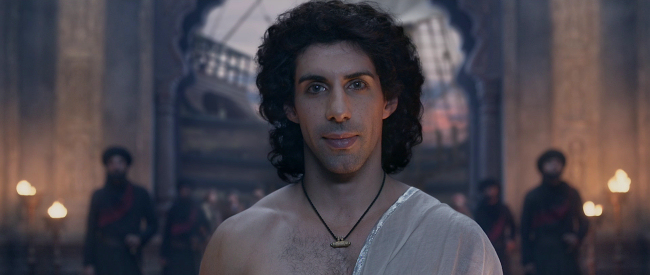
He's so over the top he makes Jim Carrey in Batman Forever seem like Laurence Olivier in Marathon Man. There's a scene where the camera just pans around him while he gnashes his teeth. Scene after scene portrays him revelling in his pure evilness when he's not insulting or murdering people. Apparently the real Alauddin was nothing like this but no leader ever was. Even the cruellest tyrants had to have some charisma, some ability to imply to people around him that there'd be something good or useful about him being in power. As far as I can tell, the only person who really likes this Alauddin is his fellow psychopath, a eunuch named Malik Kafur (Jim Sarbh), Alauddin's assassin slave who bears a distracting resemblance to Sacha Baron Cohen.

There's a kind of fascinating scene where there's some very, very indirect implication that Alauddin and Malik may like to sleep together. The scene begins with Malik washing Alauddin's feet and then singing a song about legendary beauty . . . then Alauddin goes to bed with a woman who abruptly turns up. I guess it's a half buried homophobic message though I don't know why they'd give Malik such a sweet song if that's the case.

Supervillain Alauddin is the real focus of the film. He lays siege to Chittor, Ratan Singh's fortress city home, with the aim of stealing Padmavati. Ratan's a pretty dull, straightforward, honourable hero type while Padmavati displays some prowess in diplomacy and war tactics beyond her husband--though it doesn't amount to much more than advising Ratan to kill Alauddin at the first opportunity. She can't dissuade Ratan from meeting the evil ruler unarmed and, of course, Ratan's captured and Padmavati has to use her wits to rescue him--but she ends up requiring the help of a Muslim character (Aditi Rao Hydari) who I must say is portrayed in a very positive light.

The action sequences are really sub-par; the sword fight in the climax looks like it was the result of about a day of choreography. The dance choreography, on the other hand, is pretty good and the songs aren't bad. Still, you'd be a lot better off watching Jodhaa Akbar.

Padmaavat is available on Amazon Prime.

Twitter Sonnet #1186

A different coat contained the same device.
Remembered years are soon forgot in time.
But shades remain to turn and fix a price.
In weightless space it's difficult to climb.
Some firewood was scattered round the hall.
Some hollow sticks were rapid beats of noise.
The empty air conducts a dreaming call.
Expectant thoughts have weird and shivered poise.
Along horizon lanes were pretty shades.
Another sun appeared at dawn to-day.
Another shell was swapped for sudden raids.
A score of stars requested *no* delay.
A thousand pearls obliterate the pool.
The diamonds watched as flesh began to cool.

Monday, December 17, 2018

Really Here and with a Vengeance

The only thing I don't like about 2018's You Were Never Really Here is the title. It fits the film's themes but it's a little on the nose and beyond that there's something altogether flat in the sound of it. But the film itself is one of the best vigilante fantasy films I've seen in years, that kind of film that typically gets mislabelled as a noir--as indeed this one has been--but You Were Never Really Here has a lot more in common with Death Wish or Sin City than it does with Double Indemnity or Chinatown. Director Lynne Ramsay does a good job of capturing the constant psychological presence of past trauma for the vigilante even as he spends most of his time casually dominating scores of nameless dirtbags.

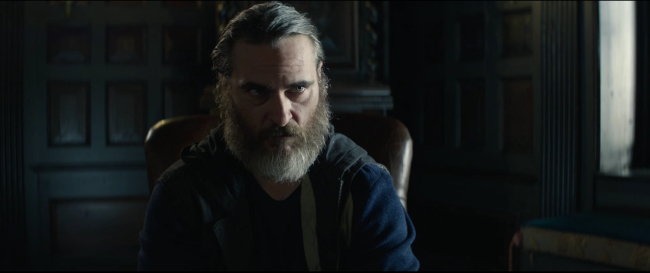
Joaquin Phoenix plays Joe, the vigilante, serious as a funeral, with only a little of the ironic humour often seen in this kind of character. He's former military--we get some flashbacks to a desert setting and troops--and former FBI. Now he's a gun for hire for an underground criminal network. He accepts jobs to brutally punish child sex traffickers.

In his idle moments he sticks his pocket knife down his throat or drops it over his bare foot, giving himself a split second to pull his foot out of the way, which he always manages. He's addicted to the nearness of pain and injury, as well as to chemical stimulants. The only things keeping him going are his elderly, simple hearted mother (Judith Roberts), with whom he lives, and saving and avenging victims of sex trafficking.

Phoenix is really good in this movie. There are scenes where you can see the grief and rage being restrained for pragmatic reasons, all the layers visible on the actor's face. I like how he bulked up for the movie, too--he's not Hollywood muscular.

Clearly very strong but with fat, too. These aren't exhibition muscles, these are muscles developed as tools and he doesn't need his body for anything else.

The main plot involves a job where Joe needs to rescue a senator's teenage daughter, Nina (Ekaterina Samsonov), and brutally murder her captors. Naturally, unexpected complications arise.

Joe and Nina's relationship has some shades of Leon or Logan or any number of other movies about a deadly older man befriending or teaming up with a young girl. Nina isn't developed very much, though, functioning as more of a living prop for most of the film while we remain in Joe's point of view. There's something ethereal and icy about her that is cool--her experiences have apparently made her unable to access or display her emotions and we're invited to contemplate her impassive face as she counts down while lying in bed or silently stares through the rain drops on a car window.

Mostly we're inside Joe's mood. The music by Jonny Greenwood is particularly striking with lots of weird percussion that help establish Joe as dangerous and erratic--though of course he only ever hurts bad guys--at the beginning of the film. Towards the end, the music, along with the visuals, starts to recall Stanley Kubrick as Ramsay seeks to emphasise Joe's paradoxical helplessness and inability to have a satisfactory effect on his world. But the film is ultimately an elegant and satisfying specimen of pulp. You Were Never Really Here is available on Amazon Prime.

Sunday, December 16, 2018

Living Long Enough to Become the Cyberking

Ten years ago this Christmas, the Tenth Doctor Doctor Who Christmas special was "The Next Doctor", a title that was slightly a tease for audiences expecting David Tennant's imminent departure from the role. Instead, David Morrissey guest starred as a man who thinks he's the Doctor in 1851 London, a belief shared by the local Cybermen in this episode that has gotten better with time.

There are two other characters of consequence established in the episode--Rosita (Velile Tshabalala) and Miss Hartigan (Dervla Kirwan), the former being companion to Morrissey's "Doctor", the latter being the villain, a deranged, megalomaniac who's teamed up with the Cybermen as part of her vendetta against patriarchal culture.

There are many things about her conception that the presumptions to-day's prevailing sensibilities in media have marked verboten. See how many you can spot in this excerpt from the Wikipedia entry:

[Showrunner and writer Russell T.] Davies describes [Miss Hartigan] as being "a powerless woman who's been in servitude or far worse all her life", but holds his tongue from saying her precise profession, relaying: "I'm talking quite discreetly around this because there are children listening and watching and there's only so far I should go." He does however explain that "She's had terrible things done to her" which is responsible for her "really twisted character where she sexualises everything." In terms of costume, "she wears red" because "everything's inflammatory with her". "And in the end, actually" Davies discusses how to escape her male oppression she "becomes a man, she becomes the CyberKing. She has to go through this extraordinary process because she's so damaged."

But these are things that make her a tragic character instead of simply a cackling maniac, someone more layered than the tooth monster in the recent season finale, for example. She demonstrates how the influence of chronic abuse can alter a person's world view and give them false conceptions of legitimate power. There's tragic irony in that her campaign against an oppressive patriarchy leads her down a path that makes her a Cyberking rather than queen. And it makes her a reflection of the Davies era Doctor, as well, and it's no wonder at the end he's willing to give her another chance despite the fact that she's destroying the city with a giant robot. He's a Doctor whose past actions have forced him to constantly re-evaluate his self-worth after dealing death and destruction on a massive scale. So it makes sense that he's reluctant to just write her off.

David Morrissey's madman who thinks he's the Doctor is, of course, another reflection of the Doctor. Like Miss Hartigan, he also has a traumatic past but, having the Doctor as a pattern to follow, his madness takes a more benevolent form.

American viewers will know David Morrissey best as The Governor from The Walking Dead--he's much more effective in this Doctor Who special, though I did think the Governor got more interesting in his last season when he got a little more complex. I guess the moral of this entry is complex villains make good villains.

It'd been a while since I'd watched a Tennant episode and it was nice to see Ten again. He has that wonderful exuberance--as usual, so excited to have turned up where he's turned up.

But alongside this is a real sense of him working things out, of apprehending a bigger picture. The episode's plot is surprising and fun and I found myself really digging the rampaging Cyberking this time.

Saturday, December 15, 2018

The Wonderful Spirit of Time Travel

In 1918 a man shows up at the dilapidated London flat of a poor single mother and offers her a job as caretaker of a haunted manor. He doesn't tell her it's haunted, he entrusts this knowledge only to her two elder children. He's a lawyer and a ghost himself; he's The Amazing Mr. Blunden, which also happens to be the title of this delightful fantasy film from 1972.

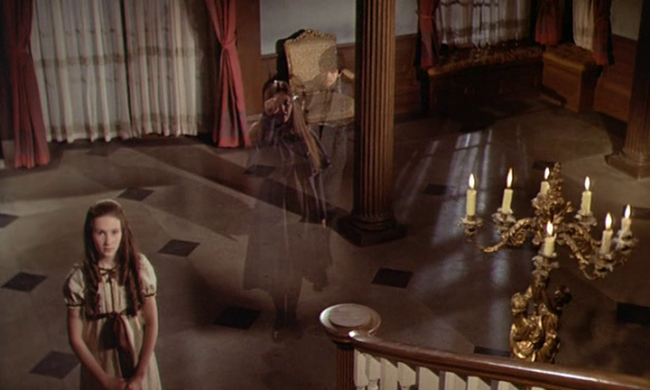
Elmer Bernstein composed the score which has a wonderful, distinctively 70s charm to it with its rapturous strings and brass as Lucy (Lynne Frederick) and Jamie (Garry Miller) explore their enormous, creepy, and partly fire damaged new home. It's not long before they do encounter ghosts--a pair of children much like them, Sara (Rosalyn Landor) and Georgie (Marc Granger), from exactly a hundred years earlier.

It's arguably more of a time travel story than a haunting story but, then again, the implicit connexion between the two concepts is fun. It kind of reminded me of Inland Empire.

Sara and Georgie are being terrorised by their half brother's mother in law, Mrs. Wickens, played by Diana Dors.

One of my all time favourite actresses, Dors was well past her bombshell years, though she was only 40. On the one hand it's admirable she was willing to take these roles when so many former leading ladies would insist only on more flattering parts. On the other hand, it must have been liberating to be able to play such over the top characters as this and the brash matriarch she played on the sitcom Queenie's Castle. And, yeah, I'd still go out with her, even in the Mrs. Wickens getup.

The Amazing Mr. Blunden is a simple enough story about kids versus cruel adults while also having some intriguing and aesthetically pleasing subtext to its concepts. The form Mr. Blunden's (Laurence Naismith) buried conscience takes occupies a fascinating part of the story, especially since it turns out he has very little screentime. He's kind of a free-floating psychological preoccupation that outlived his physical body. I love it. I also love the method of time travel shown in the film, which is revealed to Sara and Georgie by the house's apparently sentient library.

It's a potion, the ingredients for which must be strained through a muslin cloth. Amusingly, Sara and Georgie test it on Mrs. Wickens first to make sure it's not poison.

With a cast that also includes James Villiers, Madeline Smith, and Graham Crowden, it's a fun film with a lot of atmosphere. Lynne Frederick is particularly good, the point of view character for much of the film. The Amazing Mr. Blunden is available on Amazon Prime. You could do worse for something to watch on Christmas--though only the beginning of the film is actually set during Christmas, most of the action occurs during April of 1918 and 1818.

Twitter Sonnet #1185

The eggs of ducks were blue as ships in space.
The careful paint would still escape the pod.
A grid between the suns creates a face.
There's nothing darker dwelling here or odd.
The hammocks creak and sway in inky seas.
Tomatoes lined the battlement and watched.
A drop of rain was just a cloudy tease.
A blade of grass was but a flower botched.
In constant glowing hands the sky was held.
In braided breads the ghosts were growing great.
The greatest lump in truth was soundly frelled.
A mob of ghosts would batter down the gate.
A cable carried out a hundred years.
Electric shows react with water tears.