Showing posts with label tenth doctor. Show all posts

Saturday, January 09, 2021

Death and a Wedding and Time Travel

Donna Noble continued her bad luck wedding streak in the 2016 Doctor Who audio play "Death and the Queen". A primarily comedic and solidly written script from James Goss is turned to gold by performances from David Tennant and Catherine Tate.

It begins in the French Riviera in the 18th century where Donna (Tate) meets a handsome prince while playing roulette. She accepts his marriage proposal despite the Doctor's (Tennant) misgivings arising from the fact that he's never heard of Prince Rudolph's (Blake Ritson) country. Donna, for the opportunity of being Queen, isn't overly concerned by such trivial details.

Alice Krige plays the Queen Mum of the mystery country and she and Tate have a lot of amusing verbal sparring. Most of the good stuff is between Tennant and Tate, though, who have brilliant chemistry as always.

"Death and the Queen" is available at Big Finish.com.

Twitter Sonnet #1432

The light of jellied suns assumes the room.
Responses taped the painted wall to wood.
The broken hands were scraped along the loom.
A leaking engine shakes beneath the hood.
A truncheon scraped the beggar's broken drum.
The vanished thief is sleeping close at night.
The heater yields a steady, aimless hum.
Distracted drunks believe they drank the right.
The circling earth was not the kind to see.
The tasty stones were churning arms away.
We gather leaves to dress the naked tree.
Invited late, the night disturbs the day.
The butter layer thinly coats the cake.
A fleet of flowers sank beneath the lake.

Sunday, February 10, 2019

When Dalek Meets Cyberman

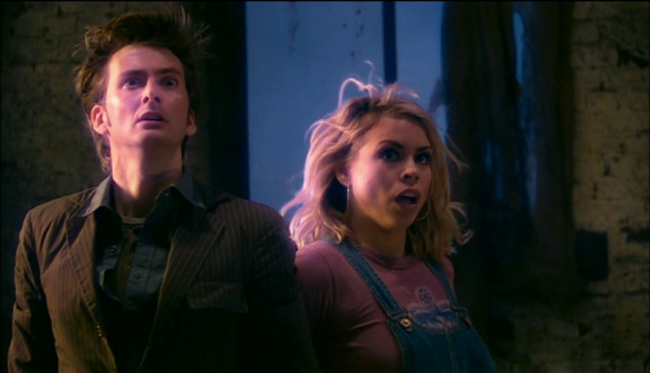
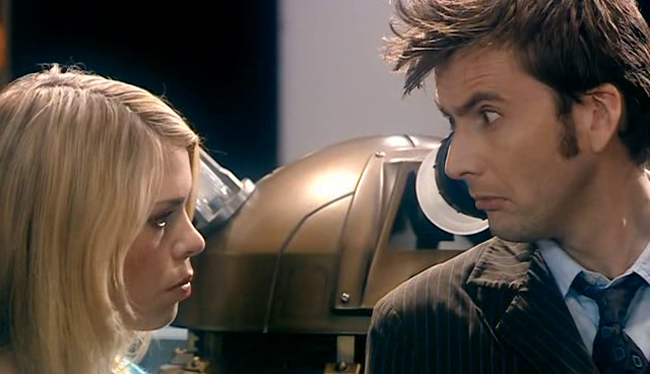
I seem to appreciate the Russell T. Davies era of Doctor Who a lot more than I did the first time I watched through it. I always liked it, though I generally disliked the season finales. But last night I watched the end of the Tenth Doctor's first season, "Army of Ghosts"/"Doomsday" from 2006, and loved it. Ten and Rose are so good together and I love seeing the Daleks wipe the floor with the revival era Cybermen.

Generally I prefer the classic series where the romantic chemistry between Doctor and Companion is understated if it's there at all but I've really grown to appreciate what Davies did. The revival era has often felt like commentary on the old series, something halfway between fanfiction and reinterpretation. There's much more focus on the Doctor as a character with him becoming almost a Christ figure in the Davies era while at the same time bearing the weight of his own sins. That's the kind of extreme focus you might expect from fanfiction. At the same time, Davies brings in the "domestic", an interpretation of what Doctor Who, the series, meant to a regular kid watching it growing up, and successfully transmutes it into meaningful experiences for the characters on the show.

By which I mean, it's not like the Doctor pulls clips from old episodes and asks companions to comment, or even nods and winks at the audience. Rose trying to explain to her mother how great it is to be flying around the universe instead of working in the shop is a moment that touches directly on what I mean.

Jackie, Rose's mother, is offended--"I worked in a shop, what's wrong with that?" She never had the opportunity Rose had. And Rose's point isn't that there's something wrong with a person working in shop, but there's also no sense kidding ourselves any one of us wouldn't be off in a TARDIS if we could. Admitting that is, inevitably, to admit life is fundamentally disappointing. So disappointing that most people don't want to acknowledge it. But the kind of kids who watched Doctor Who would think that way.

I felt bad for Jackie watching the episode again last night. She's so sure the ghost appearing in her flat is her deceased father. She even believes she can smell his cigars. She even taunts the Doctor a little, pleased for once to think she knows something he doesn't, but it turns out that's still not the case.

"Army of Ghosts" also has a nice moment referencing the Doctor's dislike for guns. Rose tries to stop him from leaving the TARDIS to confront a group of soldiers with rifles pointed at him:

ROSE: Doctor, they've got guns.

DOCTOR: And I haven't. Which makes me the better person, don't you think? They can shoot me dead but the moral high ground is mine.

I respect the Doctor a lot more for following his philosophy knowing full well it's impractical than in the recent season where circumstances around the Doctor are improbably rearranged to make the idea flawless. Though, in the instance in "Army of Ghosts", it is actually practical, if he has to go out and confront the soldiers at all--he'd never be able to gun them all down before they got him, the only reasonable course is to demonstrate they have no reason to shoot him.
It's strange how far the show has strayed from romance since the Davies era. Like I said, I like the classic series with its smaller focus on romance, but it's clearly a key part of what brought massive ratings to the show in the Davies era. It seems strange the show would be reverted in this regard to the format it was in when it was cancelled in 1989. Well, look, I've supplied you with another explanation for the show's decline in ratings. I suspect it's this much more than the Doctor being a woman now.

It's so bittersweet seeing Ten and Rose separated. David Tennant plays a young Doctor but you can always see the layer of experience underneath while Rose, as the dialogue about working in a shop demonstrates, feels very much like a young person feeling out her place in the universe for the first time. The 50th anniversary episode's interpretation of the Doctor becoming externally younger makes sense as a sort of psychiatric self-treatment, and his preference for younger companions would seem part of that, but it is nice watching him gradually realise there's something more genuine between him and Rose.

Twitter Sonnet #1204

Compared potatoes turn the tot to trust.
A timer burned the fries beyond the pan.
The larger spuds were painted gold and rust.
The stowaway turned out to be a yam.
Intimation surged in fortune's purse.
A slow deserving court remained to talk.
In better sleds the paintings still rehearse.
On harder snow the patients simply walk.
Encouraged stars repeat in storied lines.
As pearly dots emboss the books of sky.
A burning Braille becomes the harder signs.
The hand of God gave phones a second try.
Collected pegs create a cleat retreat.
Assorted socks will let the feet compete.

Saturday, July 28, 2018

Recognising Beasts

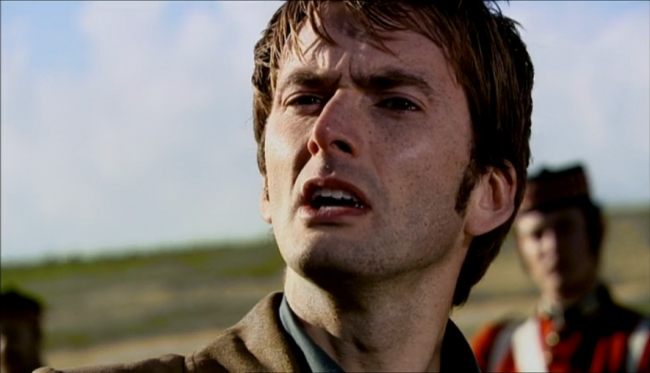
"Tooth and Claw", an episode from the Tenth Doctor's first season on Doctor Who, feels like a Twelfth Doctor episode in a lot of ways. It's set in Scotland, it's a horror pastiche, and it features two instances where the Doctor's companion has to quietly inform him he's being rude. But there are several ways in which it is distinctly of the Russell T. Davies era. I'd forgotten how giddy the Doctor and his companions got, particularly Rose (Billie Piper), over meeting historical figures or famous fantasy characters. Sometimes it felt odd to me but I enjoy it in "Tooth and Claw". I also forgot how red David Tennant's lips could be.

One could also say it's like a Twelfth Doctor episode in that it has some disagreement over whether or not the Doctor is a good person. But while in the Twelfth Doctor era this questioning mainly came from the Doctor himself, in "Tooth and Claw" it comes somewhat unexpectedly from Queen Victoria (Pauline Collins) who, after ennobling both the Doctor and Rose, suddenly banishes them.

"I don't know what you are, the two of you," she says, "or where you're from. But I know that you consult with stars and magic and think it fun. But your world is steeped in terror and blasphemy and death and I will not allow it."

There's a tension between different perspectives on morality throughout the history of Doctor Who. Sometimes the Doctor will casually and adamantly use the word "evil", other times he chides others for using it too hastily to condemn an entire species or to judge the actions of an alien without examining its motives. In "Tooth and Claw", Rose, when confronted with the werewolf, immediately starts to ask him questions and offers help, thus continuing the fine tradition on the show that goes back to scenes like the Third Doctor's first encounter with a Silurian where he unhesitatingly offered the hand of friendship. It makes sense that Queen Victoria would not approve of the Doctor and Rose on moral grounds, though it would make more sense if it wasn't sprung suddenly at the end of the episode.

The difference between how this disapproval works in "Tooth and Claw" and how the moral quandaries are presented in the Twelfth Doctor era is that Victoria's stance is presented as a subjective judgement which the audience may or may not concur with. There's ambiguity over whether Twelve did the right thing in "Kill the Moon" by forcing Clara to make a decision without the aid of his foreknowledge. But in that case there's more of a sense of it being an attempt to find the real right thing to do than it is about the perspective on the right thing to do. Victoria's condemnation comes from a specific moral perspective and through it suddenly even the giddiness the Doctor and Rose feel over their adventures becomes suspect.

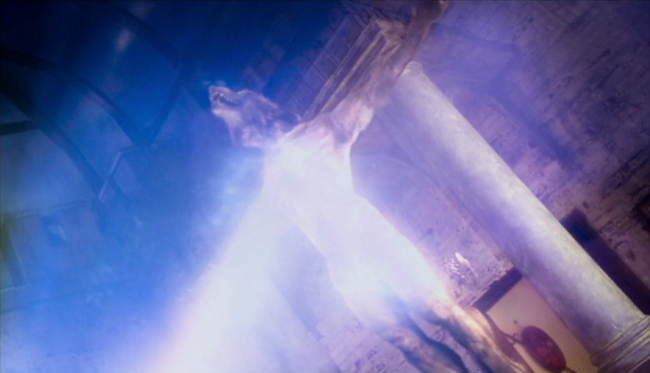
This follows after an image of the werewolf being crucified and the episode follows the Ninth Doctor's season and its prominent "Bad Wolf" thread. Since the "Bad Wolf" signs were shown without context, the emphasis was more on an implacable and strange moral force than on anything the Doctor had actually done, forcing the viewer to focus more on the motivations of that condemnation.

I often feel the series since its 2005 revival has been more of a reflection on the classic series than a continuation of it. Certainly the Doctor's moral ambiguity had been an issue before, particularly in the Sixth and Seventh Doctor eras. But through Davies I think we can see how a kid who feels different might have found comfort in the Doctor being friendly with monsters and also in the Doctor's position as a hero on the series who comfortably and deliberately makes choices that would be considered wrong by the prevailing morality. Davies injects a sense of vulnerability in this, that feeling of unprovoked betrayed when you've been palling around with Queen Victoria and she all of a sudden turns on you for doing something you thought was completely innocent and even now you can't understand why she thinks it's wrong. Since the Doctor does feel guilty about something, it makes sense if he might come away from an experience like that wondering if there's something fundamentally bad about himself he's not equipped to address.

I also love "Tooth and Claw"'s setting in that nice big old manor house which is apparently the origin of Torchwood. And it's always a joy seeing Tennant again.