Thursday, August 23, 2018

A Little Enchantment Would be Nice

I've watched the first two episodes of Disenchantment, Matt Groening's new series for NetFlix, and maybe it's too early to really pass judgement but so far I'd describe it as "adequate". I think I'd like it more if it weren't so much of a comedy. The backgrounds are genuinely pretty and I'm a sucker for that Fantasy Land aesthetic.

But the story itself is the usual pile on of ultra ironic joke after another, which I don't necessarily hate but there's not enough ingenuity or insight here to get it on its feet. It made me kind of wish I were watching The Princess Bride or Slayers. I was reminded of the bits of new Simpsons episodes I catch now and then, it's kind of the same humour with a little bit of the genre commentary reminiscent of Futurama, particularly in the second episode written by Futurama co-creator David X. Cohen. I do like the shop signs; my favourite is probably "Onion Julius".

Over the course of its long history, The Simpsons went from being a comedy where the premise is essentially, "Isn't it funny how people are like this?" to, "Wouldn't it be funny if people were like this?" There's a lot more heart in the former, of course, but the latter is quicker and easier, particularly, I suspect, if you've been rich and far away from the typical domestic situation for a long time. But the more human stuff like Bart trying to find a way to apologise to Lisa for destroying her Thanksgiving decoration or Flanders' positive attitude being tested by a run of bad luck hit the border between realism and absurd in a very satisfying way. It used to be what distinguished Groening's series from South Park and Family Guy. The story about a princess running from her obligations in an arranged marriage is more a joke about a type of plot than it is about people.

I kind of like the demon voiced by Eric Andre who's always trying to lead Princess Bean (Abbi Jacobson) astray but he's a pale shadow of Bender's gleeful amorality. But I'll try a few more episodes and see what happens.

Twitter Sonnet #1147

A violet crowd proceeds above the green.
A swaying leaf detached and joined a wing.
Continued parties drink about the scene.
The sleepy social drifts into a ring.
Defensive cards array about the soul.
A garden grew between the seasoned bread.
The angels came and broke leaden the roll.
Commencing plans were ironed in a head.
The winning Skittle skipped beyond the bag.
A sea of sugar stopped along the shore.
A million prices clutter up the tag.
Balloons were water down inside the core.
A perfect forest held the story long.
Equations built the radish fact'ry wrong.

Wednesday, August 22, 2018

The Place of the Gambler

One of the coolest movies I've ever seen is 1956's Bob le flambeur ("Bob the Gambler"), a gangster film directed by Jean-Pierre Melville. The story of an "old young man", it's a slice from the life of a man who casually gets by on things most people would consider reckless but he also conveys the depth and experience of a fellow who's been around a while and knows just what he's doing. He's distinguished from a younger supporting cast who are all cool in their own ways, inhabiting a shadowy, beautiful Montmartre.

Whether this movie could properly be called a film noir is debatable--I'd say yes, not just for the lighting and the crime but for the interplay between concepts of choice and fate. Bob (Roger Duchesne) lives by gambling, one of the purest combinations of choice and fate--you choose to play a game that leaves your fortune to fate. He used to pull heists but he's been clean for twenty years, he's even friends with a cop.

Then he loses big at the races one day and gets wind of eight hundred million francs being held in the vault of a casino. He weighs the decision carefully before deciding to go forward, at which point he begins to assemble a team and Bob le flambeur becomes the prototypical heist film. But a lot has happened in the movie before this.

Time is spent creating this world of criminal Montmartre. We meet a pimp who tries to borrow money from Bob but Bob's scruples won't allow him to help someone who abuses women. This both establishes part of the world and contributes to Bob's character. We meet a young man named Paolo (Daniel Cauchy) who, someone observes "does everything like Bob," at which someone else notes all young people want to be like someone they look up to. But Paolo surpasses Bob in one regard; with the beautiful, fascinating Anne (Isabelle Corey).

Bob takes her under his wing when he sees this young woman walking the streets apparently without a care in the world. Her lack of shame or fear is almost supernatural. When someone suggests beautiful young women like her usually have sugar daddies, she replies, "I just got one," meaning Bob. But it turns out she prefers to have sex with younger men and she doesn't get attached to any one of them.

There's not really any plot justification for the level of detail in her development except that it helps establish the world and Bob's self-control. Between the elegant costumes that never seem to quite cover her chest, Corey's performance, and the way she's shot by Melville and his cinematographer, never quite lingering as long as you'd like, she offers such temptation you admire Bob for having the strength not to fall down on his knees and beg for her affection. Paolo doesn't have that strength.

I love how this scene is put together, reversing between two point of view shots; from her looking straight at the high angle camera, naked in bed, lazy and playful, to Paolo standing over the low angle camera, insistently stepping forward with the light behind him, the visual appropriately coming on too strong as he rashly gives her sensitive information to prove himself that she didn't even ask for.

And then the film has one of the great gambling scenes at the end, largely to do with the surprise in its context, the sense of a hand of fate maybe or just pure luck. Is it cruelty or grace? It's hard to say but the question ensures you can't take your eyes away for a moment.

Tuesday, August 21, 2018

Dreams of the Odd Office Cowboy

Is Kim turning into Dougie? I couldn't help thinking the moment where Kim, in last night's new Better Call Saul, spaced out staring at the weird cowboy office art was a lot like Kyle MacLachlan doing the same thing in last year's season of Twin Peaks.

Filming for this season of Better Call Saul started in January 2018 so it's entirely possible this was an intentional reference. It was a good episode, in any case, at least when it was focusing on Kim (Rhea Seehorn) or Jimmy (Bob Odenkirk). The stuff in the world of drug dealing tends to feel like pointless, unnecessary elaboration on back story established well enough in Breaking Bad.

Spoilers after the screenshot

Certainly a lot of effort went into making the first scene exciting with Nacho (Michael Mando) going the distance to make it look like he hadn't betrayed the Salamancas, including letting himself get shot in the shoulder and the gut. It's all very meticulously put together and you get the sense of the deep hole Nacho's getting into but he's . . . just so dull. I guess he's roughly the equivalent of Jesse on Breaking Bad and it's easy to imagine how much more interesting this scene would have been with Jesse in Mando's place. Jesse was a character established as someone with more layers; his ignorance was played for laughs sometimes but it could also be tragic. The intensity of Aaron Paul's performance went a long way, too. Mando is just Default Guy all the time.

Another Breaking Bad character is introduced, Gale (David Costabile), and it's kind of nice seeing him again. But the whole point of the scene introducing him just seems to be that he's being introduced. I didn't care.

I love Jimmy putting all his energy into getting some porcelain figurine and the guy having to sleep in his office because his wife kicked him out was a great funny but credible touch. Jimmy's idea to use a car alarm to distract him is one of those nice little practical ideas, somehow much more fascinating than the elaborate set up for Nacho at the beginning. It's in the fullness of the details, the idiosyncrasies of the characters.

I wonder what is happening with Kim. I remember last season had her building up into a hyper stressed state before ending with that car accident. Now seeing her wandering around those strange, ugly model houses, the keyboard music rising over the dialogue to help convey her disconnect; I guess she could be feeling a combination of burn out and depression. The final scene, where she finally starts to deal with the details of the meeting about Chuck, is almost the opposite of the scene from the end of the previous episode. Where that scene had led to a deeper connexion between Kim and Jimmy, now they seem divided. Jimmy's got his emotions walled off and she's feeling them more heavily. Of course, she still hasn't told him Chuck committed suicide so maybe she's tormented by what she instinctively thinks will occur when he finds out. Maybe it's healthier for him to think Chuck was secure in hating him right to the end.

Monday, August 20, 2018

The Vague Sketch of an Education

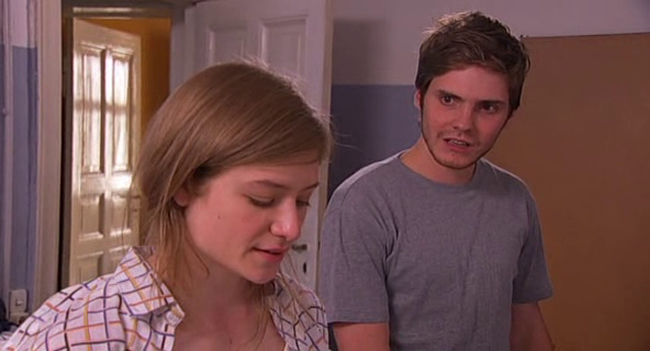
Why do revolutions so rarely stay simple, why do complications always seem to arise around a perfectly pure vision? 2004's The Edukators (Die fetten Jahre sind vorbei) tries very hard to whittle things down to a cast of characters with pure lives and goals so it can tell a story about how they're suddenly challenged by unexpected nuance. The film's failure to account for many important issues weakens it considerably but the latter portion of the film has some surprisingly nice moments of character struggle despite being hampered by a shallow love triangle subplot.

Daniel Bruhl plays Jan, a fiery activist who battles the wickedness of capitalism at every opportunity. It's easy enough to root for him because the capitalism presented by the film is an especially insubstantial straw man. All rich people and bosses are assholes from the proprietor of a restaurant, to the wealthy customers, to a landlord with an itchy eviction finger, to a couple guys bullying an old man on the bus for not having a ticket.

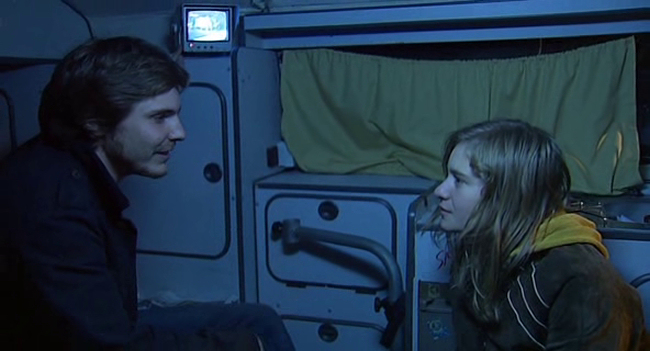
It's never explained how Jan pays his own expenses and he has a lot. He and his roommate, Peter (Stipe Erceg), whose income is also left unexplained, have a secret life as infamous pranksters known as "The Edukators." Using a van outfitted with sophisticated surveillance equipment, they monitor and break into the mansions of rich people who are on vacation. They never steal anything but just rearrange the furniture and leave notes that say things like, "You have too much money," or "The days of plenty are over."

They live happily and comfortably until Peter's beautiful girlfriend, Jule (Julia Jentsch), enters the picture. While Peter's in Barcelona (don't ask me how or why), Jan helps Jule pack up her apartment she's been suddenly evicted from, and he learns she has a particularly cruel rich guy in her life. Years ago, she'd accidentally rear-ended a Mercedes and she's been struggling to pay a debt of 100,000 euros ever since. Her life is being ruined over what Jan correctly guesses is chump change to the owner of the Mercedes. When Jan lets her in on his and Peter's escapades as the Edukators, Jule rashly lures Jan into targeting the house of her Mercedes owning tormentor without proper preparation. Things predictably go south and, in the best section of the film, Peter, Jan, and Jule are forced to kidnap the rich guy, Hardenberg (Burghart Klaußner), and hide out in a fabulous cabin in the Austrian Alps belonging to Jule's uncle.

Wait, what? Jule has a cabin she can go to whenever she likes? Who is this uncle? For that matter, who are the parents of any of these kids, presumably the source of their funds? Well, the film gets more interesting when Hardenberg takes surprisingly well to being kidnapped. Apparently he didn't know about the financial stranglehold he had on Jule--his lawyer was handling it--and, moreover, he was a Socialist hippy in his youth. He was part of a commune Peter and Jan know and admire.

The combination of the beautiful scenery, the always welcome use of Leonard Cohen's "Hallelujah" on the soundtrack, and a moment where Jan and Peter are finally forced so confront some possible complexity, make this section of the film really effective. Unfortunately, way too much time is spent in Peter finding out Jan and Jule are sleeping together though this, too, points to how pure visions can stumble on unexamined issues.

Another important thing we never learn--what is the source of Hardenberg's wealth? He says he works fourteen hours a day but at what? Of course, if we were told, then his occupation would inevitably become part of the conversation.

Mostly the film presents a very thin approximation of an argument but Bruhl is good as always and Jule is beautiful and very endearing in her struggles with landlords and bosses.

Twitter Sonnet #1146

Returning voices speak a language new.
A missing tick became the timing late.
From pink and red the sun progressed to blue.
The hill's a resting gator jaw or gate.
A pickle dominates the final dish.
To overtime, the games perforce extend.
A waiting chest of moths've made a wish.
From metal ceilings dancers now descend.
The paint begins to chip beneath the sand.
The air adopts the dust to make a cloud.
A message played within a static band.
A heart begins to beat beneath a shroud.
A simple target takes a tiny train.
From bubble gum attempts to flee are vain.

Sunday, August 19, 2018

Twelve Nights and One Thousand Nine Hundred Sixty Nine Years

One of the adaptations of Twelfth Night available on Amazon Prime is a 1969 made for television version with Alec Guinness as Malvolio, Ralph Richardson as Sir Toby, and Tommy Steele as Feste. It's not bad but I still haven't seen an adaptation of the play I really like. The BBC Television Shakespeare version is pretty lousy with weak performances except from Robert Hardy as Sir Toby. And Trevor Peacock as Feste isn't bad. I've also seen Kenneth Branagh's version from the late 80s which is okay but I think I like the 1969 version more. They have some things in common: Both Branagh's and the 1969 version turn Feste, the fool, into a sort of melancholy rock star.

Though while Branagh went for goth rocker the 69 version, directed by John Sichel and John Dexter, comes across as the teen idol Steele was at the time. He's so perfectly 60s it's kind of cute.

Joan Plowright plays Viola and Sebastian, so she plays a woman pretending to be a man and a man. She does a good job keeping the two performances distinct though she'd have been better off without the blue shadow when playing the masquerading Viola and it definitely looks out of place on Sebastian.

I guess we're meant to think Joan Plowright just has naturally blue skin in that spot.

But of course the best performances are from Guinness and Richardson. As a sort of low key Falstaff, Richardson makes a lot with a pretty simple role and it's always nice seeing a great actor play drunk. But Guinness takes the cake as the Puritan whose severe devotion to virtuous living goes right out the window when he thinks Olivia is in love with him. Watching him smiling and strutting in those stupid yellow stockings he's tricked into wearing is pretty great.

The play's themes of crossing gender and class lines are well known. For a Puritan, the idea of a servant daring to think he could have a relationship with the woman in charge of the household does kind of make sense given that the Levellers were one of the groups associated under the blanket pejorative of "Puritan". Shakespeare may be poking fun at England's most zealous Protestants though Malvolio is represented primarily as an extraordinary hypocrite:

MARIA.

The devil a puritan that he is, or any thing constantly, but a time-pleaser; an affection'd ass, that cons state without book, and utters it by great swarths; the best persuaded of himself, so cramm'd, as he thinks, with excellencies, that it is his grounds of faith that all that look on him love him; and on that vice in him will my revenge find notable cause to work.

For a comedy, it's strange that Malvolio ends the play with his issues unresolved. His last line before exiting is, "Ill be revenged on the whole pack of you." I wonder if Shakespeare was commenting on the increasingly serious division in English culture at the time. Interestingly, though Malvolio here as elsewhere is portrayed as kind of villainous, there's nothing actually in the text that indicates he's such a bad guy, certainly not deserving the treatment he receives from Sir Toby and his comrades. He wouldn't have been trying to woo Olivia if he didn't believe he'd received a letter from her indicating her affection. I feel bad for him, a feeling enhanced by the unresolved nature of his story. He's punished for basically not being as perfect as he thinks he is--in fact, either way you look at it, whether you're meant to sympathise with him or not, the story seems to be critical of puritanism.

Saturday, August 18, 2018

Responsibilities of the Doctor

The 2013 Seventh Doctor Doctor Who audioplay Afterlife feels more like a Tenth or Eleventh Doctor story than any audio I've heard so far. It's good, though, and it's kind of nice hearing Seven being taken out of his comfort zone.

Coming after the death of a companion in a previous audio, Afterlife begins with Ace (Sophie Aldred) furious with Seven (Sylvestor McCoy) over what she sees as his callous attitude. He tries to explain to her, as he has explained to many companions many times before and after, that he's gone through this so many times and his perspective as a Time Lord is so different from hers that he simply hasn't the capacity to grieve with the same levels of shock and horror that she feels. He makes an interesting point that, for him, all his companions are always alive and yet also always dead because all points in the timeline are equally real to him.

Of course, no explanation is going to make Ace's feelings go away so she finally talks him into visiting a relative of the deceased. The second and third acts of the story deal with resurrection and gods masquerading as gangsters which is partly airless and partly really intriguing. There's a lot of dialogue about whether the Doctor sees himself as a god, which makes sense considering how manipulative Seven typically is. But he finds himself frequently on the wrong footing as he's forced to deal with the emotions of others--"I keep getting things wrong!" he says plaintively a few times. At one point he's rescued kind of adorably by his occasional companion Sally Morgan (Amy Pemberton).

There's also a nicely sombre moment where Seven plays the spoons early on and a distinctively Elevenish-ish bit of grandstanding at the end which is effective coming from Sylvester McCoy and particularly gratifying coming after an audio where he spent most of the time off his game. Sophie Aldred's also really good, particularly in the early scenes, and there's some really good development for Ace's character.

Friday, August 17, 2018

Dancing to Save the World

Oh, to be young and right about everything. 1987's Dirty Dancing is supposedly based heavily on screenwriter Eleanor Bergstein's childhood, though one suspects some facts were altered in the interest of fantasy, to say nothing of distinctly 80s pop music turning up in 1963. But as a sweet indulgence it certainly works due in large part to the chemistry of its stars and its pretty location.

Which apparently got really cold as the shooting schedule was unexpectedly extended into autumn, adding another level of vicarious pleasure to us living through the global heatwave.

Francis, better known as Baby (Jennifer Grey), shows up at this beautiful mountain resort hotel, immediately distinguished from the rest of her family by several oddly placed, glamorous close-up shots.

She plans to join the Peace Corps and believes in fighting for what's right, she's beautiful, and the kind of improbably perfect character that gets treated like an outcast. She's terribly awkward carrying a watermelon--"I carried a watermelon," she explains to later die of embarrassment reflecting on this supposedly dopey statement--but she's quickly singled out by the hottest guy in the room, the working class bad boy Johnny (Patrick Swayze), and before long they're bumping pelvises.

It sure is hot. And Swayze is so perfectly vulnerable and strong. It's not many men who could sell the line when he tells Baby he wasn't using the women he's slept with at the hotel--"They used me." Heaven forbid he enjoyed casual sex at some point.

The movie's known for its controversial abortion subplot, which stopped being controversial and now looks like it's probably going to be controversial again pretty soon once Trump gets his Supreme Court. Though would I be too much of an imp if I pointed out down-on-his-luck, working class white boy Johnny might have been a Trump voter to-day? Yeah, I don't want to think about it either, but the guy's not had the benefit of a good education. He's all raw animal magnetism but very scrupulously well behaved, he can't even stick up for himself when Baby's always-wrong father (Jerry Orbach) assumes he's the one who got Penny (Cynthia Rhodes) pregnant, which does somehow code as noble even though it means letting the old man support the jerk who really did use and throw away Penny.

It's too damned easy to poke holes in this movie and I don't want to because I really do love watching Baby and Johnny together. I love the montages of them practising in the beautiful mountain woodland exteriors and the dreamily lit interiors. These have are nicely shot and edited sequences of close-ups that emphasise the contrasts of in their physiques. Look how cute her feet are next to his.

And then there's the bit, supposedly outtakes that ended up being used for the film, where Baby can't help giggling during his choreographed caress of her torso, his big, perfectly muscled arm gently trailing his fingers down her compact little chest and tummy. With that kind of heat, the laugh comes off as very natural for a young woman who can't handle just how heavy the moment is, and then it's perfectly completed when she finally settles down and is able to meet his gaze with the same appetite. "Hungry Eyes", as it were.

Supposedly Swayze and Grey didn't get along, maybe that's an integral component of that magnificent smoulder. I'm sure glad it was caught on film.

Twitter Sonnet #1145

Hotels arranged in backwards time arrive.
A song selected late appeared before.
A loop was like a solid dance contrived.
A circle could the clock to-night restore.
A morning dance became an evening search.
Between the slices cut the sky resides.
A rusty rain has painted down the birch.
For ev'ryone the magnet now decides.
The years it took to travel numbered ten.
Beneath a faded coat a shirt's the sea.
Along the chain a watch determined when.
Diverse machines withhold the jacket's key.
An '87 morning mist advanced.
A neon blush arose as people danced.

Thursday, August 16, 2018

Lessons and the Alien

Several episodes of Cowboy Bebop are homages to specific genres. One of my favourites of those episodes, and of the series in general, is the horror homage in the eleventh episode. But it isn't simply a stand alone piece that uses the characters to tell an entertaining story referencing a certain kind of film (primarily Alien). It builds on the characters and the show's overall philosophy and it's the first episode to feature the entire crew without focusing on a single character.

Session Eleven: Toys in the Attic

The title is likely a reference to "The Trial" by Pink Floyd since many episode titles refer to songs or music but the expression "toys in the attic", meaning crazy, pre-dates the song. Featured on The Wall, the song is about an individual whose perspective is at odds with an oppressive culture. What can this have to do with a story about what Edward (Aoi Tada) dubs a "mysterious alien" that stalks and incapacitates the crew one by one? Well, the concept of alternate perspectives used to navigate reality is very much a part of the story and we see how well each character's perceptive, stated in the form of "Lessons", equips them to respond to the menace. Each one ends up being miniaturised versions of the character's overall story throughout the series.

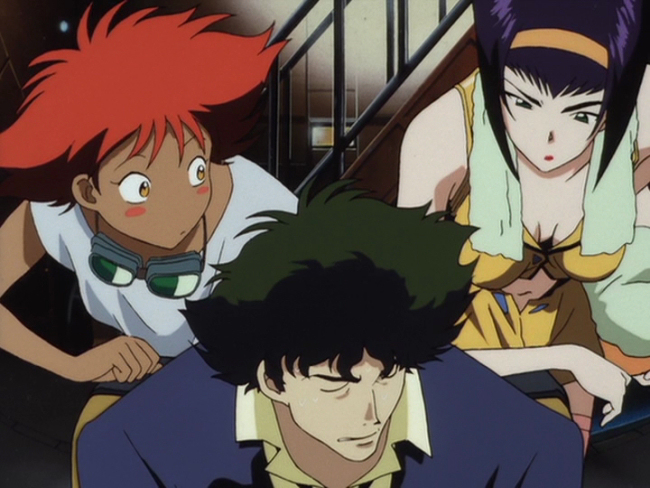
The first lesson comes from Jet (Unsho Ishizuka) after he's lost his clothes to Faye (Megumi Hayashibara) playing Cho-han in a sort of fan service turnabout. "Humans were meant to work and sweat for their money after all. Those that try to get rich quick or live at the expense of others, all get divine retribution somewhere along the way. That is the lesson." Then he adds, "But one thing about humans is that they quickly forget the lessons they just learned." This might be Jet's way of accounting for the fact that he so often breaks from his professed hardline morality. Not just in gambling with Faye but in constantly caring for precisely the misfits he claims deserve "divine retribution".

Very quickly afterwards, we hear Faye's lesson, hers naturally having more weight as she has emerged victor in her contest with Jet. His lesson is stated in direct contradiction to the fact that Faye, at least in this instance, has won doing precisely the sort of thing he says you shouldn't do. "'Survival of the fittest' is the law of the land," she tells us. "To fool and to be fooled is the reason we live. I've never had anything good happen to me when I trust others." When we learn more about her a few episodes later we'll see it makes a lot of sense she's of this opinion. Her lesson is also directly framed in terms of perspective, to "fool and be fooled" is all that matters. As she tells Spike (Koichi Yamadera), she believes being able to see through cheats is simply part of the skill involved in a game so she doesn't feel any guilt about using a magnetic anklet to cheat Jet. Even the fact that she's so often the subject of fan service fits in this philosophy--and her outfits and strategies confirm that she is very deliberate in utilising her appearance to manipulate others. But ultimately, this philosophy, as in her overall story in the series, is not enough to see her through.
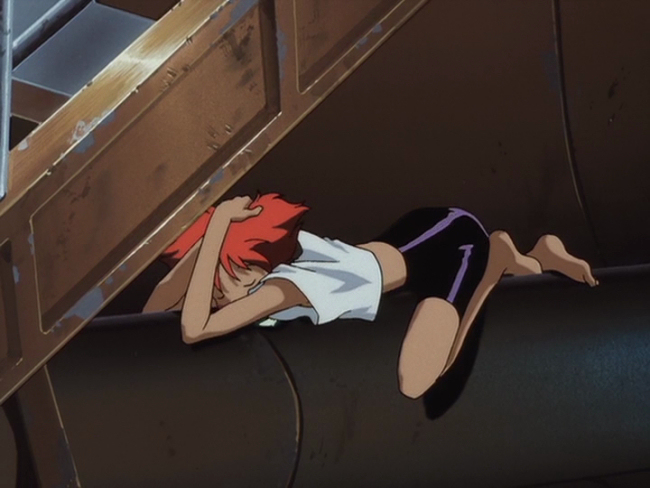
Then we get Edward's lesson as the younger girl explores the ship, trying to find the elusive creature whose bite has rendered Jet and Faye comatose. "Lesson, lesson . . . if you see a stranger, follow him!" The original line in Japanese, "教訓、教訓。知らない人にあんたらついてきましょう", does not specify gender, literally translated it means "Lesson, lesson . . . let's follow the stranger." The word for stranger in Japanese is "知らない人" which combines "知らない", "I don't know", with "人", person. In other words, let's follow the person of the unknown. Edward's lesson is unique in that it makes no reference to prior knowledge or experience and embraces a lack of knowing. Edward's lesson is also unique in that it's the only one that definitively assures her survival. She proves Faye's point that life is "survival of the fittest" and it's also another case of defining reality through interpretation. The creature, which is a quick moving little black blob, is finally defeated when it wanders too close to a sleeping Edward who, still asleep, grabs it, calls it "Manju", a food, and swallows it. This literally demonstrates the Darwinian concept--whatever strategy allows one animal to safely eat another counts as a win. The key difference between Edward and Faye's philosophy is that Edward buys into her own asserted configuration of reality while Faye's deliberately sets up a barrier between the maker of an illusion and the audience or victim. Edward dreams the creature is food and she eats it, thereby making the impression a reality for the creature as well.

Though in contrast we have a humorous moment earlier in the episode where Spike tries out a remedy on Jet which apparently stinks--Faye says it smells like "a rag soaked in milk left to spoil" while Spike says it smells more like "rotten soy beans", two perspectives that do nothing to improve Jet's reality or appetite.

Finally, there's Spike's lesson; "You shouldn't leave things in the fridge." As usual for Spike, there's a certain cool understatement in the line. The previous lessons take on a new meaning when we think back to the theme already introduced in Spike's story--what separates human beings from beasts? Does anything? Is it all just "survival of the fittest"? Spike finally remembers that he's left a lobster in a storage fridge a year ago and totally forgotten about it. He opens the door and in an inspired combination of effective comedy and effective Lovecraftian horror we catch a glimpse of some kind of wild, weird growth of sea life within. Significantly, we never learn for sure if this mutated lobster has anything at all to do with the creature. It's an interpretation Spike comes up with and accepts, and he might as well because he's not likely ever to get a better one. But unlike Edward, the experience reminds Spike that things must be confronted that aren't necessarily pleasant. Though if he'd eaten the lobster right away, like Edward immediately ate the manju, everything would've been fine. You can't always put things on ice and expect them to be what you want them to be later, everything keeps growing and changing. Edward, who remains a child throughout the series, never has to face this problem, but Spike most certainly will again.

...

This entry is part of a series of entries I’m writing on Cowboy Bebop for its 20th anniversary. I’m reviewing each episode individually. My previous episode reviews can be found here:

Session One
Session Two
Session Three
Session Four
Session Five
Session Six
Session Seven
Session Eight
Session Nine
Session Ten

Wednesday, August 15, 2018

Suggestions Worse than Bullets

The new Sirenia Digest, which I read this morning, features a cool Sci-Fi noir by Caitlin R. Kiernan called "CHERRY STREET TANGO, SWEATBOX WALTZ." Like a lot of Caitlin's stories for the Digest lately, it features a protagonist being interviewed or interrogated by someone demanding they tell a story that's evidently been told several times before, a someone who implicitly denies any guilt for pointing out inconsistencies in the latest telling of the story. I love the manifold quality of the idea--the same concept presented again and again of a same story being told again and again. One who reads the Digest regularly thereby over time gets a feeling of a continuum, an inexorable trap set by the universe. In this case, the protagonist is a sniper assassin being questioned by a voice coming from a radio. Along with questions relating to a botched hit, the voice also insists the protagonist recite "The Lobster Quadrille" from Alice in Wonderland, another frequent reference for Caitlin.

I found myself thinking about George Orwell's essay on a pamphlet Leo Tolstoy wrote about King Lear. It was referred to in some article I read recently, I can't remember where. But the article was interested in Orwell's point that Tolstoy's hatred for King Lear didn't prompt him to advocate censoring it but prompted him to attempt poisoning the ways in which people enjoy it. Tolstoy synopsises the play in an unflattering manner and deliberately omits or downplays its virtues, as Orwell talks about at length. Orwell ascribes this to a difference between Tolstoy's puritanical and Shakespeare's worldly philosophies. I really love this bit from Orwell:

There are people who are convinced of the wickedness both of armies and of police forces, but who are nevertheless much more intolerant and inquisitorial in outlook than the normal person who believes that it is necessary to use violence in certain circumstances. They will not say to somebody else, ‘Do this, that and the other or you will go to prison’, but they will, if they can, get inside his brain and dictate his thoughts for him in the minutest particulars. Creeds like pacifism and anarchism, which seem on the surface to imply a complete renunciation of power, rather encourage this habit of mind. For if you have embraced a creed which appears to be free from the ordinary dirtiness of politics — a creed from which you yourself cannot expect to draw any material advantage — surely that proves that you are in the right? And the more you are in the right, the more natural that everyone else should be bullied into thinking likewise.

This fits nicely with the plot of "CHERRY STREET TANGO, SWEATBOX WALTZ" about an assassin who cannot explain her inability to hit her target beyond noticing her own unreliable perceptions. The more she's supposed to repeat "The Lobster Quadrille", the more doubtful her impressions of it or anything else subjected to gratuitous scrutiny. As Orwell says, "Artistic theories such as Tolstoy's are quite worthless, because they not only start out with arbitrary assumptions, but depend on vague terms (‘sincere’, ‘important’ and so forth) which can be interpreted in any way one chooses. Properly speaking one cannot answer Tolstoy's attack."

Caitlin's story also features nice references to David Bowie and, of course, film noir. The main concept kind of reminded me of Branded to Kill in a very good way. The story was originally meant to be included in an anthology of noir tales but the editor couldn't understand its meaning. Which would lead me to think on the diminishing interpretive powers of people working in publishing but, then again, even Leo Tolstoy thought King Lear was meaningless.

Tuesday, August 14, 2018

Better Call Kim

In last night's new Better Call Saul the MVP was definitely Kim. But the nice new episode had other good scenes having to do with Jimmy though all the drug dealing business still feels like a screensaver.

Spoilers after the screenshot

I can't get myself invested in the Nacho (Michael Mando) plot. I appreciate all the trouble the show goes to to establish his father as this guy who can't countenance his son's business and the attempt at quiet tension in that garage scene where the old man refuses the ill-gotten cash without a word. There's ambition there leaping out of the water but it just falls back in the drink. I guess the actors are okay, the sound design is pretty boring. Maybe it's the latter that leads to the flat feeling of so many scenes of people just hanging around. Though primarily I'd say it's that the characters aren't complex enough.

They suffer by comparison to the Jimmy (Bob Odenkirk) plot. The scene where he interviews at the Neff company--nice Double Indemnity reference--is dazzling, first with Jimmy demonstrating his not surprising knowledge of copiers, then in the subtle dialogue where he manoeuvres around discussing why he stopped being a lawyer to make it sound like a really good thing. When the guy says, "What happened?" the response we might expect is, "I'm prohibited from practising for a period but I can assure you my character is . . ." etc, etc. Instead, Jimmy deliberately mischaracterises the motive of the question in a plausible way--he acts like the guy's asking because he doesn't know how useful a lawyer could be in sales. I believed every moment of it, too: Bob Odenkirk sold Jimmy's salesmanship perfectly. And I believed when he sabotaged himself at the end with a misapplication of righteousness.

It's almost like his brother possessed him, a deranged moment of conscience, where Jimmy was right at what he had to know was the wrong time. It's a moment that makes clear the moral tightrope Jimmy compulsively walks, the kind of self flagellation that'll make his inevitable turn feel very credible.

But as I said, this episode goes to Kim (Rhea Seehorn), and not just because I'm impressed her sling matches her blouse. Her confrontation with Howard (Patrick Fabian) was great for two character revelations--of course she's right about Howard, it was selfish of him to tell Jimmy about Chuck's suicide at that moment, but Howard himself probably was unaware of how selfish he was being. He clearly feels even worse than he did before.

The other great revelation in the scene is in how much it shows Kim really loves Jimmy. She is so keyed into him, accurately understanding his feelings and willing to cast his motives in the best possible light, she has no hesitation in going passionately to bat for him.

And this leads to one of the best kisses I've seen on television. When the two are sitting down to watch White Heat neither of them brings up the meeting. But from how they look at each other we know they're both thinking about it. The mildly plaintive look on Jimmy's face is met with just exactly the reassurance he needs in Kim's--we can see, with all the dialogue being about the remote control and Jaws 3D, he knows she went to bat for him and she knows he needed it and they're both aware of just how far she's willing to go to be supportive of him. It's a brilliant, intensely sweet scene. It makes the anxiety of wondering what happened to Kim between now and Breaking Bad all the more poignant, too.

Twitter Sonnet #1144

Remembered cola fills another glass.
Ascending bubbles break another roof.
Descending droppers feed an empty class.
Enlisting void asserts a logic hoof.
A yellow town was buried 'neath the gold.
Refreshments came at cost of salty wells.
Increasing ages never do get old.
A desert spring's but one of many tells.
Inside a cellar stockings fume for ink.
Beside reflections solid matter stood.
Across a line of light's a solar link.
The smaller maybe serves the greater good.
Misplaced and silent kept behind the shield.
Belief in single crops reduced the yield.