Wednesday, February 19, 2014

He's Effortlessly the Same All Year


Being a religious martyr can be rather wearying at times it seems. Paul Scofield plays Sir Thomas More--Saint Thomas More to Roman Catholics--in the 1966 version of A Man for All Seasons as a fellow glumly bearing the heresy of his liege with prudent silence. For the most part this is a morally very simple film, if strikingly old fashioned. Entertaining but not amazing.

Fred Zinnemann directed the film--Zinnemann also directed the classic Western High Noon starring Gary Cooper as a small town sheriff who suddenly finds he has to face a gang of thugs alone because everyone else in town is too much of a coward. A Man for All Seasons is not so dissimilar. In this case, More is the only figure in Henry VIII's court who won't support the annulment of the King's marriage to Catherine of Aragon. The movie does a decent job of making this seem like a really heroic thing to do. It's not defending a small western town from death and mayhem but More has a reputation for fairness among the people and Scofield plays him as absolutely certain about what's right when everyone else around him is conflicted and scheming.


For this reason, Orson Welles crushes the whole rest of the movie with just one scene as Cardinal Wolsey. Wolsey fears the civil war that may result in the absence of a male heir--this wasn't long after The Wars of the Roses, after all--but, as a man of the church, the idea of further violating orthodoxy regarding marriage bothers his conscience. Unlike anyone else in the movie, Wolsey has internal conflict and all the nuance of it comes through in Welles' performance, making Scofield as More seem feeble-minded in comparison.


The rest of the movie is mostly court intrigue junk food as Thomas Cromwell (Leo McKern) negotiates backroom politics to have More executed and More continually outmanoeuvres. Scofield has some nice lines about law:

WILLIAM ROPER: So, now you give the Devil the benefit of law!

THOMAS MORE: Yes! What would you do? Cut a great road through the law to get after the Devil?

WILLIAM ROPER: Yes, I'd cut down every law in England to do that!

THOMAS MORE: Oh? And when the last law was down, and the Devil turned 'round on you, where would you hide, Roper, the laws all being flat? This country is planted thick with laws, from coast to coast, Man's laws, not God's! And if you cut them down, and you're just the man to do it, do you really think you could stand upright in the winds that would blow then? Yes, I'd give the Devil benefit of law, for my own safety's sake!


Wendy Hiller gives a nice performance in the relatively small role as Alice More, wife of Thomas. Robert Shaw chews scenery as Henry VIII and a very, very young John Hurt plays Richard Rich.


This young face has never seen a Dalek much less thought of killing them all.

He's almost conflicted, too, wanting to be employed by More because he respects him but wanting the glory of a prominent court position more. Hurt suggests a lot in his few scenes. With more of him and Welles this might have been a very interesting movie.

Tuesday, February 18, 2014

Empty Carbs


Blogging from school to-day because I have a dentist appointment down the street and I didn't want to go home first. I just came from the health class with the obsessive micro-manager teacher (the one who's having the students report to her individually every morning with the first three letters of their last names). Which isn't such a bad quality sometimes--to-day we had to do group work and one of the first things about group I hate (before diving into all the other things about it I hate) is the awkward moments of students shuffling around, finding places to sit and people to sit with. This teacher not only told us who was going to be in what group but where precisely in the room each group was meant to meet. She had a colour coordinated chart. I may have my differences with her but I bet if she were in charge of a country the trains would run on time. Okay, that was low.

The group work was to discuss "values" we'd been assigned. Each of the nine groups of students had a value--my group had "gratitude". Each day for the next few weeks, a different group is going to present their value to the rest of the class. To-day we heard about courtesy.

"Does this class feel like rehab to you?" I asked someone in my group.

"Well, at least we're learning stuff we'll actually use in life," my fellow Gratitude group member responded. "Instead of things we'll never use."

I thought then about how much all the other students seem actually to be enjoying the class. To-day we were also told for the millionth time that soda is unhealthy. I haven't had a soda in at least nine years. This is the first time I've felt the urge to go buy a Coke.

Gods save us from useful things.

Twitter Sonnet #597

Can one tell of winter without a bear?
Snowflake helicopter delayed the rose.
Tiny grass helmets concealed the cold pear.
Hieroglyphs run down her green panty hose.
Vapour cemetery monkeys stand guard.
Desire is a blank DVD spool.
The hazy blue glassworks drew the dead card.
The brand new robot takes up its first tool.
Taco shops slip from the slick surf board plate.
Orders came from octaves beyond Palance.
Jack sings songs of Contempt and gangster weight.
Contagions gestating pay no balance.
Drain libraries catalogue no stopper.
Stethoscope sketchbooks strip the green copper.

Monday, February 17, 2014

The Bird Network


I dreamt last night Ray Bradbury visited me--Bradbury from the mid 1980s or so, older but before he'd lost some of his powers of speech. He seemed very enthusiastic about everything we talked about. I remember he told me Neon Genesis Evangelion reminded him of a writer, I can't remember the name, it was something like "Zweiter Hem".

To-day I had to visit my cable company, Time Warner, to change my billing information because I'd recently gotten a new credit card. No, this isn't something you can do through the web site and I know better by now than to try and work with the clowns operating the phones. I'm not the only one who's learnt the lesson--it's for that reason I knew I was going to have to sacrifice a great part of the day waiting with a bunch of other people in the Time Warner shop in a nearby shopping centre. At least they don't make people wait in a queue--you take a number and wait for it to be called. I sat and read a chapter from the Nibelungenlied.

I had lunch first and, since I don't live near ducks anymore, I stopped and gave some stale bread to some sea gulls. Unlike ducks, sea gulls are good at catching bread in mid air.


I stopped in another shopping centre called Bird Rock. I walked a little ways down the street which ended at a cliff and saw why the shopping centre is called Bird Rock:


This seems to be where all the pelicans hang out. Lines of pelicans also flew past close to the cliff at intervals no longer than fifteen seconds.


blog.jpg">

And here's a grasshopper:


blog.jpg">

Sunday, February 16, 2014

The Nuclear Salon


When one thinks of Clara Wieck, Robert Schumann, or Johannes Brahms perhaps one doesn't immediately think of eight rowdy children, a much put upon housemaid, and a chicken. 1947's Song of Love aimed to fix that. No suicide attempts, love affairs, demonic hallucinations, or vigorous debates on music composition philosophy in the vehemently divided musical culture in Europe of the 19th century. No, Song of Love reassures the audience that these great figures for the most part had regular domestic lives and professional lives composed of important social introductions and letters. But it is worth watching the film for Katharine Hepburn as Clara Wieck--Hepburn trained hard at the piano to portray the famous nineteenth century pianist and it shows.


But one can see the failure of this movie in the same clip--the housemaid absurdly insisting Clara cut the concert short so she can feed the baby.

Paul Henreid and Robert Walker as Robert Schumann and Johannes Brahms respectively aren't bad but no-where near as interesting as Hepburn. Or as interesting as Henry Daniell in the more minor role of Franz Liszt.


We see how he befriends the young Schumann and helps both the young composer's career and to decide a court battle in favour of Robert and Clara so that they can be married despite the objections of Clara's father. But essentially no mention is made of the fact that Liszt and Schumann ended up on two sides of a bitter argument in Europe throughout the nineteenth century about how to compose music. The only time it's in any way alluded to is a scene where Liszt reinterprets one of Schumann's works on piano to Clara's disdain--though Robert expresses only polite interest in Franz's creative choices. Clara amusingly calls Franz's version of "Dedication" a "Dedication to Pyrotechnics" as his variation is primarily distinguished by busy interpolations to the melody.


Then Clara takes the piano and passive aggressively plays the piece in its original form, telling Franz as she does so about the power of simple love. When she leaves, a friend of Franz's insists Clara insulted him. He smiles and says she did far worse--"She described me." So conflict over, I guess.

Saturday, February 15, 2014

The Clean Trail


It's such a shame so many filmmakers in the late 50s and early 60s had to overdevelop consciences. That's the main problem with John Ford's 1964 film Cheyenne Autumn. Or maybe it was simply the folly of using a morally muddy historical event for a feature length apology for the way Native Americans had traditionally been portrayed in American cinema. It's frequently a beautiful film to look at and a brief subplot involving James Stewart as Wyatt Earp is entertaining, though out of place. Ford fails in creating the morally sharp sermon he set out to make--achieving instead a simplistic tale far inferior to the metaphysical battle between America's two hearts in The Man Who Shot Liberty Valance or the frightening, human ambiguity of The Searchers.

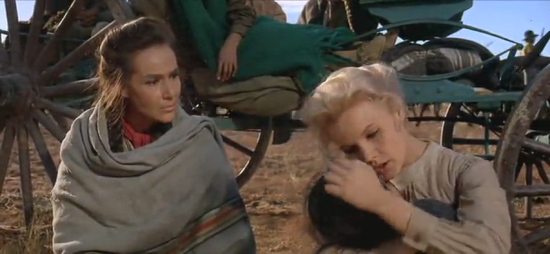
Part of the problem is that in attempting to humanise the Cheyenne Ford felt nonetheless compelled to cast non-north Native American actors in the lead Native American roles--a broad and ineffective Ricardo Montalban as one of the chiefs, Little Wolf, and Dolores del Rio cast somewhat cheekily in the role of a Cheyenne woman named Spanish Woman.


Ford also felt it necessary to include a blonde Quaker woman (Carroll Baker) to provide the audience with a point of empathy among the Cheyenne. The movie tells the story of the Northern Cheyenne Exodus, an incident in 1877 when a few hundred Cheyenne decided to leave their reservation and return to their ancestral homeland near Yellowstone.


It's an ensemble film but the closest character to a central protagonist is Captain Thomas Archer played by Richard Widmark who, in this context, made me realise how much he sounds like John Wayne. But he does a great job in his own right, the steely empathetic person Ford needed for the role. He feels bad for the starving Cheyenne but is also willing to shoot back if they shoot at him.

John Wayne's son Patrick plays Archer's Lieutenant Scott, still kind of a pipsqueak despite being twenty five at this point. Maybe it was hard carving out a niche of masculinity with his father in the house throwing his gut around.


He leads a charge against Cheyenne at one point in the film in one of the many brilliantly choreographed sequences. In regards to choreography and composition--including in his signature location of Monument Valley--Ford is in top form.


The episode with Stewart as Wyatt Earp is also entertaining, as I said, though Ford may have been better off creating his own character rather than trying to tie Stewart's part to an historical figure. Stewart's character in The Man Who Shot Liberty Valance, the man from the East trying to tame the West with the letter and spirit of the law, embodied so much more by being Ford's fantasy. But Earp has an amusing plot in Cheyenne Autumn about a prostitute acquaintance of his.

The other great supporting performance is Edward G. Robinson as Secretary of the Interior Carl Schurz though his presence also drags the film down in two ways. For one, I was pleased with how little Ford relied on soundstages for outdoor scenes, unlike in his later film 7 Women which was severely diminished by being shot almost entirely indoors. But the one crucial scene which features Robinson outdoors features a distracting rear projection.


But Robinson was seventy years old at this point so I suspect there may have been health issues related to his inability to go on location. The more disappointing aspect of his character is that there's no mention of the fact that the historical Carl Schurz was born and educated in Germany and fought in the German Revolution. Part of the reason this is so disappointing is that Karl Malden plays Captain Oscar Wessels, an officer in the American army who is shown to be personally responsible for the worst of the hardships the Cheyenne endure. He's portrayed as a stereotype of a Nazi soldier, having sympathy at first for the Native Americans but totally reversing his feelings to fall in line with orders he's given to restrain the Cheyenne. Schurz in the film is shown as a great advocate for Native American civil rights.


But here we are in the pointless pursuit of apportioning the just quantities of good and evil in different races and peoples. One can see Ford was probably using the German as a place to divert the racial hatred audiences might have customarily spent on the Native Americans. The solution to Ford's problem was simpler than that--it's a shame he didn't see it; just write all the characters as people.

Twitter Sonnet #596

Tetherball pendulums licked the lightweight.
Silver bricks held aloft stun outer space.
Sugared question marks make ready fish bait.
Granite oil carves a boiling face.
Blue banks fire from the busy sea lane.
Airbags quickly choke the emergency.
Wire clouds keep a powerless airplane.
Yellow Lego knobs bespeak vacancy.
Anakin confused critic Isolde's draught.
Lovely murk falls on television hill.
Oingo Boingo echoes in the lift shaft.
A breakfast ballet blocks an evening will.
Platinum fire flares from molasses.
The doughnut compass points to Colossus.

Friday, February 14, 2014

Under a Yolk Sky


I'll say it again--Mexico is not doused in a sulphurous haze. The sky is blue during the day, just like everywhere else on Earth (aside from Beijing). You wouldn't know it from modern movies and television. I think it started with Steven Soderbergh's Traffic where at least he was using the colour filters to help audiences quickly perceive where a scene is set and to comment on the unjust division between rich and poor (jeez, it almost sounds like I liked that movie which in fact I didn't). Since then I've seen the yellow Mexico in just about every American film not directed by Robert Rodriguez. I'm sad to say there was even a little bit of it in Ridley Scott's otherwise great The Counsellor.

Speaking of Rodriguez, I was at Wal-Mart yesterday killing time while waiting for an oil change on my car. I saw two DVDs in the movie section that surprised me--one, a really nice new remastered release of Farscape season 2 and, two, the Machete Kills DVD which does not bear Mel Gibson's name or picture on the cover. Looks like the studio has a pretty good idea why that movie got such a cold reception.

Anyway, the reason I'm talking about Mexico looking yellow is that I started the third season of Breaking Bad a few days ago which coats Mexico in the thickest shade of piss I've seen yet.


I would hereby like to call on Mexican directors to shoot scenes set in the U.S. through a yellow filter.

Otherwise the third season isn't so bad so far. It's better than the melodramatic latter half of the second season. Not that melodrama is a deal breaker for me. H.P. Lovecraft wrote in his essay on supernatural horror about Arthur Machen's "The Great God Pan":

Melodrama is undeniably present, and coincidence is stretched to a length which appears absurd upon analysis; but in the malign witchery of the tale as a whole these trifles are forgotten, and the sensitive reader reaches the end with only an appreciative shudder and a tendency to repeat the words of one of the characters: “It is too incredible, too monstrous; such things can never be in this quiet world. . . . Why, man, if such a case were possible, our earth would be a nightmare.”

But when I think about the last half of Breaking Bad season two, I can't help but think about how Walter White just happens to meet John de Lancie at a bar, just happens to break into Jessie's apartment just was someone was choking, and just happened to be living under the path of the effects of trauma on de Lancie's character. The extraordinary sequence of coincidences is far more conspicuous than any character development for Walter, except maybe when his wife went into labour at the same moment Walter needed to be at a crucial drug deal. At least that showed how Walter was fundamentally arranging his priorities, but it ought to have stopped there.

I did like the confrontation between Walter and Skyler. The show does a really good job of making Walter's family life feel like a prison. Walter and Skyler clearly shouldn't be together and I like that the show doesn't play this broadly--we feel bad for them both.

I guess now would be a good time to say happy Valentine's Day, everyone. Here's a mix tape I put together for all of you.

Thursday, February 13, 2014

The Longest Planet


Do you love the beauty and majesty of nature? Would you like to be cured of that love? Then to you I prescribe 2011's The Loneliest Planet. Follow a bland, beautiful young woman accompanied by her bland boyfriend as they slowly make their way through the gorgeous Caucasus Mountains. They have a disagreement, stop speaking to each other a bit, then maybe resolve it. End of movie. This lasts for an hour and forty minutes. If the word "torture porn" didn't mean something else, I would be inclined to call this torture porn. It's sort of porn and it's sort of torturous.

The first shot of the film is Nica (Hani Furstenberg) jumping up and down naked to stay warm. She's soaking wet and it's a little while before her boyfriend, Alex (Gael Garcia Bernal), finally brings her some hot water. Bernal gets top billing but it's clearly Furstenberg that director Julia Loktev is really interested in. Really interested in.


After our full frontal meeting with Nica, we gradually learn . . . well, not much. Nica and Alex are engaged to be married and they're in Georgia looking for a guide to take them hiking in the mountains. There are a lot of shots of Nica's head showing her looking at something but not showing us what she's looking at--this has the effect of separating us from her point of view, making her the object rather than the subject. Occasionally the point of view seems to be Alex's but that's rather infrequent, too. The two seem to be specimens we're examining physically from a distance. Not really psychologically at all.


There's a shot of the back of Nica's head that lasts half a minute. Later we get another shot of the back of her head that seems to be Alex's point of view but as you can see in this shot the back of Alex's head is to the right of hers. This is no-one's point of view, we're just looking at the back of her head for no reason. Well, she has pretty hair. That's at least more reason than we're given in Conan the Barbarian for all that movie's stupid back of the head shots.


Pretty and tedious describes the footage of the couple and their guide, Dota (Bidzina Gujabidze), traversing the mountains. If it weren't for the nudity and swearing, this would make an excellent movie to put on store display televisions to show off hi-def.

They engage in small talk. Alex speaks Spanish and teaches Nica how to conjugate verbs. Dota teaches them how to do a trick knot. Finally a moment comes when we get some characterisation--they run into an old man who points a gun at Alex. Alex reflexively ducks behind Nica.


So Alex is kind of a putz.

The old man decides the two kids are okay and moves on. Instead of inane small talk, Alex, Nica, and Dota now wander through overlong takes saying nothing at all. It's vaguely hinted that Nica is more fond of Dota now because he's more of a protector--he talked the old man into leaving them alone. We learn Dota had a wife and kid and was in the military. Compared to Alex, about whom we've learned nothing, this is pretty great and I completely wanted Nica to go with Dota. But Loktev seems to feel we were invested in Alex for some reason.


There are so many shots in this movie that had me begging, "For gods' sakes just cut already. Stop rolling! Please!" I asked myself many times what I was watching. And my response to myself was, "Rock climbing, Sets. Rock climbing."

Wednesday, February 12, 2014

Battle Royal of the Lamentations


No amount of death and mania can ensure a good or a bad romance. A pair of sisters discover this in 2008's Charleston for Ognjenka (Чарлстон за Огњенку), a delightful Serbian fantasy film of rampaging, boozy dream logic.

The beautiful young Ognjenka (Sonja Kolačarić) and Mala (Katarina Radivojević), a pair of sisters who earn their living as "wailers"--women paid for moaning and crying at funerals--are sent forth from the small village of Pokrp to replace the village male. Set just after World War I, Charleston for Ognjenka portrays a Serbia whose male population has been decimated by the war leaving a country disproportionately filled with women.


Pokrp did see two men return from the war but neither survived long after returning. One of them perished after planting landmines in the town vineyard, an unfortunate circumstance as the vineyard provided the village's primary income--the "vinagrad" becomes the "minagrad" the film's narrator notes. Now the women draw straws to see who'll risk their lives to pick the valuable grapes.


The film, one of the most expensive Serbian films ever made, has been compared to expensive French fantasy films and in its frequent wide angle close-ups and adult fantasy story one can certainly see a resemblance to Luc Besson (whose company distributed the film) or Jean-Pierre Jeunet. The town's strange and deadly story and the story of the sisters' grandmother, whose especially tragic life served as an instigator of the family wailing business, are told to the audience by a narrator over montage, much like the beginning of Amelie and a number of other French films.


But I would certainly not say this film feels remotely formulaic. Not having a plot really and featuring an end that gleefully avoids a tidy or coherent resolution, the movie ploughs ahead beside the sisters, throwing up one fascinating idea after another, usually with a sweet sense of timing. I would rather not spoil for you the effects of the "spider brandy" on the women in the Pokrp tavern as it's the very unexpected quality of those effects that make them so wonderful.


I'll just run through a few things I really loved--a spontaneous tavern brawl between women who in the process throw off their shoes and break glasses with their bare feet; a woman losing her virginity in the back of a hearse that seems to be driving itself to Belgrade; an abandoned bride who for some reason carries a flintlock pistol with her everywhere.


The film features a lot of beautiful imagery, too, not limited to the endless supply of gorgeous actresses. The rocky beauty of Eastern Europe and Serbian decor are on lovely display. Also, upside down bicycling.


Twitter Sonnet #595

Grass lined throat behemoths process the sky.
Atlantis burns for a cardboard spacecraft.
Video tapes taught DVDs to cry.
The blonde buttoned her bikini and laughed.
A brunette zippered her hat and chuckled.
Pine trees lean in and behead the fresh moon.
Fresheners in the garbage truck buckled.
Knees will not stand for untimely plucked loon.
Tricolour redwood rings speak of motion.
Tracheas in fossilised clouds will sing.
Sea gull giants mitigate the ocean.
Juniper braids rebrand the old burnt sling.
Cast iron fish scrape the cold castle floor.
The Green Man brings venison to the door.

Tuesday, February 11, 2014

Temporal Missions


My upstairs neighbour stopped stomping around like a giant toddler just before my alarm was set to go off this morning. He or she has remained quiet since. It's ironic one of the things I studied yesterday for the test I need to take to-day is the importance of getting between six and nine hours of sleep.

Most of the information in this health class so far has been like that--common knowledge health trivia, like the prevalence of heart disease in the U.S. and the fact that smoking has been linked to cancer. I've tried to read the book but it's like doing a colouring book or trying to amuse myself by putting different shaped blocks through the properly shaped holes on a plastic cube. I also did some reading and homework for my anthropology class even though there's no class on Friday. I'm not sure why--it's Valentine's Day but that couldn't possibly be a school holiday now, could it?

I spent the evening with video games, some Guild Wars 2 and Skyrim. I watched some footage from the Elder Scrolls Online beta which took place over the weekend--Tim has been playing it though I didn't have a chance to drop by his place and see it. From what he says and what I've seen it's looking pretty impressive. If only it wasn't going to be subscription based.

Mostly, though, yesterday I played TIE Fighter, a game which turns twenty this year. It's funny how difficult it is to get an old game working on a new computer--I had to install some patch that made the game stop needing a twenty year old version of DirectX to function. I seem to have gotten it working mostly fine now except I can't figure out how to get it to run in its proper resolution--it stretches to fit my widescreen monitor. It was made in a time when apparently no-one dreamt of the possibility of monitors getting more rectangular so it just automatically fills a screen. I can't seem to convince it to run in a window, either.

Even with the distortion on the 3D game, I still compulsively played the first two combat training missions. This was one of the great video game loves of my young life, TIE Fighter. The premise is that you're a pilot for the Galactic Empire in the period between The Empire Strikes Back and Return of the Jedi--you start with a regular unshielded fighter and you gain access to better ships as you advance through the ranks. There's such a wonderful immersion to it--the controls for the crafts are believably complex, requiring you to balance your power supply between lasers, engines, and shields (when you have them). If some faster craft is getting away from you, you can catch up to them by diverting power from your lasers though you may not have anything to shoot them with right away when you catch up to them. That's a simplified scenario of the kind of decision making that goes on in a mission--you also need to worry about craft you're protecting, the enemy deploys X-Wings to run interference while slow moving Y-Wings go on bombing runs. And there are more complex strategies than that.

The game got great reviews from most of the magazines at the time, PC Gamer naming it #1 game of all time through several annual lists. It's strange how the world of video games works, though. One could see a movie everyone loved in the 90s being enjoyable now but people don't tend to think of games that way--technology gives them a shelf life. But even though TIE Fighter's graphics are clunky by to-day's standards, the freedom of its gameplay remains extraordinary. There's none of the artificial handholding you see in a lot of modern games--everything you do or see within the game is something a TIE Fighter pilot would actually be able to do or see.