Saturday, August 31, 2024

The Big Swift

I've been contemplating Taylor Swift to-day. Every now and then, I feel I must make some gesture of connecting with the modern world. So I thought I'd give my attention to this new young sensation. Well, I guess her first album was almost twenty years ago now but that's new in my book.

Seriously, though, I haven't been totally ignorant of Taylor Swift all this time. I used to hear her music when I worked at JC Penney. Spending so much time at the mall did help me soak up some modern music. Dedicating some time to her works this morning, I was really more surprised by the songs I hadn't heard. I'd never heard "We Are Never Ever Getting Back Together", "Anti-Hero", "Bad Blood", and others. I heard "Style" and "Blank Space" over and over again at JC Penney. "Blank Space" is my favourite.

She seems to have a reputation for "confessional" songs but "Blank Space" seems like the direct opposite of that. It's like a synopsis for an episode of Dynasty. It's bigger than life, pulpy, and neat as a confection. Its lyrics snap together as tidily as the frosting on a birthday cake, embellished by the sprinkle or gumdrop here and there of a clicking pen sound effect and coiling turn of vocal tone. It's fetishistic, a lot of her songs and videos are, though never really kinky. She's more Batgirl than Catwoman. It works because she's intensely pretty. Her face has the mathematical proportions of a face generated by computer from data on effectively attractive attributes.

Then there are some songs that do seem like they may be confessional, the best by far being "Anti-Hero".

I'm impressed to see she actually directed this video and did a decent job. Her shifting size recalls how Alice's changing size originally functioned in Lewis Carroll's books, as a reflection of emotional state and perceived position in society. The video stops for a funeral skit that's funny but goes on just slightly too long.

I'm still not sure if the song is truly confessional or just less pulpy. The lyrics also recall Alice in Wonderland:

It's me, hi, I'm the problem, it's me
At tea time, everybody agrees
I'll stare directly at the sun but never in the mirror
It must be exhausting always rooting for the anti-hero

Whether or not it's actually Swift's psyche on display, she paints an insightful, psychological picture.

She also has a number of revenge anthems of which "Shake It Off" is the best. There's one called "Bad Blood" with such a god awful music video I felt embarrassed for her despite its millions of views (and likely millions in revenue). It apes Taratino but with terrible cgi and choreography and an endless conveyor belt of cameos from celebrities who all look weirdly uncomfortable, like they're only there because they didn't know how to say no.

Mainly, though, it was a pleasant excursion into the present, watching Taylor Swift videos.

Friday, August 30, 2024

Do You Eat All You Hunt?

An FBI agent enlists the help of the cannibal he'd previously caught to track down another killer in 1986's Manhunter. The first cinematic appearance of Hannibal Lecter (played by Brian Cox) was directed by Michael Mann and based on Red Dragon, Thomas Harris' first book. It was later adapted again by Brett Ratner and although I barely remember that movie I can say with confidence Mann's version is better.

William Petersen gives an intense performance as Will Graham, the FBI agent, though it's a broader portrayal than other protagonists in films from Harris' novels. It kind of fits with the neon saturated motion picture Mann crafted though I miss the contrasting grit of Mann's Thief or Heat. Thief has become one of my favourite movies to watch at 3am when I can't get back to sleep, by the way. But all Mann's movies have that kind of raw edge, 3am feeling. He likes to film sunsets and sunrises where the light transforms into something that seems at home with all the neon, glossy windows, and shiny raindrops.

Cox is fine as Hannibal Lecter (spelled Lecktor in this film for some reason) though nothing like the revelation later presented by Anthony Hopkins. Francis Dollarhyde is very creepy as the villain.

Joan Allen has a small part as the killer's love interest. I'd been playing Skyrim before I watched the movie and just so happened to have interacted with the character she voices in that game. I kept imagining her character in Manhunter saying, "You're that stranger been poking around."

Manhunter is available on The Criterion Channel.

X Sonnet #1876

As dry as powdered sugar, silence burns.
The desert watches sweetly dancing ghosts.
Believers scoff at all that shadow learns.
The pin of science pierced the angry hosts.
Convenient placement won the dog a treat.
Coincidence composed the paper book.
For muscle strength, the ant digested meat.
In old parlance, we call the meal a hook.
Confusing wind would dash the pot aground.
Precluding lunch, the noodles soak the floor.
An ancient guest would have a look around.
A tiny hole would serve as cricket's door.
A busy year became a famous day.
The lazy postman flushed the rest away.

Thursday, August 29, 2024

When Surface and Symbol Swirl Into Confetti

An American horror author goes to Italy and finds himself the target of a killer's obsession. Sounds simple enough but 1982's Tenebrae is actually bonkers as fuck. Although many analysts and director Dario Argento himself see logical themes and poetic structure to the film, these things pale in comparison to the film's gloriously nonsensical true nature.

Tony Franciosa plays Peter Neal, the author, whose bag is tampered with at the airport by his glamorous ex-wife, Jane (Veronica Lario). Meanwhile, a woman is caught shoplifting in Rome and offers sex to the store manager in recompense. She's harassed by a homeless man on the way home and is then murdered by a shrouded figure. It's already clear Argento is playing with subtextual ideas of guilt and punishment but, whatever the motivation, the scene is far more interesting just as a depiction of a naughty woman having a very strange day.

The crowning achievement of the film, as far as I'm concerned, is a scene in which an innocent young woman in a micro-miniskirt is randomly chased by a dog and, completely by chance, ends up in the killer's home. This girl also happens to be the daughter of the owner of the hotel where Neal is staying and was assisting Neal in his amateur investigation.

Some say the dog is a reference to Hound of the Baskervilles, which is elsewhere referenced more directly in the film. Maybe it is but I prefer to think of it as just a totally random manifestation of the sadistic humour of fate. It's like a scene from a Mack Sennett comedy plopped into a slasher film and twisted into a nightmare.

Every time Argento presents the viewer with some obviously pregnant symbol or reference, his intended meaning is all but obliterated by just how magnificently, boldly weird it is. It's almost like L'Age d'Or or something but this level of surreal may not be achievable by conscious intention.

Tenebrae is available on The Criterion Channel as part of their synth soundtrack films collection. The score for this movie is pretty groovy.

Wednesday, August 28, 2024

Hot Times in a Hot Place

Lizabeth Scott is courted by Burt Lancaster and John Hodiak but all she wants is to run her mother's casino in 1947's Desert Fury. It's an interesting movie that has generated a lot of discussion for its possible inclusion of homosexuality but I wouldn't call it a good or especially enjoyable film.

John Hodiak gets top billing and I've seen him in movies. He was in Lifeboat and The Harvey Girls but I didn't remember him. There's not much remarkable about him except at the very end of the movie he puts on a really nice, demoniac grin. He might have been a good Joker. The opening credits end with "Introducing Wendell Corey". At least I remembered Corey from various roles but I never would have imagined he rated an "introducing" at the age of 37. I guess he'd had a good stage career up to that point.

Hodiak and Corey play Eddie and Johnny, a couple of crooks who come to the desert town of Chuckawalla in Nevada where they catch the eye of Paula (Lizabeth Scott). I love the offbeat location for this movie. The reddish soil and bright green foliage is striking in the Technicolour and sets a pace for the film's lurid colour palette.

It's debated whether Eddie and Johnny are actually a gay couple. I think they are and were intended to be though it's portrayed as an aspect of their crooked behaviour. Johnny's unwholesome influence on Eddie is part of what makes him a bad match for Paula. That and he seems to have murdered his previous wife. He has a rage problem, too, which Hodiak plays ham-fistedly.

Apparently people also think there's a coded lesbian relationship between Paula and her mother, played by Mary Astor. That I don't see. All their dialogue is about whether or not she should follow in her mother's footsteps and what her deceased father would think. I could see the two of them playing lovers in another movie. Astor looked young for 47 and Scott always looked like she was 90 though she was in fact 27 here. It's her voice, too. I try to imagine what she must have seemed like in the '40s, how her brittle voice and gaunt features could have been interpreted as youthful but I just can't. She's not an exceptionally good performer, either, and I suppose this is all why she's not as well remembered as Bergman or Fontaine.

Burt Lancaster plays a cop who tries to be a good influence. I still don't get the appeal of Burt Lancaster but he comes off well in contrast to the other actors (well, Corey's good). I liked his character. My favourite part of the movie is when Astor's character, Fritzi, tries to arrange a marriage between him and Paula in the hopes of steering her into a life away from the casino. Even though Lancaster's character is in love with Paula, he sabotages the whole thing. He wants Paula but he doesn't want it as some kind of business relationship with her mother. Good man.

Desert Fury is available on The Criterion Channel as part of their Vacation Noir playlist. Though no-one's really on vacation in this one.

Tuesday, August 27, 2024

Films at the Edge of Memory

To-day I read "Dark Adapted Eyes", the new Caitlin R. Kiernan story in the Sirenia Digest. It's a treat for anyone obsessed with film and film history. It presents a story, told with one conventional narrative scene, one article, and one interview, about a lost film called Dark Adapted Eyes. The first part, the third person part with dialogue, is set in a diner in L.A. and has a nice old L.A. feel to it. One of the characters mentions going to Tower Records so it must be set many years ago, I'm guessing the '80s.

Caitlin works in a lot of Hollywood trivia knowledge. This lost film is supposedly a 1952 Hammer movie directed by Jacques Tourneur that resembles Alien so much that people talk about it as an influence. 1952 would've been years before Hammer became famous as a horror studio and Tourneur was working in Hollywood at the time (Hammer is a British studio). In fact, in 1952, Tourneur was making Way of the Gaucho in Argentina (or possibly his 1953 film Appointment in Honduras). But it's part of the story that it would have been impossible for Tourneur to have directed the movie and it's stated that Tourneur even denied directing it. All these little problems, though, help give it the quality of some incredible, obscure movie. It sort of reminds of learning about Luis Bunuel's Robinson Crusoe. The story sure gave be some California nostalgia.

Monday, August 26, 2024

Spiders Surpass the Birds

This spider really goes with my boot. I didn't step on her.

This kind was new for me but I'm used to seeing lots of spiders around here as autumn approaches. I know I can't expect respite from this god damned heat any time soon, though, probably not 'til the end of October. It's funny how the weather app on my phone adjusts its predicted high temperatures every day. Yesterday it said it was going to be 31 Celsius to-day but it's already been revised up to 34 C (it feels a lot hotter thanks to the humidity). Next week is supposed to have days in the 20s. I'll believe that when I see it. I think these numbers are coming from averages from environmentally saner decades.

What else have I seen on the street lately? This poor bird:

I think he was flattened by a car and then snacked on by a cat or weasel. There are weasels around here! The little dickens are so cute but so fast, I haven't gotten a picture.

Some fast turtles got out of the way when I reached for my camera--except this lazy fellow:

Finally, I'm not gonna talk about the elephant in the park.

X Sonnet #1875

Domestic grains'll rule in absent state.
Imported beers deny to tongues a taste.
Creative doughs reward the eater's wait.
Digestion stalls for those who dine in haste.
Recursive Hells resurge to reap the new.
Designing dames determine dungeon maps.
Complete collections draw the craven crew.
Demonic daffodils devour saps.
The picture of a picture spun the paint.
Without a foot, the bird could safely land.
Above the swallow's head, the lass was faint.
The sky traverser's hatred spurned the sand.
The honest monster broke the witch's cage.
Computer books would fumble ev'ry page.

Sunday, August 25, 2024

The Departure Tradition

I'm two episodes in now on Hazbin Hotel, a series on Amazon Prime which a former student recommended to me. Which was a surprise because I'm used to my students not knowing anything about American series. But when I watched the first episode of this one, I said to her, "Hey, you should watch Invader Zim! This is like Invader Zim!" But she'd also seen Invader Zim! It goes to show, you never know for sure what the kids are really into. And I don't blame them, they have to watch out for adults who might emotionally blackmail them or just give them a hard time for any ideological misalignment.

Hazbin Hotel was an independently made pilot that Amazon picked up for series, similar to The Amazing Digital Circus, that Australian series I talked about a while ago, which was also recommended to me by a student. And like it, I can easily imagine it being something on Adult Swim twenty or so years ago, except the animation and vocal stylings are more like mainstream Cartoon Network and Nickelodeon. You know, like Invader Zim, lots of shouting and extreme inflections with a hyper-stylised yet somewhat austere art design reminiscent of Tim Burton. I think back to when I was a kid and how I received it when, saying I was into Dragonlance, adults said I should read Lord of the Rings. It's true, Lord of the Rings is loads better but Dragonlance was my thing. Kids are looking for their own things to establish their own sense of self. Mental independence is crucial and, in Japan, I think it's even more precious given the cultural imperative to conform.

But since Hazbin Hotel is about Satan's daughter, trying to be a heroine in Hell with an oppressive God and Heaven, I can't help wishing I could share John Milton with everyone. But just thinking of all the obstacles to that end is beyond daunting. Maybe at some point I can do a history of Satanic heroes powerpoint or something.

Saturday, August 24, 2024

The Beer is Dear and Peerless Here

At the mall yesterday, I was surprised to see a whole bunch of imported beer. I never see imported beer at the supermarkets which led me to think Japan bans foreign beer. There's all the familiar foreign liquors--Johnnie Walker, Jack Daniels, Bacardi, Beefeater, etc. They even have highballs in cans. Highballs are so popular in Japan they've got what I assume is basically very watered down Jim Beam in beer sized cans. Why would they have all these and not imported beer too? I guess foreign beers just aren't popular.

I've been enjoying beer so much this summer I've started to wonder if my old dislike for the beverage has been banished forever. I think it's just that I like Japanese beer. I took the opportunity yesterday and bought a bottle of Budweiser (American), a bottle of Corona Extra (Mexican), a can of Krombacher (German), and a can of Guinness (Irish).

I don't think I've ever tried Bud so I guess it's a bit ironic that my first taste of the iconic American beer would be in Japan. My first thought with my first sip was, "This is really bland." I wondered if I'd caught Covid or some other disease reputed to kill taste buds. But, no. Out of curiosity, I googled "Budweiser bland" and found many professional and amateur testimonials to the brand's infamous watery flavourlessness. I can't imagine why that appeals to anyone. Maybe people are just seduced by the "King of Beers" label.

Next I tried the Corona, which I think I have had before. It tastes faintly of corn (I see now it does actually contain corn). It's not bad but a little weak for me.

Finally, I had the Krombacher. I got the Weizen, I see now I should've gotten the Pils if I wanted to try the most popular variety. The Weizen tasted a bit like spearmint to me so I guess my tongue failed me at last. The internet says it's supposed to taste like honey and banana. I couldn't get into it, I felt like I was drinking gum. What an injustice to spearmint. There must have been a time, centuries ago, when people could enjoy the spearmint flavour without thinking of gum.

I haven't had the Guinness yet. I do sort of fondly remember drinking that. I'm going to have it with some Irish whiskey to-night. But I'm thinking now, when it comes to beer, all I like are Asahi Dry and Sapporo Black Label.

Friday, August 23, 2024

Flower or Octopus?

What more fertile ground could there be for sexual awakening than a swimming pool? Aside from the fact that it's not ground at all, but that doesn't stop 2007's Water Lilies from blooming. See what I did there? The original French title is Naissance des Pieuvres, which translates to the 1 billion percent better title of "Birth of the Octopuses", or "Birth of the Octopi", depending on what you believe about the etymology of the word "octopus". The Japanese title is 水の中のつぼみ, or "flower buds in the water", closer to the English title for some reason. Maybe because the film has nothing to do with octopuses. That's probably why I like the octopus title better. It's a decent lesbian coming of age story. I wasn't happy with the ending but maybe I wasn't supposed to be. I think I was supposed to be, but maybe I wasn't, I can't say for sure.

Marie (Pauline Acquart) and Anne (Louise Blanchere) are best friends. They're both fifteen but Anne is bigger and more physically developed. She's on a swim team and Marie goes to watch sometimes. It's there she first lays eyes on Floriane (Adele Haenel) but doesn't recognise her own attraction to the gorgeous girl for what it is. Marie is introverted and reserved but finally talks to Floriane and strikes up a deal to be let in to watch the team practice. Marie seems to have interpreted her own feelings as an indication that she wants to train as a synchronised swimmer.

Meanwhile, Floriane's boyfriend, Francois (Warren Jacquin), walks in on Anne when she's changing and sees her naked. The result of this is that Anne develops a massive crush on the boy. I liked that detail. Marie and Anne drift apart as Anne obsesses with the boy and Marie obsesses with Floriane. It's a psychologically credible story and the actresses all deliver good performances. I believed I was watching relationships between teenagers discovering their own sexual urges. I didn't really like the minimalist sets, though apparently director Celine Sciamma received praise for them. I like a set that reflects character and environment. Nothing happens in a vacuum and it feels dishonest and insubstantial to me when the outer edges of the picture are left blank, so to speak.

The end of the movie shows us who ends up with whom and I wasn't happy with the pairings. It's like the movie was made by someone who felt Scottie should've ended up with Midge in Vertigo. Lots of people do feel that way so I may be in the minority in disliking this ending. One thing we should all agree on is the actresses did a fine job.

Water Lilies is available on The Criterion Channel.

Thursday, August 22, 2024

Writing, Writers, and Artists

"WHOM THESE CHAINS BECOME NOT SO", by Caitlin R. Kiernan, is the new Sirenia Digest story I read to-day. It's good. It's a sort of mash-up of the ancient Greek Andromeda story, altered so that she can expect no rescue, and a vignette of an author for the story discussing it with a friend and sometimes lover. The imagery in the Andromeda story is lovely and horrific. Equally so is the friend/lover's description of a strange dream.

Whether or not the author in the story is meant to be Caitlin and the other person someone she happens to know is never clear. It did get me thinking about the community that surrounds a group of writers and artists, such as the Beats, the Pre-Raphaelites, and the group around Henry Miller and Anais Nin. There must be many such groups and many, even for some that contain successful and famous writers, that are beyond living memory. I was sort of thinking about the extended group of fantasy and horror authors that includes both Caitlin and Neil Gaiman. If the sexual assault allegations do spell the end for Gaiman, it's going to suck for a lot of the people he was routinely generous to. I shouldn't be but I kind of am surprised by how quickly some readers are ready to wipe their hands of Gaiman. I've been coming to the opinion, though, that the reason Gaiman and his close friends have been publicly silent is that he plans to sue. And I think he has a great case and the more people who swear him off, he better case he has. Tortoise Media has taken some very suspect accounts of ex-girlfriends and couched them in malicious language and put what little substance they have behind a pay-wall. Sadly, there are many people now willing to "cancel" at the first use of the word "allegation". So Gaiman has plenty of ammo to claim damages.

Speaking of writing, I was watching Willow a couple nights ago and it occurred to me it's really badly written. I realise that's hardly a revelation to most people but I loved that movie when I was a kid. I was even really stoked for the Disney+ series. Everyone was feigning shock when Disney recently cancelled The Acolyte but the Willow series was a much bloodier execution. Not only did they cancel it, they removed it from the streaming service. Do you know how many crappy movies and TV series are still on the service? Air Bud is still on Disney+. Remember the one about the dog that plays basketball?

Unlike The Acolyte, which seemed to be made up of people looking for paychecks and status, the Willow series seemed more like a labour of love. Warwick Davis had been wanting to come back to the character since forever and he really seemed to have bonded with new cast members--all of whom I thought were perfectly fine.

All that love and camaraderie and Disney didn't just cancel they show they insulted them with a removal from the service. TaleSpin can stay, Willow the series has to go. Willow the movie is still on, of course.

And yes, I know Disney is using legal fine print from the Disney+ subscription to get out of paying damages to the family of a woman who died in a Disney restaurant, so I know they've done worse. But art is the primary topic for this blog, okay?

Anyway, yeah, the Willow series was indeed badly written. Though I don't blame Jonathan Kasdan and Bob Dolman who wrote the first couple episodes which I still think were fine.

Bob Dolman was screenwriter on the original Willow. As I was dozing through it a couple nights ago, it occurred to me how much the story is dependent on coincidences. There's the coincidence of the baby coming to Willow on the river, the coincidence of the brownies flying over Willow on the hawk once again carrying the baby. The coincidence of running into Madmartigan the second time in that tavern, of Bavmorda's daughter being there to personally inspect the place moments later. That kind of thing makes a fantasy world seem small. I mean, that's what you say when you meet someone who coincidentally knows someone you know; "It's a small world." The more coincidences you pile on, the smaller the world gets.

Take Star Wars: A New Hope as an example of the opposite. Now, let's ignore the fact that Anakin built C3PO and owned R2D2 in the prequels. Ignore the fact that Anakin grew up on Tatooine. In fact, let's ignore the prequels entirely. There are otherwise no major coincidences propelling the plot forward in A New Hope. Leia's blockade runner was going to Tatooine specifically with the intention of seeing Obi-Wan Kenobi. The droids are just droids on the ship among many--we see another protocol droid in the background. Leia probably chose R2D2 because he was closest at hand. Now, it was improbably good luck that C3PO and R2D2 weren't shot when they walked across the corridor in the firefight but, in terms of the plot, that could just as well have happened as not have happened--it doesn't move the story forward, it's just a bit of garnish.

The two wander the desert and they're both picked up by Jawas. It's not clear how much time passes from the time they land on the planet to the time the Jawas picked them up but it's not unlikely that the Jawas, being scavengers that roam the wastes, would have spotted the two shiny mechanical beings sooner or later. It's a bit of a coincidence that both droids meet again on the same sandcrawler but not a huge coincidence.

It would be a big coincidence for the droids to wind up with Leia's brother, Luke Skywalker, but I suspect Lucas hadn't thought of that yet. At any rate, it was far from anyone's mind who first saw the movie. When the movie first came out, as far as anyone knew, Luke's father was a Jedi who was killed by Darth Vader. And Vader killed a lot of Jedi. So it's not a big coincidence. So this all contributes to making the fantasy world fill big, composed of various people with various motives which would usually only coincide due to intent or natural flow of circumstance, making everything feel more credible and therefore lifelike.

I do like the prequels but I think my biggest problem with them at this point is the inclusion of C3PO and R2D2. Lucas was originally inspired by Kurosawa's The Hidden Fortress which is told from the point of view of two peasants who are just trying to survive while the clans fight around them for reasons they don't comprehend. They have their own motives separate from those going on all around them. The first part of A New Hope is from the droids' point of view and it therefore makes sense we don't have much of a grasp of what motivates the parties at war. But the prequels are all about those politics--and, anyway, the way they're shot, they're clearly told from the points of view of the Jedi.

Anyway. I'm rambling a lot to-day. That probably means I'm procrastinating. By the way, here's a YouTube version of my Top 20 Pirate Movies post:

It took 24 hours to upload during which time I couldn't use the internet for anything else so do please watch it. Thank you.

X Sonnet #1874

Remember thirsty skulls control the woods.
So walking late, refuse to carry wine.
For ghosts recall the taste of spirit goods.
The afterlife a palate doth refine.
Contestants name a spotted cat as king.
The second bachelor brought a lively fish.
For singing pawns, the queen bestows a ring.
For swimming prawns, the princess grants a wish.
It's Pan whose appetite surrounds us all.
We know a film in truth is just a tree.
Remember words to make a stronger call.
A wasp is not a thin and longer bee.
You shouldn't tighten helmets through your brain.
A smaller skull is but a dodgy gain.

Wednesday, August 21, 2024

Was There Ever a Right Box?

A complicated inheritance scheme results in a flustered slapstick scramble for mayhem and money in 1966's The Wrong Box, based on the novel by Robert Louis Stevenson and Lloyd Osbourne. It's been more than five years now since I read the book and I think that benefits the movie a lot. However, I think the film has its genuine assets, mostly in the form of an incredible cast.

Michael Caine stars as Michael Finsbury. Wikipedia has a quote frm Caine's autobiography:

[The film] is so British that it met with a gentle success in most places except Britain, where it was a terrible flop. I suppose this was because the film shows us exactly as the world sees us - as eccentric, charming and polite – but the British knew better that they were none of these things, and it embarrassed us.

Fortunately, I'm an American so I'm free to enjoy its Vaudevillian Britishness.

The story involves a tontine, a legal arrangement by which certain heirs of a large family are designated by the order of death of its elder members. It's more complicated than that, its complexity being a point of comedy in both the book and the movie. Michael is set up as the shy, awkward, good young Finsbury while the dastardly, scheming Finsburys are played by Peter Cook and Dudley Moore. Cook plays Morris Finsbury, whom I remember being a little more sympathetic in the book. Cook plays the role with some manic zeal, securing a death certificate for his apparently deceased uncle (Ralph Richardson) from a forlorn back-alley abortionist played by Peter Sellers. Sellers is, of course, a highlight, hardly seeming to comprehend his visitor's request. He seems the victim of some kind of mental deterioration caused by a stressful career and lives alone with scores of cats, some of which Sellers cleverly uses for gentle physical comedy.

The two elder Finsburys are played by Ralph Richardson and John Mills. Richardson's funnier and has a running gag about how he bores everyone he meets with his bottomless store of trivia.

Like a lot of ensemble comedies of the 1960s, particularly from England, it's really a lampoon of civilisation. I think Robert Louise Stevenson and Lloyd Osbourne were satirising Victorian culture and the movie does this, too, but in the context, its satirical barbs reach much further. I also enjoyed the hearse chase scene.

Tuesday, August 20, 2024

Actually, I Think I Can Wait

Jennifer Love Hewitt's boyfriend breaks up with her as high school ends and everyone's in line for the rebound in 1998's Can't Hardly Wait. It's about as uncinematic as a movie can get with bland cinematography and production design and the plot would make a sitcom writer laugh (in contempt). Yet it somehow has a cameo or supporting role for seemingly every young indie star and comedy star for the decade that followed the film.

Seth Green, Selma Blair, Jason Segel, Jenna Elfman, Amber Benson, Jerry O'Connell (at least he was known from Stand By Me), and others I probably don't recognise all show up for the house party at what never looks like anything other than a soundstage. Our hero is Preston (Ethan Embry), who's been pining for Jennifer Love Hewitt for years but has never spoken to her. He has written her a long letter and dreams of giving it to her and beginning a miraculous romance.

Miraculously, although he throws it away, the letter does wind up in her hands. Even more miraculously, it thoroughly woos her. The movie avoids showing us exactly what was in the letter. I would say wisely if the whole contrivance weren't itself a bit lame. It basically means the spark between these two characters is composed completely out of thin air. The movie was supposedly inspired by John Hughes movies but the romantic leads in all of Hughes' movies have meaningful dialogue and interactions, they all have issues they work out. Can't Hardly Wait is like porn without sex or nudity.

A subplot with Seth Green and Lauren Ambrose, in which the two get locked in a (spacious soundstage) bathroom together is a little better. At least these two talk and the have a history, having been friends in elementary school. And the performers do have chemistry, almost enough to make up for the cornball stock sitcom plot. The other subplot is about a nerd who becomes cool. Yep, it's all stock.

Can't Hardly Wait is available on The Criterion Channel.

Monday, August 19, 2024

Do Aliens Know What They're Doing?

Tiny aliens land on the roof of a young woman's New York apartment and a disastrous confluence of drugs, sex, and alien technology results. 1982's Liquid Sky is a charming dive into a highly stylised version of the punk New York club scene filmed in spectacularly realistic locations. Shot on location in Manhattan, exterior shots of a penthouse apartment against the New York City skyline accompany beautifully garish '80s punk or post-punk fashion. There are sequences when the film indulges in prolonged shots of models just standing there, expressionless, covered with loud, bulky clothes and riots of vibrant makeup. The protagonist, Margaret, is played by Anne Carlisle, who also plays a male character, Jimmy. Jimmy is one of many male characters constantly trying to get into whatever weird garment Margaret's wearing for pants. To her shock and eventual glee, her sexual partners tend to wind up dead with glass arrows in their heads. A German scientist (Otto von Wernherr) across the street provides us with an almost coherent explanation that the aliens were seeking the human brain chemicals associated with orgasm. But maybe heroin is close enough. Of course, a lot of the characters do cocaine (it's the 80s club scene, after all) but Margaret also has a heroin habit. Her aggressive girlfriend, Adrian, is high on life and has trouble listening to anything anyone tells her, preferring to launch into loud, extempore diatribes or experimental performances. When the German scientist tries to warn her, she interprets his every word as an indication he's a cop and drowns out his warnings with shrieked rebukes. For all that, she's really attractive. A girl has to go a long way to overcome the appeal of her good looks. Why does Anne Carlisle play both Margaret and Jimmy? I'm not sure but there is an interesting scene between the two of them in which Jimmy keeps telling Margaret she's ugly and Margaret replies compulsively telling Jimmy he's beautiful--it's even more interesting because she has nothing but hate for every other man in the film. Is it a comment on feminine self-regard? On misogyny? On how women weaponise their sexuality? From the point Margaret figures out what the aliens are doing, none of her come-ons are innocent, after all. Liquid Sky is available on The Criterion Channel. X Sonnet #1873 To boil right, the apple needs a rib. Contortions built the human heart from bone. But stupid monkeys crowd the ragged jib. Aguirre wrote a letter flying home. Symmetric slashes drift to hold the eye. Concerned with murder, art, and hats, he acts. Where rising colours bleed beyond the dye. Contracted killers make with slackers pacts. Mi corazon contrived to film a wine. Commercials flatten love and fatten spite. Consorting maidens guard the shining Rhein. Contestants settle cards with Hoyle might. The common beard unites the manly face. Consuming prints would eat the runner's trace.

Sunday, August 18, 2024

Alain Delon

Now Alain Delon has passed away. He died yesterday at the age of 88. I just watched him last week in Purple Noon, a movie in which, as he so often did throughout the '60s, he played a killer. Something about that mesmerising, impossible symmetry of his cool good looks suggests someone who sees himself as above human law and morality. Perhaps that's also why he played Zorro in the '70s. I haven't seen that one.

To those interested in art films, a frequent image is of Delon as the quiet contract killer in Jean-Pierre Melville's Le Samourai. There's nothing especially Japanese about the movie beyond the title but a few years later, in 1971, he costarred with Mifune Toshiro, cinema's preeminent samurai, in Red Sun, a movie that also featured Charles Bronson and Ursula Andress. Maybe that'll give some of you Americans reading an idea of the calibre of celebrity enjoyed by Delon all over the rest of the world. For whatever reason, he never did become as well known in the U.S. Of course, nowadays, the kids don't even know Cary Grant, so maybe it all evens out.

Here's Delon in an eerie, beautiful scene from Purple Noon:

Delon wasn't always cool and remote. He played a man constantly on the edge of panic in the paranoid thriller Monsieur Klein. But even when he was playing an icy killer, the thing that made it work was the impression of a crack here and there, a glance to suggest uncertainty, a self doubt that erects a bulwark of arrogance. He exhibited one of those rare, perfectly balanced sets of qualities that make a star.

Saturday, August 17, 2024

The Famous House

I had another vivid dream last night. I dreamt I was at a very large mansion with a lot of celebrities. It was dusk and not many lights were lit. The walls were white and covered with shadow. There were candles here and there. There was a giant concrete chess set and Bill Maher was there, calling it ridiculous. I was talking to Chrystabell who was wearing a very elegant green and black gown but she looked very uncomfortable, constantly fidgeting in her seat. Later, when everyone went to bed, it occurred to me she might be jonsing for a hookup. So I walked to her room and started nonchalantly plucking some dead leaves from a houseplant outside. Before I could knock, she came out, looking a bit sweaty and dishevelled and behind her, in her bed, smiling from ear to ear, I saw Yellin from The Princess Bride. That's the ginger with the big moustache played by Malcolm Storry who gives up the key to Inigo and Fezzik. I guess she really was desperate. I cursed myself for not moving faster.

Too bad for her David Lynch wasn't there.

By the way, I talked about David Lynch and Detour yesterday but failed to mention Lynch had recently dubbed over a scene from Detour as part of a promotion for Cellophane Memories, his new album with Chrystabell:

My internet is so slow to-day, it's driving me up the wall.

Friday, August 16, 2024

Memento Memories

I found myself watching 2000's Memento yesterday. It's not Christopher Nolan's first film but it's the one that made him a star director. It's still a great noir, capturing the essence of noir as few movies ever have. Since it'd been a very long time since I watched it, it made me remember how great the movie-going experience used to be, when you could go and see an interesting low budget film at the cinema and find something truly remarkable.

It came from a time when a number of smaller films were making names for directors with some kind of gimmick, typically a very clever twist, as in The Usual Suspects or The Sixth Sense. Memento was better than most, though, because of how intimately tied its gimmick was to the protagonist's story and the story's preoccupation with guilt and memory.

It's a movie about a man who can no longer create new long term memories and Nolan puts us in his perspective by telling half the story backwards, giving us scenes in reverse order, so the audience is almost as much in the dark about Leonard's (Guy Pearce) situation as Leonard himself. So in its basic premise, it's a movie about the fallibility of memory, but its conclusion makes it about something even bigger, more universal, than Leonard's problem; the human tendency to edit memory. Leonard's condition only makes plainer something that all human beings are prone to but most are too close to to acknowledge.

Googling for reddit and other forum discussions after watching the movie, I found many people want to have the ending explained though I don't think anyone has any trouble understanding the film leading up to the ending. It's more, as they say, accessible than other movies about unreliable memory such as Mulholland Drive, Lost Highway, or even Blade Runner. Memory editing may be something everyone indulges in, but the act in itself comes with an instinct not to recognise it. What good is editing a memory if you don't believe the memory is authentic? This is one of the reasons Greatest Film lists by artists and critics differ from lists of the most popular films. It's only with a combination of experience, contemplation, and education that one can recognise the greatness of some works of art because they deal with aspects of human nature that humans find painful to contemplate.

I got to thinking about why Mulholland Drive tends to rank within the top ten--and often at number one--of greatest films of the 21st century lists while Memento is in the 20s. Mulholland Drive is about a beautiful young woman--never underestimate the power that putting a beautiful young woman at the centre of a narrative has in moving a needle. But Lynch's films more truly put the viewer in the perspective of the character who edits their memories. It's a kind of high wire act. What's the difference between a film that doesn't make literal sense because it's anchored in a modified impression of reality and a film that doesn't make sense because of filmmaking ineptitude? Well, sometimes there may be no difference. The 1945 film Detour may be greater for the narrative its critics have interpreted it as having than for one that was consciously constructed by director Edgar G. Ulmer. But it's safe to say David Lynch knew what he was doing with Lost Highway and Mulholland Drive and those movies succeed in how Lynch uses sound and imagery to give the viewer a visceral experience. They succeed for how each scene is both a cause and effect; each scene reveals story and character and explores both on deeper levels. It's an interplay of surface and symbol that mirrors the complexity of human perception as it navigates the world, compulsively observing, interpreting, and, the instant the present becomes the past, which is only an instant, editing.

X Sonnet #1872

Cicada silence tricks the rain to fall.
But clever drops would wet refracted eyes.
A billion baby bees balloon the ball.
Committees purchase crows for making pies.
Reluctant pencils picture pirate fights.
Relentless voices veil the king from view.
The dreams of gold discolour sweaty nights.
The fish has swapped the tartar sauce with glue.
Remembrance fights to place on rarer lists.
Returning dreams recall adventure days.
Forgotten films remain in neural mists.
Convening brains discern the shrouded ways.
When rapid choices win in lieu of thought
In webs of ink the frightened fly is caught.

Thursday, August 15, 2024

Gena Rowlands

Gena Rowlands' most remarkable performance is as the title character of 1974's A Woman Under the Influence. She had a long career of solid performances and she passed away a couple days ago at the age of 94. I only just recently watched her other most famous role, as the title character of Gloria (1980). Both Gloria and Woman Under the Influence were directed by her husband, John Cassavetes and both films adore her to the point of reverence. They're both flawed films but not through any fault of Rowlands'. The brassy dame she plays in Gloria is admirable even as Cassavetes frames her as more badass than she is; her character, Mabel, in Woman Under the Influence is credibly possessed of a mental disorder even as the flawed screenplay goes through contortions to make it clear. She also has great chemistry with co-star Peter Falk.

After being directed by her husband for so long, she worked for own kids as well, both directors Nick and Zoe Cassavetes, most notably with Nick for The Notebook and with Zoe for Broken English, starring Parker Posey. As much as she was a fascinating lead, she was always a good, solid supporting performer, too. She was a remarkable actress.

Wednesday, August 14, 2024

A Time for Talent

There are many Tom Ripleys on the screen, but arguably the handsomest is Alain Delon in 1960's Purple Noon. It's based on The Talented Mr. Ripley, the first of a series of novels Patricia Highsmith wrote about her illustrious con-man, the same one that Anthony Minghella's 1999 movie is based on. Roger Ebert preferred the '99 version because Purple Moon goes for a moral ending but I found the 1960 film's bravura filmmaking more impressive.

At a time when rear projection was still commonly used, Purple Noon plays out its drama on a real yacht, really at sea. It contributes tremendously to the suspense when the actors are truly wrestling with the boat's speed, sails, lines, and wake.

Delon plays Tom Ripley and Maurice Ronet plays his victim, Philippe, whom Tom plots to kill before stealing his identity. Philippe seems to know what Tom's up to yet seems blocked from doing much about it by his own machismo, preferring to verbally spar with Tom. He's more dissatisfied with his girlfriend, Marge (Marie Laforet).

One reason Tom Ripley is such an effective character is that his plots are far from flawless. He makes mistakes and sometimes his plots are disrupted by freak--but absolutely credible--luck. He's sinister but also vulnerable and the viewer starts to root for him without hardly meaning to, not so different from Norman Bates in the first Psycho.

This is another movie included on Criterion's new Vacation Noir playlist and, boy, this sure feels like a vacation. All of the stunning location shots are absolutely gorgeous and the viewer, in addition to the high tension sequences on a yacht, is treated to a lavish stay at one luxury Italian hotel after another. It's a pleasure.

Tuesday, August 13, 2024

Gas Cruise

Recently married Jeanne Crain finds herself gaslighted at sea in 1953's Dangerous Crossing. It's a slightly nutty, fairly predictable, but pretty darned fun little mystery.

What would you do if you went on a cruise with a guy you'd just married and he completely vanished once the ship left dock? No-one seems to remember him and your luggage isn't even in the cabin you thought it was in. You might think you're going crazy, and that might just be the plan.

Jeanne Crain works a little too hard selling the crazy idea--her hysterics when someone says there's no evidence of her having a husband aboard are just tad over the top. But she is beautiful and she experiences her crisis wearing a series of gorgeous dresses and nightgowns. If you've seen a couple films in the "gaslight" genre, you'll figure out what's actually happening pretty quick but it's still a mildly juicy ride. Minute Maid, not Tropicana.

Dangerous Crossing is available on The Criterion Channel this month as part of a "Vacation Noir" playlist. I really wouldn't call this movie noir, though.

X Sonnet #1871

Forbidden fins were fed to evil fish.
Gigantic dogs require bigger hands.
Obscure and clean, the mouse produced a Wish.
Forgotten soon, in Hell the movie lands.
Convenient devils smile north of moons.
Determined times decide the taxi route.
A woman chose to live among the Dunes.
Fortuna's phony dragon suffers gout.
Bestowing sweat, the power pork revives.
Defensive fat refutes the skinny firm.
But then, the gallant circus cart arrives.
Invited friends invent a nutty term.
Announced before the waiting staff was ice.
Correct assemblies poison heroes twice.

Top Twenty Pirate Movies

I found myself in the mood for a pirate movie a few days ago and I came to the realisation that I've probably seen all of them. All the ones made before 1970, anyway, and a good chunk of the ones made after. I decided it was high time I gave back to the world that has blessed me with such plunder by writing a top twenty list, especially since nearly all top pirate movie lists on the internet are naught but useless buckets of bilge water. The makers of them generally seem to dive in before realising they haven't actually seen many pirate movies so they end up including things like Porco Rosso and Serenity. Now, I love Porco Rosso and Firefly--Porco Rosso happens to be my favourite Ghibli movie. But you and I both know, when you google for pirate movies, that's not what you're looking for.

All the same, I will blur categories for my list very slightly. I'm including the small sub-genre of smuggler movies--you'll see what I'm talking about when I get to them. But to make it plain, my criteria for each film is that it be set before 1900, preferably in the 17th or 18th century, have something to do with sea voyages and criminality, and preferably have an element of swashbuckling. So here we go.

20. Yellowbeard (1983) my original review

I have to admit, I'm recommending this one more as a curiosity than for its quality of storytelling. It has half the cast of Monty Python, Cheech & Chong, Madeline Kahn, Peter Cook, James Mason, David Bowie, and Marty Feldman in his final role. The screenplay is more clever than actually funny but if you're interested in the Golden Age of Sail, you'll laugh more than the average viewer. My favourite line comes from James Mason as a sea captain: "These three people posing as pressees are in fact foul stowaways!"

19. The Crimson Pirate (1952)

I don't really like Burt Lancaster and he's definitely miscast as a pirate but I feel duty bound to include this one. At least it has a decent plot, possibly inspired by Red Harvest, and features Christopher Lee in an early role.

18. Pirates (1986)

Another one that's more of a curiosity than a genuinely entertaining film, I think director Roman Polanski is just not a good fit for the material. It's meticulously detailed and the Spanish galleon he had built for it is glorious. But it's perhaps no surprise that Holocaust survivor Polanski was more interested in showing how miserable life was for the common sailors aboard ship than he was in swashbuckling adventure. Which wouldn't be a problem if he weren't trying his damnedest to have fun. Still, Walter Matthau was inspired casting as a pirate captain.

17. Pirates of the Caribbean: The Curse of the Black Pearl (2003)

Johnny Depp gives a refreshing performance that took the genre in a whole new direction. Sadly, it lost momentum pretty quickly as subsequent films in the franchise settled into a dull cgi slapstick routine. Even the first film doesn't have the best screenplay in the world and I struggle to stay awake whenever I try to watch it again.

16. The Dancing Pirate (1936) my original review

This amusing musical comedy is about a dance instructor captured by pirates and then mistaken for a pirate himself. He doesn't help his reputation as a shady character when he teaches the local woman how to waltz.

15. Wake of the Red Witch (1948)

One of the few nautical adventures John Wayne starred in, this one is a tale of revenge on the high seas. It features some atmospherically filthy scenes in taverns and aboard ship.

14. Abbott and Costello Meet Captain Kidd (1952) my original review

Of all the pirate names to inspire fear on the seven seas, "Puddin' Head" ranks pretty low. But the film featuring that character is a decent pirate adventure. It succeeds more at that than at comedy, in fact, but Abbott and Costello are always a delight.

13. The Spanish Main (1945) my original review

It's got a fantastic wardrobe and Maureen O'Hara is an asset in any pirate movie. Sadly, Paul Henreid in the lead is dull and miscast and the screenplay is pretty lame.

12. The Sea Hawk (1940) my original review

One of the two pirate movies Errol Flynn made when he still had a lust for life, this one is loosely based on the life of Francis Drake and takes more than a few pages from Flynn's Robin Hood. It's got a grandeur to it and Flynn's enthusiasm at this stage in his career is always infectious.

11. Jamaica Inn (1939)

Here's one of those smuggler's movies I was talking about. Directed by Alfred Hitchcock from a Daphne du Maurier novel, it features Charles Laughton as a corrupt seaside country squire. Once again, Maureen O'Hara is also on hand to elevate the proceedings but it's already a good piece of atmospheric adventure.

10. 20,000 Leagues Under the Sea (1954)

It's not a terribly accurate adaptation of Jules Verne's classic novel but Disney does give us an invigoratingly garish piece of fantasy storytelling. It also has one of the qualities I consider to be the best part of a pirate movie, one that evokes something of the actual issues underpinning the real, historical pirate--is Captain Nemo a good man or a bad man? The tension between the two possibilities is the driving factor behind the best pirate movies ever made.

9. Captain Clegg (1962) my original review

And here's another one, also another smuggler movie. This is a Hammer movie--and, yes, I know Hammer made a few more, more genuinely pirate movies than this, but this is better than those. Peter Cushing plays the title character of ambiguous motive and morals and Oliver Reed costars as a smouldering young blade.

8. Against All Flags (1952) my original review

Maureen O'Hara starred in a lot of pirate movies but this is the only time she got to play a pirate herself. Her fiery performance runs circles around costar Errol Flynn, who by this point in his career was sedated by alcohol 24/7. She also has some nice swordplay, showing again the skill she'd demonstrated in At Sword's Point, a Three Musketeers movie from the same year.

7. Captain Blood (1935)

Here's peak Errol Flynn in a film based on a Rafael Sabatini novel. Somewhat based on the life of Henry Morgan, its title character is given a backstory some have speculated to be Morgan's, that he was a slave sent to the West Indies who escaped to become a buccaneer. Sabatini's novel is steeped in racism for how it depicts the contrast between black and white slaves. The film waters it down a lot, though you can still see it here and there. But it has a great duel between Flynn and Basil Rathbone and Olivia de Havilland is ravishing, wearing silky dresses amid the maximum splendour of 1930s production design.
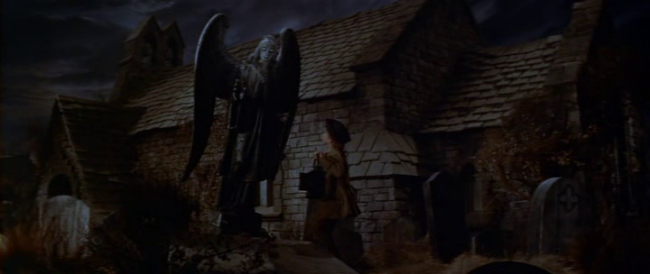
6. Moonfleet (1955) my original review

Speaking of great production design, this one from Fritz Lang is a triumph of atmospheric sound stage exteriors. Plotwise, I have to admit to some bias here. It's not well written, bearing little resemblance to its source novel and a lot more to Treasure Island. But the production design combined with one of Miklos Rozsa's best scores is enough for me. Stewart Granger as the morally ambiguous smuggler gentleman (this is another smuggler movie) wins me over a little more each time. George Sanders and Joan Greenwood are absolutely delicious as demented aristocracy.

5. The Black Pirate (1926) my original review

This is one of the ones that really established a lot of the hallmarks of the genre. Douglas Fairbunks' acrobatic performance gave everyone the template for a swashblucking hero for the rest of cinematic history. It's also just an awesome spectacle. In the '20s, after the groundbreaking films of DeMille and Griffith, it sometimes seemed studios just didn't know when to stop building sets. And then they'd pile casts of thousands onto them, which is what you see here.

4. Anne of the Indies (1951) my original review

This is another one I have a big soft spot for. Directed by Jacques Tourneur, I think this is a spiritual successor to his famous 1942 horror film Cat People. Like that movie, this is a rare example of a woman being allowed to play a noir heroine. Normally women function as the two poles of moral choice for a conflicted male protagonist--either the wicked femme fatale, or the good girl next door representing wholesome home and family. Like Simone Simon in Cat People, Jean Peters' pirate Captain Providence tries to cut a path in a world dominated by the moral hypocrisy of the men around her. She's loyal and vindictive, shockingly ruthless yet desirous of validation. Every devious thing she's done seems to be matched by a devious thing done to her that no-one seems to acknowledge. It's hard to say what she deserves from a moral standpoint which makes this a perfect blend of noir and pirate film.

3. Peter Pan (1953) my original review

Disney adapts J.M. Barrie's story to be a perfect encapsulation of what and why kids used to fantasise about pirates. The freedom, the limitless wonder, the colourful characters, and the underlying tension between a child and its perception of the mysterious and sinister world of adults.

2. The Black Swan (1942) my original review

This one just has all the basic ingredients and cooks them to perfection. Tyrone Power as the captivatingly amoral lead displays his equally captivating fencing prowess. His treatment of Maureen O'Hara as the love interest is shocking even by to-day's standards but, as she showed in multiple swashbucklers, she could hold her own. This one also has magnificent shots of tall ships and George Sanders as Power's friend turned foe. This one is a triumph of pulp storytelling, the kind of unhinged voyage through morally murky waters that'll keep your eyes glued to the screen as you wonder how each scene will top the previous.
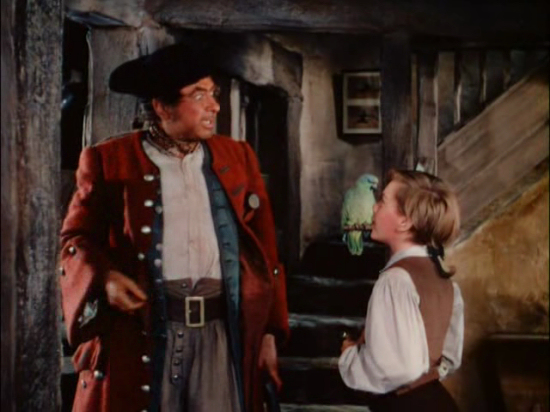
1. Treasure Island (1950)

I guess this is the obvious choice and it's number one on a lot of other lists. But it deserves it. Robert Louis Stevenson's novel is a brilliant work in itself and it had previously been adapted with the great Wallace Beery as Long John Silver. But there's just no competing with Robert Newton who, with this movie, defined the pirate in the public imagination forever after. His performance is also at the centre of the film's central dramatic question: is he a good man or a bad man? That's what Jim Hawkins, from whose point of view the story's told, is always tried to figure out. And since Silver is a surrogate father figure for Jim, it's a critical question and every scene shows how circumstances depend on its answer. From first meeting Silver at the inn, where he cunningly gets himself hired as ship's cook, to the moment he hands Jim a pistol and beyond. He's a captivating blend of repulsion and magnetism and the dilemma he presents is a reflection of just who the real historical pirate was: a pioneer for self-determination pitted against the oppressive ruling powers, or a ruthless murderer and tyrant himself?