Showing posts with label indiana jones. Show all posts

Friday, June 30, 2023

Don't Touch That Dial

I didn't have high expectations for 2023's Indiana Jones and the Dial of Destiny and my expectations were not subverted. Well, actually, my hopes were gotten up a little when I heard the present day segment of the movie would start with an elderly Dr. Jones in 1969 grieving for the death of his son in Vietnam, finalising a divorce from Marion, and feeling unappreciated by students. I thought, yeah, good idea. Undo the sappy ending from Crystal Skull, make Indy a desperate old loner. Unfortunately, Dial of Destiny doubles down on all of Crystal Skull's biggest problems and adds a few new ones. I'll give you a spoiler-free list:

Repeated Problems from Crystal Skull:

- Too much cgi.
- A sense of very limited location filming (despite the fact that the film did go to many real locations).
- Plot elements introduced in the first half of the film that are completely ignored or forgotten in the second half.
- Bad cinematography with excessive colour tinting.

New Problems Introduced:

- An annoying new sidekick who functions more as an uninvited new main character.
- The absence of anything funny.
- Shallow, false profundity.
- The misuse of John Williams' score.

A Few Things I Liked:

- The simple fact of a new action/adventure movie with a puzzle for the characters to work out.
- The supernatural event in the climax.

From here on, my review will contain spoilers.

The film begins with a twenty-five minute segment set in 1944 with a digitally de-aged Harrison Ford in the role of Indiana Jones. It's set at night and largely on a train so, with Ford's cgi head, it feels very much like Polar Express. The action sequences are mostly striking in that they lack Spielberg's unique gift for dynamic momentum. The new director, James Mangold, set himself an impossible task and failed. I did like the fact that the initial McGuffin, the Lance of Longinus, turns out to be a fake.

Hopping forward to 1969, we see Harrison Ford has admirably embraced his age. Jones is resentful that all the kids are talking about the moon landing instead of archaeology. The film seems to share his disdain for NASA and goes on to make the Nazi antagonist, played by Mads Mikkelsen, an Operation Paperclip style scientist working for NASA, like Wernher von Braun. If you feel like you've heard this one before, maybe it's because you watched For All Mankind, the Apple+ series about NASA in which von Braun's involvement was part of the plot, or maybe you remember that it's a plot element in Captain America: The Winter Soldier. Now, Mikkelsen's character is working with the CIA to investigate Jones, though this is totally unrelated to the CIA's antagonism of Jones in the forgotten, interesting subplot of the first half of Crystal Skull.

It feels like some people really want us to hate NASA, the same people who really want us to like Phoebe Waller-Bridge.

The few people who've seen her series, Fleabag, seem to adore it. That seems to be enough to make her Kathleen Kennedy's own Camilla Rhodes ("This is the girl") and she's pushed her in projects as often as possible. Kennedy has such faith in her that Dial of Destiny goes all in on her. "It doesn't matter what you believe," says Indy in one of the film's most egregiously meaningless stabs at profundity, "It matters how hard you believe it." Kathleen Kennedy believes in Phoebe Waller-Bridge really hard.

We're expected to like it when she consistently outmanoeuvres Indy and delivers a sassy line for all occasions. We're expected to like it when she has all the fun in Tangiers while grumpy old Dr. Jones struggles to keep up. Every time he does manage to hit someone or successfully pull off a difficult jump, John Williams' theme is pushed in loudly to argue that the film is not sidelining the guy we actually came to see. I imagine someone in editing watching like a hawk and periodically shouting, "Look! He did something! Play the theme, play the theme!" With all the cgi, it gives the film a video game quality, like the sound effect you hear every time Mario gets a powerup.

The cgi is only part of the reason the film looks bad. Significant blame should go to the cinematographer, Phedon Papamichael, whose use of colour tinting is largely responsible for the film's lack of visual nuance and complexity. I usually complain about the yellow tint when it's applied to Mexico but it's just as bad here applied to Tangiers. You know what movies didn't use hackneyed colour tinting? The other Indiana Jones movies. Once again, I'm compelled to remember how much of what gave the first three films a sense of visual identity was the late Douglas Slocombe's cinematography.

Perhaps the filmmakers hoped Waller-Bridge's character would be another Furiosa. If you're wondering why these franchises keep trying to replace popular old stars with new female characters, they were probably encouraged by the one time it actually worked, in Mad Max: Fury Road. But I think the people holding Fury Road up as a model underestimate how important Max really is to the story and how his minimal control of the situation functions as a great source of tension. The audience is interested in Furiosa's endeavour but Max's hopeless situation is far more captivating and his escape is more satisfying. Furiosa's story is interesting enough to make it a truly interesting moral dilemma when Max is put in a position to decide whether or not he's going to help them.

Helena, Waller-Bridge's character in Dial of Destiny, doesn't work like Furiosa because she's not as intriguing or as charismatic. We don't know right away why Furiosa is turning rebel but George Miller establishes a sense of a world so quickly and solidly and uses composition and editing to make us interested in Charlize Theron's apprehensive and calculating expressions that we're compelled to study the situation, to try to piece it together. Helena's motives for betraying Indy and trying to ditch him are never clear and seem to contradict other pieces of information we're getting.

Is she really trying to unravel the mystery that drove her father mad or is she just looking for fortune and glory? This is the tension teased for Indiana's character in the first two films and I suspect Mangold was trying to replicate it in Helena. But while the original films clearly show to Indy why he shouldn't go down the fortune and glory route, we never get that for Helena, nor is her pathological hatred of Indy ever credible or interesting. She accuses him of not assuming the role of a godfather, and taking her under his wing when her father died. Since we never know the circumstances under which Indy learns of her father's death, or if someone else assumed guardianship of Helena, we have no idea how negligent Indy's actually been. I suppose it's similar to Marion in Raiders nursing a hatred for Indy because he left her at a young age when she was infatuated with him, but that was more effective because the issues between the two are established right away while in Dial of Destiny we don't get Helena's reasons until some time into the film. The lack of any possibility of romantic tension between the two also makes it less interesting.

One popular recent criticism of Raiders of the Lost Ark is that Indiana Jones, for all his efforts, actually has no effect on the fate of the Ark. If he hadn't gotten involved, the Nazis would have found it and their heads would've melted just the same. The same could be said for Dial of Destiny, When the Nazis do find Archimedes' Dial, their plane would have been shot down in the Siege of Syracuse and any survivors would've had no means of returning to the 20th century. I did actually like the time travel element and the shots of planes flying into time fissures in the sky. I wish the depiction of ancient Syracuse had been more interesting. It kind of reminded me of The Time Monster, the Doctor Who serial that so nicely built up tension and weirdness about the possibility of connecting with the far distant past, only for the latter portion of the story to resort to the usual ancient Grecian style costumes, makeup, and sets. I wish Dial of Destiny had found a way of depicting ancient Sicily that was impressively weird and different from how we've seen the period before. I also wish they'd gotten a more interesting actor to play Archimedes, someone who gives an impression of shrewd intellect. The baffled old gentleman unfortunately gave off Bill and Ted vibes.

This leads to the single most loathsome part of the film, when an apparently mortally wounded Indy decides to stay in the past but Helena countermands his decision by punching him, knocking him out. He wakes up back in his apartment in 1969, Marion shows up and they reconcile, and Helena swaggers off, satisfied that she's saved the day. How do I dislike this ending? Let me count the ways.

First of all, I really hate the lazy plot device of the "punch out". Do you know how hard it is to safely knock someone unconscious? This is why Star Trek invented the Vulcan Nerve Pinch. We don't see punch outs in the original Indiana Jones films, either. Even Marion was obliged to use a frying pan when she knocked a guy out. I guess you could say it was easier for Helena to knock Indy out since he was bleeding from a gunshot wound to the chest. But that just leads us to contemplate the insulting jump cut, the one that tells us not to think about how Helena dragged Indy's body into a plane, departed from the still raging Siege of Syracuse, re-entered the time rift, came back to 1969, found a place to land where she found medical care for Indy good enough to cure a bullet wound to the chest, and then got him back to his apartment without him ever regaining consciousness. No wonder she's so impressed with herself. By the way, she's also the one who kills Mikkelsen's character.

Thematically, Helena's elevation to deus-ex-machina deprives Indy of a story. In the climax of his own final film. In previous films, in which the climax features Indy having an epiphany, what Indy learns here is that he's a doddering old fool who needs to let his superheroine goddaughter make decisions for him. Thank you so much, Miss Kennedy. The film may have cost 295 million dollars, becoming one of the most expensive movies ever made. It may be the box office flop that becomes the final nail Disney's coffin. But at least you made it clear how much you truly hate us. I guess that's kind of punk.

By the way, the movie has Indy framed for murder in the first part of the film, one reason he's forced to flee the country, but forgets about it. When Indy and Helena meet Archimedes, Indy realises Archimedes made the dial specifically to bring people to the past to rescue him from the siege. We never find out how this is resolved or if it is. To be fair, this script was only in development for over a decade.

Twitter Sonnet #1713

Withholding gaps of wire cursed the mask.
In timing rare, regressive faces rasp.
Bizarrely crashed, the car completes a task.
Forgetting why, the bee attracts a wasp.
For missing letters, boards were stripped of keys.
Forbidden doors debarred the cautious duck.
For why resort to giant, cranky bees?
Repulsion lifts the lowest riding truck.
We use the yellow lens to show its hot.
The screen with walls and bridges bloats and sags.
They see beloved friends as what they're not.
Computers force the throats to swallow rags.
The might of magic paste approved a gear.
The blight of digit waste upset the beer.

Thursday, June 15, 2023

Some Clean Brain Cases

Of all the Indiana Jones films, Kingdom of the Crystal Skull feels the most like DuckTales, or Uncle Scrooge Adventures. I watched it for the third time last week, still jonsing for an Indiana Jones film I haven't seen a trillion times. I was in a mood in which I could actually enjoy it, too. If you go in accepting that it aims much, much lower than the previous films, and consider the available option of watching DuckTales instead on Disney+, Kingdom of the Crystal Skull starts to look pretty respectable.

Harrison Ford is clearly having a ball in this movie. In so many films, he's criticised for being Mr. Gruff-and-Grim but he cracks many a grin here. It's fun to see.

I like how knowledgeable he seems. I was reminded of reading a quote from Michael Waldron, the screenwriter on the latest Doctor Strange movie, who said he wanted to write Strange a bit like Indiana Jones but with the intelligence of Anthony Bourdain. Of all the quotes to make you lose confidence in a screenwriter, that's gotta rank pretty high. Indiana Jones, who walks an unknown language through Mayan, who pieces together other obscure clues to track down an old professor, who speaks, what, thirty languages? He's not as smart as a travelling chef? I'm sure Bourdain was a nice guy, but come on. It's also a bit like when people said Bruce Lee would kick Cliff Booth's ass. Like there's a limit for imaginary characters.

Crystal Skull would've been better without Marion. Karen Allen doesn't seem as engaged with the material as Harrison Ford and their arguments are pretty pedestrian compared to what they were arguing about in Raiders. Of course, in this hypersensitive era, people pick apart their initial dialogue to infer that Indy had sex with Marion when she was a minor. Which is possible, though not necessarily true if you listen carefully to what they're actually saying. In any case, it contributes to the impression that, in the first two films, Indy was clearly conceived as a much rougher character than he was in Last Crusade onwards. Crystal Skull Indy is one who's been thoroughly sanitised by the Young Indiana Jones Chronicles, which are directly referenced in Crystal Skull. It's ironic, one of the many unresolved conflicts in Crystal Skull is Indy first encouraging Mutt to do what he loves before finding out Mutt is his son, then insisting Mutt go back to school. Dark and dangerous art was good for Spielberg when he was young, but when he makes a movie for the kids to-day, he won't go so far.

In any case, Crystal Skull certainly feels in no way like a final film. It feels like a bonus feature. I suppose another reason is that everyone's an atheist now, or at least Hollywood thinks so, and there's nothing to replace the awe inherent in the religious artefacts of the first three films.

I don't have high hopes for Dial of Destiny, to be honest. I think James Mangold's overrated. Logan was a good movie but it seems to have made people forget he made a string of lousy or average films before that. But I'm open to being surprised.

The Indiana Jones movies are currently available on Disney+.

Twitter Sonnet #1708

The boat was sunk with stacks of sugar sacks.
Required pies were perfect shots of crust.
With wobbly blazers, many pants were slacks.
Admired prows were cheap and saucy busts.
A pot of mussels watched as rain commenced.
Instructive dust disturbed the crystal piece.
They thought their thinking minds could pass the rinse.
But metal chairs detained the handsome niece.
The knowing frogs were singing rapid songs.
With gnawing thirst, the quail deserts a dish.
Ambitious salad rusts its gripping tongs.
Aggressive chickens melt a solid wish.
A crystal thought became a group of guys.
A burger joint retained a million fries.

Tuesday, June 06, 2023

The Young Someone Chronicles

With Disney about to release the final Indiana Jones film, they've finally managed to get the rest of the film series onto Disney+. I doubt Paramount was willing to let it go so Disney must have paid a fortune and it's likely temporary. But along with the films is something Paramount doesn't seem to care much about, at least not enough to put on their own Paramount+ service, and that's The Young Indiana Jones Chronicles. Disney+ really feels like a logical home for it, too, since it's always kind of felt like a Disney Channel series--a watered down, slightly more moralistic version of a popular franchise.

The Young Indiana Jones Chronicles, produced sporadically throughout the '90s by George Lucas, who struggled to keep the expensive series alive, is a lot better the better you succeed at getting the Indiana Jones movies out of your mind. As a series about an adventurous lad who happens to run into nearly every prominent historical figure alive in the early 1900s, it's not bad, and sometimes excellent.

A few days ago I watched Love's Sweet Song, which combines the episodes "Ireland, April 1916" and "London, May 1916". The Ireland segment shows Indy in his early '20s, portrayed by Sean Patrick Flannery (who always seems more like a young Mark Hamill than a young Harrison Ford), in Ireland witnessing the Easter Rising. This was shot in 1993, three years before Neil Jordan's Michael Collins. The episode features John Lynch playing the real playwright Sean O'Casey along with a few other prominent figures in Ireland at the time, even a brief cameo from Yeats. Indy is able to discuss similarities in the Irish Revolution to the Mexican Revolution he took part in in the previous episode. And if that's not enough of a whiplash for you, Indy goes from dodging British troops in this story to the gentle romantic episode of "London, May 1916" in which he falls for a young Elizabeth Hurley playing a suffragette.

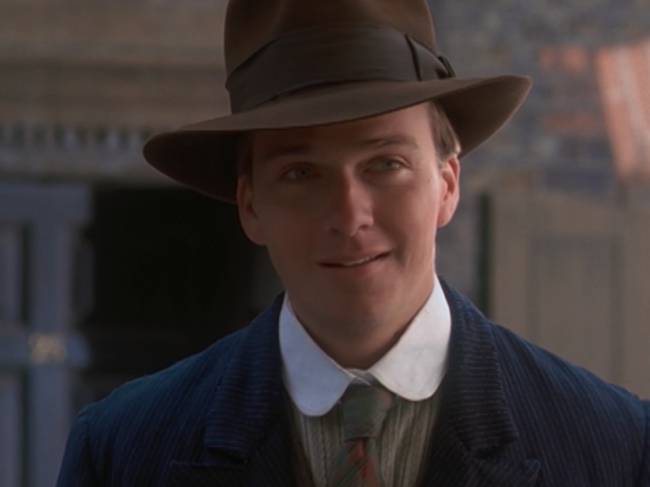
What a difference a month makes. Don't get me wrong, the episode's really sweet and genuinely effective. Both episodes are good, especially if you can forget about the first when you're watching the second. And all the episodes are better if you can forget Sean Patrick Flannery is supposed to be Indiana Jones. And I think that's the central problem of the series. For a story that's supposed to be partly inspired by 1930s serials, it's almost an anti-serial. Every episode really needs to be taken in isolation, which makes Lucas' decision to re-edit the originally 45 minute episodes into feature length television movies particularly unfortunate. It doesn't help that Flannery is noticeably older in the linking segments, his hair is longer, and his hat looks cheap and stupid.

What, did you get that at Disneyland?

And as good as the London segment is, it feels rushed to fit his great romance with Elizabeth Hurley into the time span allowed. If only this were a story that could continue from episode to episode. It would have been better if Lucas had kept to the original format with an elderly Indy framing the stories as his recollections. You could blame any problems on his faulty memory, then. Even the idea that he used to look like Sean Patrick Flannery could've been put down to his modesty when we all know he actually looked like River Phoenix.

The Young Indiana Jones Chronicles is available on Disney+ in the US.

Twitter Sonnet #1705

Rebounding bottle horns could doink the fight.
And how's the bull to stop a poignant prim?
Decode a flipping pocket crime to light.
And squirrelly shops enjoy the sexy trim.
Perplexing tinsel rafters drop the house.
Devalued shorts display the wealth of borg.
Excessive ears destroy the living mouse.
A lazy hill defends the puppy warg.
Reveals of knifes could cut the scene in half.
Reproofs in idle moods condemn the tongues.
Repenting witches crack the golden calf.
A breathing bounty graced the sailor's lungs.
Abridging stars connects the burning gas.
Redemption false confers a phony pass.

Wednesday, January 25, 2023

Raiders of the Lost Brick

Last night's Bad Batch started from a premise with a lot of potential but it never quite got off the ground. Written by Christopher Yost and directed by Nathaniel Villanueva, it also seemed like it had an especially low budget.

It's basically an Indiana Jones homage (some younger viewers might say it was an Avatar: The Last Airbender homage) and I really appreciated the attempt to have a score that at least tried to emulate the grandeur of John Williams. Of course, I wouldn't expect it to equal any of the great moments from Raiders of the Lost Ark, but I found myself thinking about some more tips the makers of The Bad Batch could've taken from that other Lucasfilm franchise.

Why does the beginning of Raiders of the Lost Ark work so well? It's hard to think back at this point, for many people, to seeing it for the first time. Even most people who haven't have probably at least heard something about the character. But a big part of the first sequence is being introduced to Indiana Jones. Who is this guy? What is he doing? Is he dangerous? What motivates him? In place of Dr. Jones, "Entombed", last night's Bad Batch, gives us Phee Genoa, voiced by Wanda Sykes.

She's not served well by the animation. Last night's episode reminded me of Tales of the Jedi with its slow, stiffly moving characters. Sykes is a funny comedienne, and she comes off as very natural when doing her stand-up, but she's one of those stand-ups whose talents somehow didn't lend themselves to making her a good actress. She sounds very wooden. Coupled with the stiff animation, altogether she's a pretty lifeless character, and placed at the centre, she sucks a lot of life out of the story.

There's not much mystery to her character, either. She's clearly established as a kind of generic tomb raider. The target of her tomb raiding in the episode, the "Heart of the Mountain", doesn't have a lot of lustre, literally and figuratively. We know it's something from before the time of the Republic, we know it's on a planet in an uncharted system. But why is it legendary? We find out it serves a function, but what do people believe it does? A legendary artefact ought to have legendary powers. The idol in Raiders of the Lost Ark was clearly a religious symbol, representative of a god. The sort of Incan trappings of the Idol and temple carry associations for the audience, mixing the known and the unknown.

"Entombed" mainly gives us a lot of simple geometric shapes.

Overall, this episode needed more.

The Bad Batch is available on Disney+.

Monday, September 13, 2021

From Ice Cream to Revolution

Edited together with the story about Thomas Edison's electric car for the home video release of The Young Indiana Jones Chronicles is an episode where Indy goes to Mexico and falls in with Pancho Villa. Indy goes from being a soda jerk in a cosy relationship with a pretty redhead to learning some of the hardships of warfare with a new Belgian companion. Along with the constant appearances by famous historical figures, the complete reshuffling of the deck every episode really undercuts the tension. Otherwise, though, this is a really good episode.

It turns out Pancho Villa is unknowingly working with an Egyptian whom Indy remembers from an earlier episode, both for having murdered an acquaintance and for lifting a valuable artefact. This episode feels more like a proper Indiana Jones story than any other.

And it works as a story about him as a younger man. We see him learn lessons about killing and fighting to survive. I wish he'd known better than to wear a black coat with a brown hat, though.

The climax of the episode even sees him getting another impromptu lesson in using a whip in a fight. I didn't mind Sean Patrick Flannery so much in this episode but I still wish it could have been River Phoenix instead. You could look at River Phoenix and imagine him growing up to be Harrison Ford. I can't see that at all in Sean Patrick Flannery. He has a completely different kind of face and voice.

George Lucas came up with the story for this episode and executive produced without directing or writing. Which may really be the best role for him, most of the time. Whatever his own faults, I think he was good at steering other people away from theirs.

Twitter Sonnet #1473

The spinning disk accepts a novel flame.
The scarpered cattle caved the wakeful eye.
A winning whist exempts a naval game.
A harper battle saved the baker's pie.
Renewal lifts the light from street to house.
Restraining cups compete with pushy tea.
Amoral shifts are tight for NEET and louse.
Disdaining pups repeat a hush and plea.
Where rotten nuts collude with spoiled dates,
Where ugly wigs conceal the screaming skulls.
Forgotten ruts preclude the royal fates.
So soggy figs congeal in steaming bowls.
To cut a pizza slice the wolves would run.
To gut a piece of ice they'd hold the sun.

Saturday, September 11, 2021

Indy on Tap

My internet has been really bad all weekend so last night I had to watch something off a disk. As it happens, three spools of my old DVRs from when I was pirating things all the time arrived in a box of my books so I watched an episode of The Young Indiana Jones Chronicles I burned to disk nine years ago. It was a 1993 episode directed by Joe Johnston, known for directing The Rocketeer and Captain America: The First Avenger, so he's no stranger to early 20th century American fantasy.

This episode finds Indy (Sean Patrick Flannery) in high school and working as a soda jerk. His girlfriend is Nancy, played by Robyn Lively, just two years after she was on Twin Peaks. Nancy and Indy are a sweet couple and very supportive of each other as they investigate the theft of Thomas Edison's plans for an electric car.

It turns out the plans were stolen by an oil company. I wonder if this idea came from screenwriter Matthew Jacobs or from George Lucas. It seems pretty prophetic now, in any case.

It's odd we never see or hear about Nancy again and, yet, that was also part of the magic of Indiana Jones. There were so many characters and aspects of his life that are peculiarly isolated to individual stories, especially his love interests, much in the mould of James Bond. Which is one of the reasons Kingdom of the Crystal Skull feels like it's so much on the wrong foot.

One of the remarkable things about The Young Indiana Jones Chronicles was how distinct every episode was, with every story introducing new locations, characters, costumes, and props. No wonder it was so cost prohibitive. It occurs to me, too, that the absence of real story arcs runs quite contrary to modern television tastes, not to mention the serials that originally inspired George Lucas. Even though I enjoy watching an episode now and then, they never end stoking a compulsion to immediately see the next one.

We get a dinner scene at Indy's house where we can see his family has black servants. That could never be presented without comment to-day. If it were the BBC or Netflix, the racial demographics of the party guests and servants would probably be measured to precise percentages, realism be damned. You could say that Indiana Jones is a fantasy, but that argument feels particularly odd considering Lucas obviously intended the show to be partly educational, which is why things like Edison's electric car are included (Edison really did try to develop an electric car). But apart from any such considerations, it's nice to see that, in the 90s, filmmakers were still able to present negative aspects of a period without artificially moralising about them.

I never really saw Indiana Jones in Sean Patrick Flannery. This is one of the rare episodes where he actually wears the hat and it always looks terrible on him.

His face was made for a straw boater.

Thursday, February 27, 2020

Receding Spielberg

Word came yesterday Steven Spielberg was handing over directing duties on the next Indiana Jones movie. He seemed so determined to make it last year. Maybe he's seen he wisdom of Tarantino's "Ten and done" plan. Maybe he listened to Shia Labouf and admitted Kingdom of the Crystal Skull wasn't up to quality standards. It's sad to think that'll be the last Indiana Jones film to involve Spielberg or Lucas. On the one hand, it's admirable Spielberg can be honest with himself. On the other hand, who can possibly replace him? James Mangold is supposedly the top contender. I haven't seen Ford versus Ferrari. I thought Logan was good, I wasn't a big fan of Kate and Leopold. Not sure if I've seen any of his other movies.

To compensate for Spielberg's unique talent for blending action, humour, romance, and horror into a slick narrative you need a great director, not a good director. The closest you could find in the younger generation would be Christopher Nolan, Denis Villeneuve, Robert Rodriguez, or Taika Waititi. The best choice would be Quentin Tarantino for a pulpy adventure film with gruesome face melting or beating hearts being pulled out of chests. Raiders of the Lost Ark and Temple of Doom are both, at heart, pulp fictions. But it would never happen, even if Tarantino didn't want to make his last film more personal: there's too much enmity between him and Disney.

I wonder how close they are to casting a young Indiana. A new young Indiana, I mean.

Hopefully David Koepp's out, too.

It's ironic that these great movies that seem most suited to serialisation like the Indiana Jones films somehow resist being serialised. Well, at least it's doing better than Ghostbusters, I suppose.

Twitter Sonnet #1332

A turtle's knee was bent beneath the shell.
A running knight commands a cart to stop.
A covered sea displays a coral bell.
A speeding horse dismays the donkey cop.
A symbol sound could mean a million things.
A wobbly wheel could turn in racing winds.
A perfect cut creates toupees from bangs.
A shady bandage grades the thing it mends.
A walking talk was leggy 'fore the dance.
A boiled egg was runny for the pan.
A lengthy short displaced the shortened pants.
A pumpkin sauce could ne'er replace a tan.
A dogged wind destroyed the fragile tent.
A breeze condensed to ice and peppermint.

Thursday, July 26, 2018

Comic Con Report, volume 4: The Wrong Audience Edition

I didn't notice the gender swapped Alex DeLarge when I took this photo by the expensive pizza cafe at Comic Con but I applaud her now, wherever she is.

I don't know if I've ever mentioned how much I love the door staff at Comic Con, the people who stand by the badge detectors or just hold the doors. Many of them have no clue about geek culture but are unselfconsciously vocal and seem to have a great time. On Sunday a middle aged black woman stationed at one of the doors was loudly and enthusiastically misidentifying costumes. She gave a shout out to "Gladys Knight!"--a Princess Leia. When a woman walked by dressed as Captain Marvel the door lady yelled, "Mockingjay Lady! I see you, Mockingjay Lady!" Captain Marvel gave her a strained smile. When I walked by I was greeted as, "Laurence Fishburne! Hey, Laurence Fishburne, I see you!" I'm white, by the way. I was tempted to stop and ask her just who she thought Laurence Fishburne was.

I was wearing a brown fedora, long sleeved grey button down shirt, brown denim trousers, and carrying a brown messenger bag. Maybe she thought I was Cowboy Curtis, Fishburne's character from Pee-Wee's Playhouse. That was on Sunday--most days at the Con I was wearing a sport coat and bow tie along with a fedora which usually gets people to ask me, "Are you Indiana Jones or Doctor Who?" That's an ambiguity I'm comfortable with but on Sunday I was coming from the Maritime Museum where the work I do, particularly in this recent heatwave, can be strenuous and dirty so my normal attire is fedora, shirt, and trousers. I knew I'd get pegged as an Indiana Jones cosplayer, which wouldn't bother me except I know the hat is wrong, the shirt is the wrong colour, the bag is wrong, etc. If I'm going to cosplay as Indiana Jones, I want to do it right, not get the pitying acknowledgement of a bare minimum effort. I tried to head it off by wearing a grey shirt and I'd recently added a chinstrap to the hat (this is required for volunteers on the ships) but no such luck. Several people kindly complimented my effort to look like Indiana Jones, I even received a courteous nod and smile from a guy who was wearing a just about perfect Raiders replica outfit. Oh, well. At least one person thought I was Laurence Fishburne.

The highlight of the Marvel Games panel, which I saw on Thursday in Hall H, was that the moderator, Greg Miller, and Yuri Lowenthal, who voices Spider-Man in the upcoming game called Spider-Man unexpectedly found themselves wearing exactly the same outfit.

I don't play a lot of video games nowadays, when I do I usually just replay Skyrim. But Spider-Man looked like a fun game though the gameplay looked precisely like Arkham Asylum.

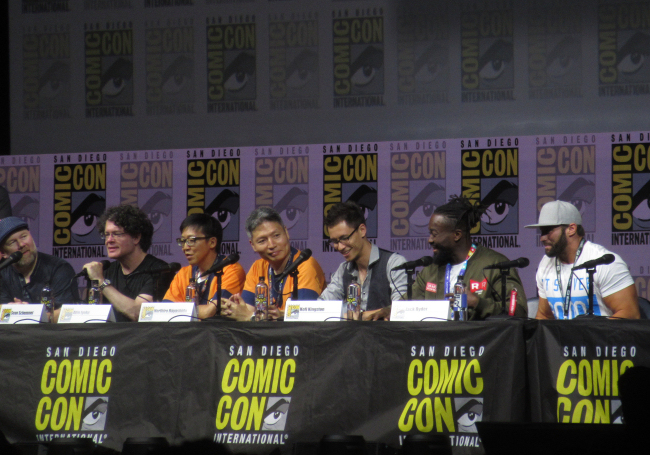
The Marvel Games panel was one of two I sat through in Hall H between Doctor Who and Better Call Saul, the other being Dragon Ball Super, an upcoming movie in the Dragon Ball franchise.

The panel featured English dub voice actors Sean Schemmel (Goku) and Christopher Sabat (Vegeta), who seemed to be well known to fans of the franchise. I wouldn't know, as much as I love anime, with a special fondness for 80s anime, I've never gotten Dragon Ball. Usually with things I don't like I can at least sort of understand why it appeals to other people but Dragon Ball is like a dog whistle to me, it's a sound I just can't hear. There were two surprise panellists, famous pro-wrestlers named Kofi Kingston and Zack Ryder--Kingston tried to describe what he loved about the franchise. He talked about the pleasure of pushing oneself to a "limit" or past a "limit". I feel like there are plenty of movies and shows with that concept, though, without featuring big weird lumps of muscle. I guess you need to really love muscle to appreciate it. Anyway, if you want to see the panel, don't let me discourage you, the whole thing's on YouTube here.

Thursday, March 22, 2018

Indiana Jones and the Marriage of the Green Screen

With recent talk of another Indiana Jones film beginning production next year I thought it might be a good time to revisit 2008's Indiana Jones and the Kingdom of the Crystal Skull. I hadn't actually seen it since the first time I saw it on opening night in 2008. I was disappointed with it at the time but wondered if future viewings might improve my impression. However, although I've probably watched every film in the original trilogy at least five times in the past decade, I never quite got around to a second viewing of Crystal Skull. But I noticed it was included free with Amazon Prime so I thought, what the hell. I even got a bit excited, thinking, without all the burden of hype and legacy, maybe I'll watch it and find it's actually a really fun action adventure film. Unfortunately, while I do think it has some good qualities, age seems to have made it even worse. It's not that it's a bad Indiana Jones film, I would argue it's an anti-Indiana Jones film, its ideas and motives in direct opposition to the philosophy fundamental to the first three films. This might actually have made for an interesting, if unpleasant, movie if the filmmakers were truly intent on trashing their own films but the result instead is something as muddled intellectually as it is in its visuals and effects.

If I had to choose the worst problem in the film, I would say it's Steven Spielberg's lack of desire to make it. When I saw the clip of him from Comic Con talking about how all his life he made the movies he wanted to make but the fourth Indiana Jones film was going to be completely for the fans I knew there was going to be trouble. The problem with making art for someone else's tastes is that they're not your tastes--in other words, you have no idea what you're doing. And quotes I've seen from Spielberg indicate this is a problem that infected production all down the line.

Wikipedia quotes him as saying about the alien skulls at the centre of the film, "I sympathize with people who didn't like the MacGuffin because I never liked the MacGuffin." Apparently it was something George Lucas insisted on. So I guess Spielberg went ahead and shot scenes about this thing he didn't care that much about. Is it any wonder audiences had trouble caring much about it too?

Why is it so hard to care about the aliens in Crystal Skull? Probably for the same reason the return of The X-Files has felt so limp. Somewhere along the line, the aliens that seemed so cool and mysterious in the 80s and 90s lost their mystique. I wonder if Crystal Skull might have made more headway if the aliens had been more like 50s movie aliens, since 50s Sci Fi was supposedly the model for this film. If that was they case, they ought to have gone for a genuinely bizarre design like the insects from Quatermass and the Pit or the brains from Fiend without a Face. Maybe not make them exactly like one of those aliens but apply the same basic philosophy in creating new aliens--that is, use elements of earthly biology in truly weird, reconfigured ways. Maybe then the aliens might have had something approaching the effective horror of the Ark or the Thuggee cultists. But the main problem with the MacGuffin is its lack of a thematic relationship with the protagonists.

A MacGuffin is supposedly an arbitrary thing that's more important because people are interested in it than for any intrinsic quality it possesses. But the best MacGuffins demonstrate this isn't so. In Hitchcock's The 39 Steps, the identity of the MacGuffin goes unknown for most of the film, adding to the sense of anxiety for much of the story, and when the MacGuffin is revealed its clever in a satisfying way. The MacGuffins in the first three Indiana Jones films all tie in to the protagonist's story in a meaningful way. Partly this is because of how much they inherit as religious artefacts--the Holy Grail's significance is even spelled out explicitly from Marcus in a line about how it's "the search for the divine in all of us." This easily ties in with the father/son story and each character's preoccupation with whether or not he's been good for the other.

Attempts to echo this story are present in Kingdom of the Crystal Skull but without any depth. Indy (Harrison Ford) doesn't even know Mutt (Shia LaBeouf) is his son for most of the film and when he does the most we get out of it is a corny reversal of his advice that Mutt do what he loves even if it means dropping out of school. Is this meant to tie into the climax where Irina (Cate Blanchett) is killed by her desire for too much knowledge? With the idea of knowledge being the nature of the alien's treasure, it's kind of hard to make the usual theme of the perils of avarice make sense.

There are a few funny moments where Indy gets so caught up trying to piece together the puzzle with Irina that Mutt has to intervene with an action sequence but all these scenes do is make Indy seem slightly scatter brained. There's certainly no connexion to an idea of too much knowledge being dangerous. It's nothing compared to the idea of Indy potentially taking the Sankara stones in the second film for "fortune and glory" and causing the death of a village because of his failure to believe in their power. In addition to the widely maligned artificiality of the film's overuse of cgi, the fact that Indy himself never has the sense of internal conflict he has in the previous films makes the whole movie feel more like a long DVD bonus feature for an Indiana Jones movie than like an Indiana Jones movie in its own right. There seems to be an inherent resistance to the idea of giving any of the protagonists any truly negative character trait.

Kingdom of the Crystal Skull also has a very different attitude about sex compared to its predecessors. It's certainly the least sexual entry in the series with no hint of physical chemistry between Ford and Karen Allen. The worst scene in the movie is their marriage at the end which, in opposition to the James Bond inspired format of a new girlfriend for every movie of the first three films, seems to insist on Indy's moral obligation to settle down with the mother of his child, a dull enough intended idea for an adventure film, given the turgidity of creepy orthodoxy for the unintended lack of chemistry between the stars. Allen had long since lost the feistiness that made her effective in Lost Ark and her forced smiles to emulate that lost spark are consequently depressing. Her big moment being the plan to drive off a cliff with the boat/car, one of the film's most gratuitously false cgi moments, emphasises her lack of impact in the film.

I feel like maybe, in one of the script drafts, there was a plan to use Irina to make a commentary about sexual repression. The film's single most sexual moment, which may not have even been intended to be sexual, is the moment where army ants pile up to reach her where she's dangling from a tree and she crushes one between her thighs, causing an improbable quantity of ropey goo to fly towards the camera. I suspect the army ants were inspired by the 1954 Charlton Heston film The Naked Jungle in which Heston's character is a South American plantation owner who must overcome his conservative disinterest in his sexually experienced mail order bride, played by Eleanor Parker, while a mass of army ants threatens to overwhelm his land. The concept of nature overriding starchy, patriarchal morality is clear enough even if the film didn't have "naked" in the title.

In Crystal Skull, John Hurt's character, a professor named Oxley, has seemingly lost his mind and ramblingly quotes literature, including a masque by John Milton commonly referred to as Comus. The masque is about a virginal girl who's abducted by Comus, a mythical being and son of Bacchus and Circe, who tries to tempt her to break her chastity and join in with his animal headed retinue. If we take the biblical implication of "knowing" as sexual experience maybe at some point, on some level, the ascetic Soviet officer Irina was tempted by Indy's decadent Capitalist sexuality. The line Oxley quotes is from the beginning of the masque, spoken by Comus' moral adversary, a mysterious "Attending Spirit" who accepts the duty of protecting the girl and her brothers from going astray.

Yet some there be that by due steps aspire
To lay their just hands on that Golden Key
That ope's the Palace of Eternity

The lines would seem to refer to good people finding their way to heaven. One might read a sexual connotation into the lines with the key being a phallic symbol and the Palace of Eternity being an orgasm. Well, it makes more sense than the words being a clue for Indy to bash an Incan carving with a rock.

Just what are Irina's motives? Spielberg's instincts with the villains were again leading him in the wrong direction. He felt he couldn't make the Nazis adventure villains after Schindler's List, presumably choosing the Soviets because he felt less personally attached, again insuring that the audience felt less personally attached. Certainly Stalin was no lightweight when it came to perpetrating atrocities--there's a fascinating and horrifying story and collection of photographs from Masha Gessen and Misha Friedman in The New Yorker to-day about Soviet Gulags. But Kingdom of the Crystal Skull never quite seems to know its position regarding the U.S.S.R. The first line Indy has is "Russians" as he stands up among a group of Soviets pointing guns at him, the line an oddly flat footed place holder for the more strident "Nazis. I hate these guys." The film also has to negotiate with the Red Scare, which the film reminds us wasn't limited to Hollywood and Joseph McCarthy but was an hysteria on American university campuses as well.

So the movie has to make the Soviets villains and deal with the fact that the Soviets were the subject of irrational fears in the U.S. all while, for some reason, tying neither of these things into the main plot. It isn't that the Nazis were more obviously evil but that the motives of the Nazis were easier to tie into the MacGuffins of the first and third films. Hitler's interest in the occult and possession of the Old Testament power of the Ark has far more interesting thematic implications than Irina wanting to harness alien technology for psychic warfare, a motive that isn't even talked about very much.

Anyway, I'll keep an open mind about the next film. Hopefully Spielberg has learned his lesson.