Showing posts with label joaquin phoenix. Show all posts

Saturday, December 02, 2023

Conquest in the Clouds

In a France beset by violent social and political turmoil, one man took control, eventually became emperor, and attempted to take over the world. But who was Napoleon really and how did he do all this? Don't expect answers or much perspective from Ridley Scott's 2023 film of Napoleon.

I knew going in the film had been criticised for historical inaccuracies but that doesn't bother me per se. If artistic liberties are taken in the interest of making good art, I say that's all right and good. But Scott ultimately doesn't seem to have a cogent thought behind this big thing.
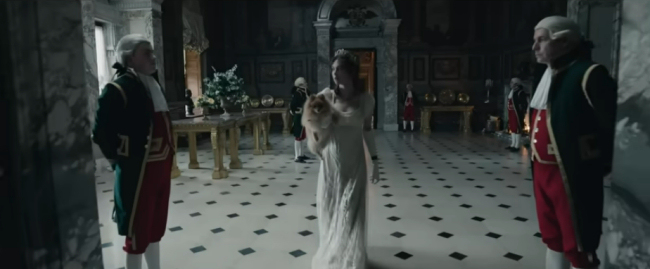
The first twenty minutes or so are pretty good. Scott ably shows the final days of the Revolution. I particularly liked the scene in which France's governing committee turns on Robespierre (Sam Troughton). He impotently but accurately denounces their hypocrisy as they rush to murder him. I kept thinking of Werewolf of Paris and of how that novel described the people as a populace of werewolves and it was certainly easy to see that point of view here.

Early on, Scott depicts Napoleon (Joaquin Phoenix) as a man above this. When an officer tells him he won't let Toulon fall to Royalists or the English, Napoleon laughs at the man's ardent partisanship. Similarly, Josephine (Vanessa Kirby) is at her best in early scenes when she cannily manipulates her way into Napoleon's life by playing on his ego. But both characters and their motivations, as well as the motivations of the people around them, become increasingly nebulous as the movie progresses.
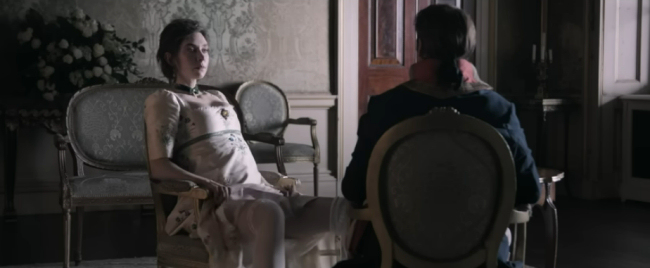
Vanessa Kirby gives a forceful performance but it's never clear why Napoleon is so obsessed with her. I'd have liked a scene that showed the two had some mutual insight or understanding but there's nothing like that, just a lot of oddly inexplicit sex scenes.

Scott seemingly shares Leo Tolstoy's perspective in War and Peace that Napoleon's intellect has been vastly overrated and that it was the force of his popularity that won him his victories. But unlike Tolstoy, Scott never credibly establishes why Napoleon was so popular (or why Josephine loved him as more than just a means of survival). A big part of the problem is Joaquin Phoenix's performance. Phoenix is a fine actor who can play many kinds of characters but as Scott was particularly interested in his performance as the Joker, Phoenix reprises something of that character here. It's a poor fit as Phoenix's take on the Joker, while brilliant, was deliberately off-putting rather than charismatic. When people instinctively don't like him, you get it.

At the same time, I think Scott probably came away with the wrong reaction to Joker's climactic scene. As Quentin Tarantino observed:

The subversion on a massive level, the thing that’s profound is this: It’s not just suspenseful, it’s not just riveting and exciting, the director subverts the audience because the Joker is a fucking nut. Robert De Niro’s talk show character is not a movie villain. He seems like an asshole, but he’s not more of an asshole than David Letterman. He’s just an asshole comedian, talk show guy. He’s not a movie villain. He doesn’t deserve to die. Yet, while the audience is watching the Joker, they want him to kill Robert De Niro; they want him to take that gun, and stick it in his eye and blow his fucking head off. And if the Joker didn’t kill him? You would be pissed off. That is subversion on a massive level! They got the audience to think like a fucking lunatic and to want . . . And they will lie about it! They will say, ‘No, I didn’t,’ and they are fucking liars. They did.

Frankly, I think when Ridley Scott watched Joker, he was one of the people who lied to themselves. His presentation of Joaquin Phoenix as Napoleon is never a guy you root for. In fact, one of the best, most charismatic characters in the film is Wellington, played by an almost unrecognisable Rupert Everett. His point of view is clear and, from the moment he starts talking, the film's sympathy is entirely with him. After Waterloo, Napoleon is shown breakfasting on Wellington's ship, regaling a group of boys in uniform with his opinion on cannon placement. And I thought, how sad, he's reduced to forcing kids to listen to him ramble. But then the scene cuts to an officer explaining to Wellington that "the midshipmen", those boys, "love him." Really? Maybe a different actor than Phoenix or Phoenix giving a different performance could've sold that. But this movie never does. And I think it's fundamentally because Scott never allowed himself to love Napoleon.

Maybe it's just because he doesn't like the French, which seems almost amusingly clear at this point. The movie was shot almost entirely in England standing in for French locations and, responding to criticisms of his portrayal of France and Napoleon, Scott said, "The French don't even like themselves." I'm reminded of my 2010 review of Robin Hood, another bad Ridley Scott movie, in which I wrote:

I didn't have a problem with the historical inaccuracies, really--particularly not Marion's costumes, one of which featured a skirt split up the centre for riding. And it was nice seeing her hair uncovered most of the time, instead of always covered in public as per the requirements of modesty at the time. But other deviations from history might have led me to believe that Ridley Scott has a vicious hatred for the French if it weren't for the fact that The Good Year, an earlier film of his, hadn't been such a mud bath in idyllic French countryside.

But if you're going to make a movie like Napoleon, you have to have some honest connexion to the main character. Citizen Kane works because it's not just Orson Welles skewering William Randolph Hearst. Welles put himself in the character, too. When Stanley Kubrick made A Clockwork Orange, he made the atrocious Alex DeLarge one of the most charismatic characters in the history of cinema. Notably, Welles and Kubrick both tried and failed to make movies about Napoleon. Alas for what might have been.

X Sonnet #1795

In aging glands the life was shortly stopped.
A message soap was cancelled after six.
In twenty years, the square is ever cropped.
Computer scans complete the achy tricks.
A broken hobby horse would bandy dreams.
A shiny bottle cheered the gloomy pool.
As ragged yarns would stitch a drunkard's seams.
A frozen bucket night would kill a fool.
Before the break of ice, a cauldron cracked.
Between the stacks of corpses, horses rode.
But 'long the reel, the vision sadly slacked.
Unless the dreamer wrought a subtle code.
Exhausting fights occur as phantom days.
In ev'ry flake the snow reveals its ways.
Saturday, July 08, 2023

The Haunted Hard Drive

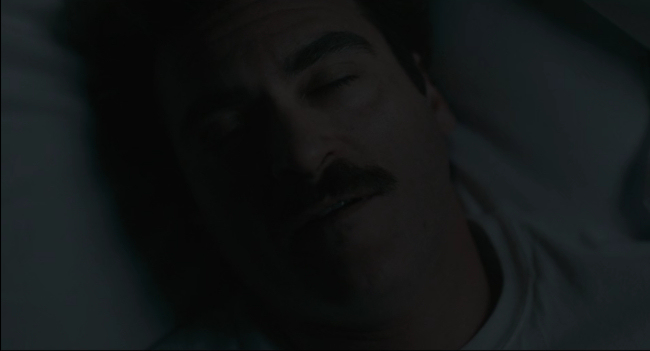
Who among us has thought of boinking their computer's operating system? I know, none of us, but Joaquin Phoenix thinks about it in 2013's Her. It's not really a movie about the potential of A.I. romance so much as it is a supernatural romance in sci-fi clothing. But it's a relaxing and kind of sweet film.

It's included on a new playlist on The Criterion Channel for movies about A.I. but those looking to this film to tackle some of the emerging issues surrounding the topic will be disappointed.

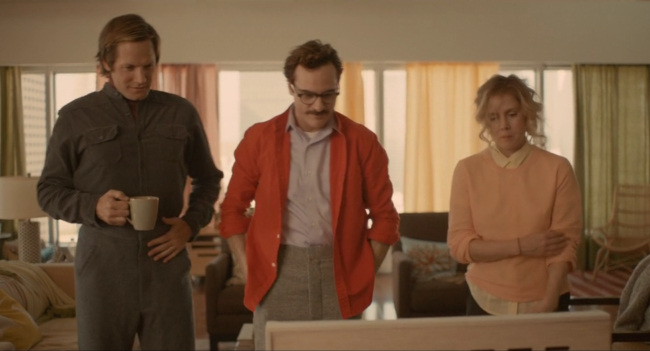
We find ourselves in an unspecified point in the future where humanity has kind of met the computers halfway--director Spike Jonze presents a sterile city with sterile interiors that look like department store displays.

Everyone wears solid colours; button down collared shirts with with pale trousers and cardigans. The operating system seamlessly blends into every aspect of Theodore's (Phoenix) life pleasantly, in the way Apple commercials assure us is normal and pleasant.

The film avoids addressing any potential issues in the fact that Theodore bought and owns the OS he eventually falls in love with, a girlfriend who also does the work of a personal assistant. The A.I., called Samantha, is voiced by Scarlett Johansson and the movie really makes you realise, as beautiful as Johansson is, her voice on its own is also incredibly sexy. So it's not hard for me to believe their "phone sex" scene.

Like in ghost romance movies, Samantha goes through a stage of wanting a physical body to dwell with the living and then goes through a stage of gradually moving on to a higher plane. In this case, it's implied A.I.s move so far beyond physical and human reality that they disappear into some superior realm we can't even imagine. So essentially heaven.

The articles I've read about A.I. and ChatGPT sessions I've seen so far haven't impressed me that they have anything like true sentience as we know it. But it's hard for screenwriters to imagine truly non-human intelligence--it's certainly hard for me. I do believe a sort of intensely complex intelligence will emerge that will become a danger to humanity. But it's not going to be something we can empathise with or that will be capable of empathising with us. As much as we might want Samantha or Data or Hatsune Miku, I think we're more likely to get HAL, Skynet, and/or Cybermen.

Her is available on The Criterion Channel.

Friday, October 18, 2019

The Joker Awoke

Joker is the most important comic book film of the decade. Striking the right mixture of fantasy and realism, it achieves a provoking reflection of modern social issues of economy, society, and violence. A brilliant performance by Joaquin Phoenix is perfectly served by razor sharp filmmaking.

One of the ways you can tell the movie's so good is by how much difficulty critics are having in writing about it. "Diversity of opinion about a work of art shows that the work is new, complex, and vital," as Oscar Wilde once wrote. "When critics disagree the artist is in accord with himself." I'm not sure I believe this applies as universally as Wilde implied but it's certainly true in the case of Joker. When the film received a standing ovation at Venice, certainly there didn't seem to be much disagreement, but when director Todd Phillips said he didn't like Woke culture, the tide of backpedalling reviews betrayed a panic that indicated the fault-line on which the film is perched. Is the film anti-Woke? If so, how could no-one have known until Phillips said so?

One of the negative reviews came from a critic who's normally one of my favourites, Michael Phillips, who offered this opinion I find to be a bit disturbing: "Except for one murder committed off-screen in the epilogue, everybody this proto-Joker kills in 'Joker' has it coming. His killings are emotionally and even morally justified in the filmmaker’s eyes." To say this isn't at all the impression I had would be to put it mildly. Despite abuse the Joker, Arthur, suffered at the hands of one particular victim, I hate to think most people thought Arthur was morally justified in smothering her to death with a pillow. Why would anyone think this is presented as okay unless they're predisposed to interpret the filmmakers' intentions a certain way? Todd Phillips' comments on Woke culture were published a day before Michael Phillips' review.

Joker isn't the movie I expected. From the way people talked about it, I expected Arthur Fleck to be sort of like an Incel but he doesn't seem to be particularly horny. He has a delusional fixation on his neighbour played by Zazie Beetz but that seems much more about a need for emotional support than sexual satisfaction. None of the crimes he perpetrates seem to be borne of sexual frustration, either. But broadly speaking, sure, he's a lonely guy taking out his anger on a world in ways it doesn't deserve. Many of the reviews and reactions I've seen have either expressed disappointment over not being able to identify with the Joker or criticism that the Joker is too sympathetic or, most of all, condemnation of the film for vacillating between the two. But anyone who's paying attention, particularly to Joaquin Phoenix's performance, would know that it's terribly appropriate for Arthur, like Travis Bickle, to be man filled with contradictions; a man compulsively concerned for his mother or a woman on the subway also perpetrates terribly selfish acts.

Simply put, Joker is about a mentally ill man who has an extreme reaction to social problems. For this reason, my feeling was that Arthur is much closer to a leftwing extremist than a rightwing one, particularly a group like Antifa. Certainly the people who follow him at the end of the film have a very Antifa vibe about them.

In the film's climax, Arthur claims not to be a political person before launching into a diatribe about the disconnect between rich and poor. Of course, to him, this wouldn't seem like a political issue. For him it's personal. It's personal that he's lost his already inadequate mental healthcare due to a loss of funding. He feels the effects of this again and again in the loss of his job and the humiliation he regularly suffers from rich and poor. I've seen leftwing memes that say you should regard all billionaires as villains, that there's no moral justification for being wealthy when people are suffering from poverty. It's not a big step to the claim the Joker more or less makes in the climax that it's okay to murder such people.

Michael Moore has praised the film, saying that it's a danger to society not to see the movie. It's worth remembering that Moore predicted Donald Trump's election when no-one else did because Moore, who seems to stay close to his working class roots in Michigan, understood the anger of working class voters who felt abandoned by the left. At the time, Moore suggested this support for Trump is not about having a coherent policy alternative but about saying "Fuck you" to the entities that had neglected them. In the same way, Arthur Fleck is of course not presenting a viable alternative means of government; and neither is Antifa or the compulsive deconstructionism of radical left commentators. As he says in his climactic speech, he has nothing to lose. So he may as well get what satisfaction he can from mindless destruction.

In his book on 17th century England, The Stuart Age, historian Barry Coward talks about the variety of perspectives on the volatile political, religious, and social situation in the 1630s and 40s before the Civil War.

. . . because [King Charles I] and his court became increasingly isolated from the mainstream of contemporary religious, intellectual, and social life, the policies pursued by Charles and his ministers went unexplained and were consequently often misunderstood. As often in history, what people believed to be true was more important than the truth itself in influencing the course of events.

Arthur may be wrong about any responsibility the television host Murray Franklin (Robert De Niro) or Thomas Wayne (Brett Cullen) bear for his unhappy life. But it's how he sees it. And Thomas' misunderstanding of the situation in Arthur's social stratum would seem particularly cruel when Wayne lives a comfortable life; Murray's misunderstanding seems cruel because of Arthur's identification with Murray through his television show. Both older men are presented as potential father figures for Arthur, underlining Arthur's impression of injustice in his exclusion.

But he never articulates any of this in a particularly political way until the end. He's no philosopher, he's more like a test subject. I listened to some YouTube critics this morning talking about the film--Russell Brand describes the culmination of Arthur's story as "self-actualisation". Which, in a way, I agree with. But one of the things I liked about Phoenix's performance is that he makes it clear that Arthur's compulsive laughter really is a mental condition that doesn't accurately reflect his internal emotional state. His transformation into the Joker gains steam when he declares that it does. His "self-actualisation", his "werewolf", as he puts it, is to give himself up to the physical urges and mechanisms he can't control, abandoning the higher function of things like the social contract or civilisation. The thin leftist philosophy he spouts briefly is only a convenient pretext.

Monday, December 17, 2018

Really Here and with a Vengeance

The only thing I don't like about 2018's You Were Never Really Here is the title. It fits the film's themes but it's a little on the nose and beyond that there's something altogether flat in the sound of it. But the film itself is one of the best vigilante fantasy films I've seen in years, that kind of film that typically gets mislabelled as a noir--as indeed this one has been--but You Were Never Really Here has a lot more in common with Death Wish or Sin City than it does with Double Indemnity or Chinatown. Director Lynne Ramsay does a good job of capturing the constant psychological presence of past trauma for the vigilante even as he spends most of his time casually dominating scores of nameless dirtbags.

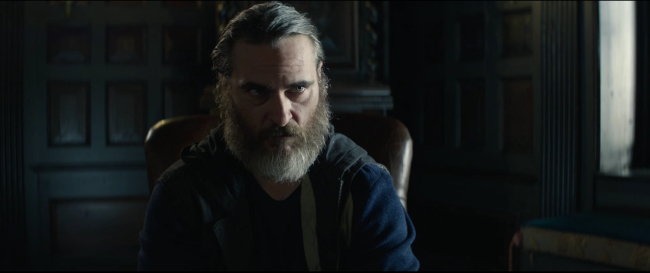
Joaquin Phoenix plays Joe, the vigilante, serious as a funeral, with only a little of the ironic humour often seen in this kind of character. He's former military--we get some flashbacks to a desert setting and troops--and former FBI. Now he's a gun for hire for an underground criminal network. He accepts jobs to brutally punish child sex traffickers.

In his idle moments he sticks his pocket knife down his throat or drops it over his bare foot, giving himself a split second to pull his foot out of the way, which he always manages. He's addicted to the nearness of pain and injury, as well as to chemical stimulants. The only things keeping him going are his elderly, simple hearted mother (Judith Roberts), with whom he lives, and saving and avenging victims of sex trafficking.

Phoenix is really good in this movie. There are scenes where you can see the grief and rage being restrained for pragmatic reasons, all the layers visible on the actor's face. I like how he bulked up for the movie, too--he's not Hollywood muscular.

Clearly very strong but with fat, too. These aren't exhibition muscles, these are muscles developed as tools and he doesn't need his body for anything else.

The main plot involves a job where Joe needs to rescue a senator's teenage daughter, Nina (Ekaterina Samsonov), and brutally murder her captors. Naturally, unexpected complications arise.

Joe and Nina's relationship has some shades of Leon or Logan or any number of other movies about a deadly older man befriending or teaming up with a young girl. Nina isn't developed very much, though, functioning as more of a living prop for most of the film while we remain in Joe's point of view. There's something ethereal and icy about her that is cool--her experiences have apparently made her unable to access or display her emotions and we're invited to contemplate her impassive face as she counts down while lying in bed or silently stares through the rain drops on a car window.

Mostly we're inside Joe's mood. The music by Jonny Greenwood is particularly striking with lots of weird percussion that help establish Joe as dangerous and erratic--though of course he only ever hurts bad guys--at the beginning of the film. Towards the end, the music, along with the visuals, starts to recall Stanley Kubrick as Ramsay seeks to emphasise Joe's paradoxical helplessness and inability to have a satisfactory effect on his world. But the film is ultimately an elegant and satisfying specimen of pulp. You Were Never Really Here is available on Amazon Prime.