

Is it better for art to please audiences or challenge them? Some few of us are pleased to be challenged but usually artists find they must lean more in one direction or another, that satiety and intelligent discourse are often at odds. I don't think there's any shame in either one, though a diet consisting entirely of one or the other is likely to make one psychically malnourished. And then there's the peculiar tragedy of a work of art that thinks it's doing one thing when it's really doing another. Such a movie is 2017's The Greatest Showman.
A lot of people would argue The Greatest Showman knows exactly what it's doing, that it's exploiting the life of P.T. Barnum in much the way P.T. Barnum himself might have. And in some sense, that's true. The best part of the film is the first fifteen minutes or so which takes off at a breakneck pace, efficiently presenting a story of a poor kid with a big dream growing to be an extraordinary man.
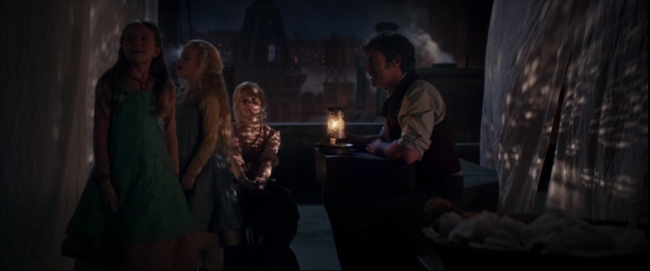
There's a lovely scene on a rooftop where Barnum (Hugh Jackman) rapidly improvises a birthday gift for his little girl, a simple lantern he cobbles together which he tells his family is a device designed to make wishes come true. It reminded me of the scene in Fanny and Alexander wherein another great showman, played by Allan Edwall, improvises a story for his little girl about a chair, telling her how it's a rare and fantastic treasure. When he pretends that he's going to destroy it, she shrieks for him to stop, a reaction that clearly more than pleases him but confirms a love he has for her and her imagination. The emphasis on that scene is on the little girl whereas the Greatest Showman scene is on the showman. But it was the girl I was thinking of anyway.
The movie was recommended to me by one of my favourite students at the school I work at. And knowing her as I do, I can see how the enthusiasm of the musical numbers appealed to her, how the costumes and the story of a good man dazzling the world appealed to her. And just like Fanny in Fanny and Alexander, I value her for that imagination. But just like a lot of other critics, I'm cursed with too much knowledge not only of P.T. Barnum but of human nature in general to enjoy the film that follows those exuberant early scenes.
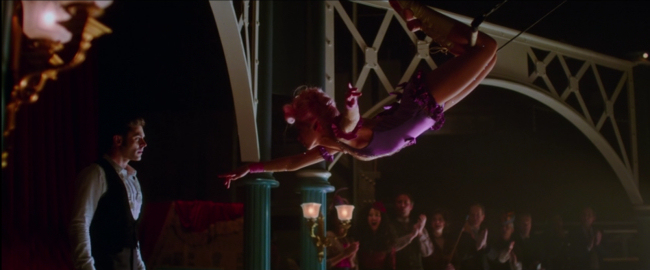
So the film brushes past questions of animal cruelty, of any mercenary motives in Barnum's heart, of any complicating personality qualities in his team of misfit performers. This leads to an obnoxious musical number, "This is Me", following a scene where Barnum quietly shuts out his circus performers from a swanky reception at an opera house. Arguably, what Barnum does in this scene is what the filmmakers do by pruning out any uncomfortable aspects of Barnum's life and career. And in addition to this, the inclusion of one slightly realistic piece of injustice begs the question of why this one was worthy to be included and the others weren't.

I wonder what it would be like to see the movie innocently. I still don't think I could embrace the oddly combative tone of "This is Me" ("We are warriors"? You want to be warriors?). And the film ultimately seems less interested in celebrating spectacle (how could it when it has so much cgi?) as it is about enjoying success, a concept I find entertaining but less interesting. And not quite what the film purports to say.
The Greatest Showman is available on Disney+.


