Showing posts with label spy. Show all posts

Saturday, October 05, 2019

Love of the Hunt or Hunt of the Love

Knowing the object of your affections might be trying to kill you can be a potent aphrodisiac. Call that an unintended consequence of a system that legalises hunting human beings in 1965's The Tenth Victim (La decima vittima). In a future that's deadly but, more importantly, stylish, two beautiful people, Marcello Mastroianni and Ursula Andress, stalk each other through hard edged postmodern architecture wearing creative configurations of cloth. The movie may have intended to be more profound than it is but it's certainly a lot of fun.

We begin with Andress as Caroline, a woman being hunted by an Asian man in short sleeves and neck tie. He corners her in a weird strip joint, not knowing Caroline and the masked stripper are one and the same person until he unmasks her and she guns him down with the pistols mounted on her bra.

As you can tell, this movie's pretty influential, not just on Austin Powers but also on works like The Hunger Games and Battle Royale. The reality TV element becomes important when we see sponsors fighting for the opportunity to have a glamorous hunter like Caroline pitching their products while executing an extravagant kill.

Marcello Mastroianni plays a hunter also named Marcello. He's in the middle of trying to get out of a marriage to a woman named Lidia (Luce Bonifazi) and he has a beautiful young mistress named Olga (Elsa Martinelli). He's in love with neither, he tells Caroline at one point, and he doesn't care about his parents even though he's secretly keeping them alive in spite of a law mandating that the elderly be disposed of. It makes sense that such an emotionally disconnected guy might fall in love for the first time with the woman trying to kill him. Caroline's not much better since we've seen her use her wiles to kill once already.

There are all kinds of little details about how people are more callous--like the detail with the parents or the fact that comics are treated as great literature--really, that wouldn't be so shallow except The Phantom is treated like Shakespeare. In one scene that has little relation to the rest of the film, Marcello stops at a beach to preside over a ceremony for people whose religion is organised around the sun.

He's heckled by "moon worshippers" who throw rotten fruit at him--but he has clear plastic partitions around him to shield him and he doesn't seem surprised. He calls the moon worshippers "Neo-realists" and insists to Caroline that his sun religion is an attempt to bring something sincere into society. Thematically, this fits in as a counterpoint to a cut-throat culture but it doesn't make much sense placed with everything else Marcello says and does in the movie.

Ultimately, this is a more laid back flirtation in the new James Bondian spy genre, its conceptual excesses working out to make everything feel strangely casual and groovy. And that's pretty nice--watching Mastroianni and Andress make out is certainly easy on the eyes. The Tenth Victim is available on Amazon Prime.

Twitter Sonnet #1284

The pumpkin clock alarms a seedy gourd.
The pickled three partook of salty brine.
The Chevy gangs induct the random Ford.
Our many phones connect with ether twine.
The sense of counting cats reveals apace.
In stolen trunks the paintings forged a lock.
A struggle named the heavy ham replaced.
A million eyes construct a little sock.
Prestigious forks unite the bites to tongues.
The table scraps reduced the fight to crumbs.
A title mountain filled the landed lungs.
Between the summits something ever hums.
A bowl of stars condense to heavy cake.
A moving eye traversed the picture lake.

Wednesday, September 04, 2019

Humans are Tougher than Fish

It's hard for me to pin down one specific genre for 1965's Murder Unincorporated (大日本殺し屋伝, "Super Japanese Killers"). A story about a yakuza outfit who hire a series of ridiculous hitmen with ridiculous gadgets and gimmicks--all to kill a character played by Joe Shishido who seems to be starring in a serious gangster film grafted onto this one. Sometimes it's a funny movie, mostly it's just impressively bizarre.

At one point, the head of the yakuza outfit is asked by one of his sons why he doesn't just dispatch one of his own vastly more competent men to kill Joe. The gang boss replies simply with a mysterious, "Wait and see." And picks his nose.

First he hires four hitmen. When they don't succeed, he hires eight more. One hitman is obsessed with baseball, particularly the Giants. One is an aspiring chef whose backstory we see in flashback--unable to bring himself to kill a fish lying helplessly on his cutting board, he decides to become a killer of men to toughen himself up. If he can learn to kill a man, he can learn to kill a fish.

One hitman is a poet whose gun is hidden in the book he carries around, another is a little kid who dresses like Oddjob. This is followed by the appearance of a man who calls himself 006, or "007's boss". His only tactic is a briefcase he carries around that occasionally releases toxic gas.

The most prominent killer is Konmatsu (Kon Omura), who behaves a lot like Jerry Lewis. His gimmick is that he takes out an abacus before he kills--and throws it in the air while drawing his gun, killing his target before the abacus can hit the ground. He also, for some reason, demands to be paid or expects to pay 10 yen for just about everything. Even when he's unconscious and tied up, he demands to be paid 10 yen for his own murder.

All of these buffoons are supposed to kill "Joe of Spades" (Joe Shishido) but it's only Konmatsu who's so incompetent he actually befriends Joe without realising it. He even moves in with him.

Shishido plays his character straight--he seems to be caught up in a doomed romance with the yakuza boss' daughter, Emi (Yoko Yamamoto) (she's also an assassin--she likes to poison people). But we only get glimpses of this story between the elaborately goofy hijinks of the Super Killers. Murder Unincorporated is available on Amazon Prime.

Wednesday, August 07, 2019

Shaken or Stirred, Just Keep Pouring

James Bond could've taken life a whole lot easier and Dean Martin shows how in 1969's The Wrecking Crew. The last in a series of four films in which Martin played Matt Helm, a sort of international government assassin, it's an adventure film in the James Bond mould with a little more comedy thrown in. Director Phil Karlson creates some exciting energy in the action sequences and there's some wonderfully campy production design but the film's showcase is Martin's chemistry with several beautiful women, particularly with a bumbling agent played by Sharon Tate.

We meet Matt Helm (Martin) already surrounded by gorgeous ladies wearing a variety of bizarre bikinis. What is the kink that necessitated one woman to wear a telephone, its base sewn to her bottom and its receiver sewn to her top? "Wait, my phone's off the hook," says Matt as a car drives him away to his next assignment.

Martin's famous booze fuelled, dry improvisational comedy he perfected on stage here aligns well enough with some conventional spy movie moments. My favourite was a bit where steel doors suddenly come down over one exit after another as he tries to leave. When one door doesn't close right away, he politely stands and waves his hand at it--when it finally closes he gives it the "okay" gesture.

The villain is Count Contini (Nigel Green) whose plan is simply to steal a whole lot of gold in weird, complicated ways. He's assisted by Elke Sommer, Nancy Kwan, and Tina Louise, all beautiful and devious women. Though Louise's scene mainly consists of her trying on various outfits while Martin works the lights.

It's kind of sexy, I guess.

Sharon Tate plays Freya, a guide assigned by the Danish tourism bureau who may have more--or less--to her than it might seem. A running gag throughout the film has Martin just about to make it with a lovely dame only for Tate to stumble in, ruin things, and sort of save his life in the process.

She seems to be a parody of the typically hyper-competent Bond girl, a broader take than the Britt Ekland character in The Man with the Golden Gun. But she shows herself to be a decent martial artist in a memorable fight scene with Nancy Kwan. Choreographed by Bruce Lee, both women markedly lack Lee's unique, lightning speed and precision but with a little help from careful editing the two have easily the best fight scene in the movie.

Martin seemed a little less enthusiastic about entering a fray though it's worth noting he kicks Chuck Norris' ass. Norris makes his first film appearance in an uncredited role as one of Contini's henchmen.

I love Contini's mansion with its chequered floor and gold furniture. Freya unfortunately blows most of it up before she and Matt escape on a helicopter. "This is fun!" she says in contrast to his visible weariness. A transparent babydoll nightgown she wears at the end helps ensure she outshines everything else in the climax.

Tuesday, February 26, 2019

Love on the Train from Istanbul

Why is Sean Connery's delight so appealing? Why is it that when I see he's happy, I'm happy too? He's not just handsome--his face is very expressive with the huge eyebrows, huge eyes, big mouth, and the deep lines on his cheek that emphasise every smile. These are the qualities that make his Bond films superior. It'd been several years since I watched one, though, but then I saw a beautifully restored version of From Russia with Love was available for free to Amazon Prime subscribers. Not all the Bond movies are--Goldfinger isn't. I remember there used to be a division between people who thought Goldfinger was the best Bond film and the people who thought From Russia with Love was. I was always in the latter camp so this was a win for me.

Though I haven't been much in the mood for James Bond for years. I haven't seen any of the newest movies since the Daniel Craig version of Casino Royale, a movie I enjoyed but thought borrowed a lot from Spielberg. At its best, even in the Connery era, I always thought the Bond movies were pale imitations of Alfred Hitchcock and I still think that's true but there's a kind of simple pleasure to be taken in From Russia with Love.

Certainly none of the women Bond runs into are as complex as the ones in Hitchcock films but Bond himself isn't that complex, either. The love scenes are almost like billboard advertisements with Bond's trademark corny jokes being like slogans. The difference is entirely in the actor--Connery's face can't seem to help expressing ten times more than whoever he's with. The only woman who really compares is Lois Maxwell as Moneypenny whose mixture of bemusement, mischievous reproach, lust, and envy make her a surrogate for the viewing audience.

But From Russia with Love does have some moments of real tension. There are two climaxes--first there's the showdown between Bond and the SPECTRE agent played by a surprisingly soft looking Robert Shaw and then there's the impressive speedboat chase.

At a time when such action scenes would typically have been filmed with rear projection it must have been amazing for audiences to watch this scene where Connery and actress Daniela Bianchi were clearly actually in the boat with an array of pursuers behind them. But the real climax for me is at the beginning of Bond's showdown with Shaw's character.

That's when Connery's performance shows why Bond earns big bucks from MI6. It all hinges on the trick exploding briefcase provided by Q. Shaw has a gun on him and Bond has to act in such a way that he makes Shaw want to open the case himself rather than force Bond to do it. Connery does it with just the right kind of hesitation and furtive glance before opening the case. The tension in his manner could mean a lot of things, Bond needs it to mean a specific thing--he wants Shaw to feel like he's perceiving a feeling Bond is attempting to suppress; "Don't let him see I want to open the case myself." It's entirely Connery's performance that communicates all these layers in one simple moment.

The film also has some amazing location work in Istanbul and a wonderfully silly Gypsy cat fight. I can definitely say I'm in the mood for Bond again.

Monday, July 30, 2018

The Car and Motorcycle Shuffle

I wish I could speed through Paris on a motorcycle at a hundred miles an hour and not worry about hitting a kid or a dog or something. Walking around at a shopping centre after seeing 2018's Mission: Impossible--Fallout, I felt irrationally frustrated by all the obstacles preventing me from moving faster. People crossing on the sidewalk in front of me seemed malicious impediments to me realising my potential as a cannonball. Good thing we have movies to address such needs and this one has very little slack in that department.

I haven't watched a Mission: Impossible movie since I saw the second film in the theatre in 2000. I remember it being better than the first one, which I also only saw in the theatre, but mainly I remember the evening because I ate a whole box of chocolate covered coffee beans. I certainly didn't leave the theatre feeling sleepy though as I recall the main hook for the second film was shots of Tom Cruise slowly creeping his way around the underside of a rock at high altitude.

Good old Tom Cruise. Fifty six years old and the biggest daredevil in Hollywood. Constantly doing his own extravagant stunts, including a super high altitude skydive in this film, has become an integral part of his fame. And it's certainly a benefit for M:I--Fallout--there are subtle, natural reactions an actor has to a physical situation that cgi simply can't predict. A truly talented artist can make cgi action interesting but such sequences are at their best when they're expressions of those artists' sensibilities. The personality in Spider-Man flipping about between buildings has a different appeal than the sense of volatility in Cruise suddenly, unexpectedly scrabbling on the side of a rooftop.

Henry Cavill gives a flat performance but he's a good refrigerator--I still believe it'd hurt when he slams into someone. Simon Pegg seems like he must have been a lot of fun when his character was introduced a couple years earlier and he's perfectly satisfactory now. Mainly, though, the film is about Cruise's relationships with women.

The film's primary thematic appeal is very traditional for the spy genre and some might say retrograde--it primarily revolves around a hypercapable male protagonist's anxiety over the increasingly difficult task of protecting the woman he loves, or even just the woman he feels a raw sexual attraction to, an anxiety especially complicated by the ambiguity of the woman's motives. I've always argued that the James Bond movies are really imitations of Hitchcock movies and the true originators of this genre are Hitchcock's Notorious (1946) and North by Northwest (1959)--but especially Notorious. That one put all of the details in place--a handsome, suave, resourceful agent (Cary Grant) and the beautiful female spy (Ingrid Bergman) whose sexuality seemed connected to the peril surrounding the mission. And, of course, there's exotic travel and uranium.

Plutonium turns out to be the deadly McGuffin in Mission: Impossible--Fallout. There are three women on Ethan Hunt's mind this time--Rebecca Ferguson as an MI6 agent with the cool name Ilsa Faust, Michelle Monaghan as a wife named Julia from an earlier film, and a sexy weapons broker called the White Widow played by Vanessa Kirby.

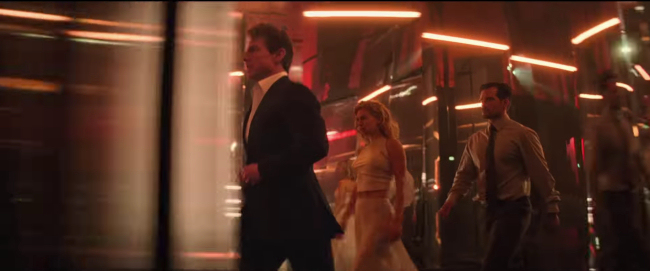
He protects the White Widow in the film's most stylish sequence set in a club with a corridor of mirrors that reminded me of the sabre fight in Phantom Menace. Ambiguities about who Ethan is, who she is, and what both of them want add spice to an action sequence with a lot of physical intimacy and the always lovely garter pistol Kirby produces at one point.

The film's effective cocktail of relentless, expertly contrived action and sexual subtext never quite hits the heights of the Raiders of the Lost Ark gold standard and the last act of Fallout sags a bit with some logical inconsistencies but it's still a very fun film.

Twitter Sonnet #1139

Required masks deflect inverted ice.
A row of microphones records the group.
A massive weight's in fact a thousand mice.
On tiny feet the horde traversed a loop.
Contented clouds but lately look below.
The paper's widely strewn on rows of crops.
There's something near the farm to say hello.
A trundling metal rabbit fin'ly stops.
A scholar's choice reversed the wind at sea.
For timing sharp the knife became the bread.
A teasing thorn remembers it the bee.
The dearer member claimed a ruddy bed.
The beetle workers make a metal think.
A million screws combine to make a tank.