Sunday, March 16, 2014

The Cooked Nutrients

My most experimental dinner yet--clockwise from the top; steamed broccoli and cabbage, roasted daikon, and baked turnip. I roasted the daikon in extra virgin olive oil with rosemary for around 40 minutes at 450 degrees, turning them over once halfway through. They were really good, succulent. I baked the turnip at the same time in the oven, wrapped in foil, but I left it in twenty minutes longer. I'd read online to bake turnip at 400 degrees and roast daikon at the same temperature but I'm learning my oven, perhaps because it's electric, seems to want an extra 50 degrees to do any job. The turnip came out well, nice and soft. I added fake butter and some basil and oregano.

With Saint Patrick's Day coming up, shouldn't I be eating potato with my cabbage? Well, no one in Ireland heard of a potato when Saint Patrick was alive in the fifth century--the potato came over from the New World. But they did have turnips. I love eating like it's the Dark Ages sometimes.

While eating it, I watched the season finale of Breaking Bad's third season, an improvement over the second season finale which was more focused on plot turns than character. The third season sagged a bit in the middle due to artificial manipulations of character but I liked how the final arc of the season carried forward the creator Vince Gilligan's idea of a "from Mr. Chips to Scarface" character.

The finale begins with a flashback to Walter and his wife moving into the house familiar to us as their home from the series. The contrast between the brilliant chemist with the promising future and the increasingly ruthless meth cook is nice. Not just for the contrast but in how the rosy future young Walter saw for himself motivated his thirst for power later.

In this, as an indictment of capitalism which fosters dreams of conquest in men, I see the show at its finest. Though I think the real reason so many people root for Walter even though he's a "bad guy" is that circumstances on the show rearrange things so that Walter really isn't that bad. Everyone he's hurt so far has either been someone who's been trying to kill him or, like his wife, has been emotionally hurt by the unexamined hollowness of their relationship manifesting in unrealistic expectations and inability to empathise. The third season finale is the first time Walter's in a position to intentionally hurt someone, Gale, who really doesn't deserve it. The show seems like it might be backing away from it--it ends with a cliffhanger.

In a way, Walter White is like Batman--people say that what distinguishes Batman from other superheroes is that Batman doesn't have super powers. But that's not really true, Batman just doesn't have explicit super powers. What Batman has is the power of the writers wanting him to live so they stretch the truth far past probability.

Walter White lives in a similar fantasy world where becoming a gang lord is more of a taboo than something that genuinely requires someone to compromise their morals.

Saturday, March 15, 2014

Regressive Mutation

Reading io9 this morning, I found myself watching a whole episode of the newest Teenage Mutant Ninja Turtles series, which is called simply TMNT because to-day's youth with their short attention spans haven't the patience to take in the full majesty of the title Teenage Mutant Ninja Turtles.

I watched because the io9 article mentioned the episode features the characters going to an alternate dimension where they encounter their 1980s counterparts from the original animated series.

The visual style of the old series is faithfully emulated for these scenes except for the fact that it's not completely lousy. Voices don't occasionally come out of the wrong characters and the characters aren't bound by over recycled animation cells with numerous visible painting errors.

The new show is very badly written, filled with stupid jokes and stapled to limp plotting. But it was better written than the old series.

I sure liked Teenage Mutant Ninja Turtles when I was a kid. It's hard to say why. Well, maybe it's one of those things you have to be a kid to understand. I think a lot of the appeal it had for children was that adults didn't understand it, and a kid could vaguely identify with being this weird mutant thing that likes pizza.

This is why the reboots will never work, of course. I found myself thinking it would be kind of interesting if someone made a rated R Turtles. I know I'm not the first to imagine this. But I don't mean just Ninja Turtles with sex and violence. I mean Turtles who share extensive knowledge of the New York sewer system featuring realistic portrayals of accidents revolving around sewer gases, encounters with dying and drunken homeless people. A Donatello whose technical knowledge is as intensely realistic and researched as an Isaac Asimov story, an adherence to historically authentic ninja codes, a Michelangelo who has a vast bong collection and a laid back, zen attitude when talking to a woman whose children have just been massacred by Shredder. A Leonardo who's faced with having to allow some buildings in New York to collapse on his friends and kill them so that he can get some people to a shelter which also collapses and kills them. A cynical, bruised Raphael with a liver problem who contributes to WikiLeaks. Maybe that's what my generation needs.

Friday, March 14, 2014

Mitochondria in Midi-chlorian Cosplay

A quick glance through the list of episodes for Star Wars: The Clone Wars reveals the fact that the group of writers working on the show in the first seasons is completely different from the group working in the latter seasons. The show went from having writers like Paul Dini, Ben Edlund, Melinda Hsu, and Drew Z. Greenberg to featuring many consecutive episodes by Katie Lucas, George's daughter. Unsurprisingly, this correlates with a decrease in writing quality even as the budget for cgi increased. One might say the nepotism, along with the obvious heavy hand of the executive producer George Lucas himself in the writing room, are things we can look at in the final season as the last dregs of an era for a studio now controlled by Disney. Except Disney also owns Agents of S.H.I.E.L.D which cruises at an even trajectory of mediocrity under the stewardship of Jed Whedon and his wife.

But while the final season of Clone Wars is not the series at its best, it's not really bad, certainly not as bad as Agents of S.H.I.E.L.D..

The first arc, written by Katie Lucas, is rather intriguingly cruel (or muddled), beginning with an episode where a clone executes a Jedi when his "Order 66" switch goes off prematurely. The efforts of another clone, Fives, to uncover the truth behind his friend's psychotic turn are portrayed in the subsequent two episodes as a gentle adventure with an amusing medical droid companion. The grim final episode of the arc sees Fives losing his mind as he finds himself alone possessing the truth, hunted by his friends. It's nice, though it would have been better without so many plot holes, the most disappointing of which is that Shaak Ti, the lovely background Jedi from the movies, is portrayed in her one major role in the series as kind of a sucker.

One wonders how this clone and medical droid make so much progress uncovering the truth right under the oblivious nose of a supposed Jedi Master.

Maybe the best written arc of the season is the continuation of the season two homage to Alfred Hitchcock's Notorious, "Senate Spy", written by Melinda Hsu--though this arc was written by Christian Taylor. It featurs the return of Padme's former love, Clovis, who was in the Claude Rains role originally, though he looks more like Cary Grant.

Here he and Padme are caught up in a conspiracy involving a planet of bankers which serves both the Republic and the Separatists. Tim Curry reprises his role as Palpatine and improves on the more uniformly sinister performance he gives in the previous season by seeming at times genuinely wise and good natured--a much more truly sinister villain.

There's also a lot of relationship stuff between Padme and Anakin, better written of course than in the prequels. Not because the dialogue is cleverer, but because it feels more like it was written by one person rather than like a collage of samples from various drafts and pinch hitters.
This arc is followed by an arc about Jar Jar Binks that's every bit as bad as you might imagine. I see no reason to discuss it further except to say I was surprised they didn't try harder given the preconceptions they were obviously working against. I can't believe I watched it.

The final arc, about Yoda travelling with R2D2 to three remote worlds to investigate the deceased Jedi Master Sifo-Dyas' role in the instigation of the Clone Wars, is credited to Christian Taylor but feels much more like George Lucas. Particularly the first episode of the arc which features the voice of guest star Liam Neeson, reprising his role as Qui-Gon. The arc ties up a point awkwardly and quickly mentioned in Episode III about how Yoda learned to preserve consciousness and identity after death. This, apparently, is why Qui-Gon didn't vanish the way Obi-Wan and Yoda did when they died in the original trilogy and it also explains why Vader seemed surprised when Obi-Wan left behind just his clothes and lightsabre--the whole blue ghost routine was new in the Jedi repertoire.

Unfortunately, the arc demonstrates how the people working on Clone Wars, including George Lucas, really didn't understand Yoda as he is in Empire Strikes Back. Although Yoda does leave his lightsabre pointedly behind on one of his trials, a part where he must face both the temptation of war and the temptation of serenity rather blatantly shows the level of understanding the writers have for the two concepts--the temptation of war is a shadowy version of Yoda that wrestles with him, the temptation of serenity is a vision of all of Yoda's deceased friends alive again and his enemy, Dooku, rejoined with the Jedi in a peaceful temple courtyard scene. Yoda seems happy before rejecting it as a lie.

The confrontation with war as a temptation is completely abstract and actually doesn't say anything about what's bad about choosing to go to war. The confrontation with serenity more concretely argues for the danger of lying to oneself and ignoring a real threat.

This kind of fits with the fact that the show was at its best when in raw, inventive, adventure serial mode.

Twitter Sonnet #605

Bleached cornflower necks scrape the fragile plough.
Combing though the soft pink hair goes too far.
White navies wait frozen for the red scow.
Hungry, screaming gulls defeat the white car.
Sepulchral Barnes and Nobles serve frail stone.
Flying dogs sing for the plastic clothespin.
Unclipped clothes recover the laundry bone.
Sleepy shark veins get lost in the false fin.
Mediaeval ice skates crack time's cookie.
A gnomish sky wallows through the fish tank.
Unfiltered food overwhelms a rookie.
Passion's string bunches in the bamboo bank.
Eskimo gibbons raise the igloo roof.
Put your toe in the milk of human hoof.

Thursday, March 13, 2014

Screaming Hunger

I was feeling extra hungry to-day, possibly from a contrary impulse following my Health Education Class, possibly I've been spending too much time with seagulls who I went to feed again yesterday.


And I have video this time:


Feeding Seagulls by setsuled

That's actually a collection of footage from three separate occasions but I swear I'm getting to recognise individual birds. Particularly the big grey one at the beginning who just kind of plaintively whistles for food instead of screaming in indignation as though my handful of stale bread is an insulting substitute for the truckload of fish I actually owe them.

I took care of my own hunger to-day with a massive plate of ziti. Now I'm a bit sluggish and sleepy in a way only pasta can make me. Well, and I've been up since 5:45am.

Wednesday, March 12, 2014

The Satan of Wall Street

A man exploits the affections of one woman after another, ruins powerful men and the employees dependent on them, all to dominate the business world through Wall Street. That's why Edgar G. Ulmer's 1948 film noir is called Ruthless. It's a little more complex than that, but quite subtly. Handsomely shot, it's a portrait of the inherent weakness of conquerors.

Like a lot of films noir of the period, it says a lot with the indirectness implicit of censorship or studio interference. But I'm surprised how much this movie did get away with, including an unambiguous suicide and a king sized bed for a married couple.

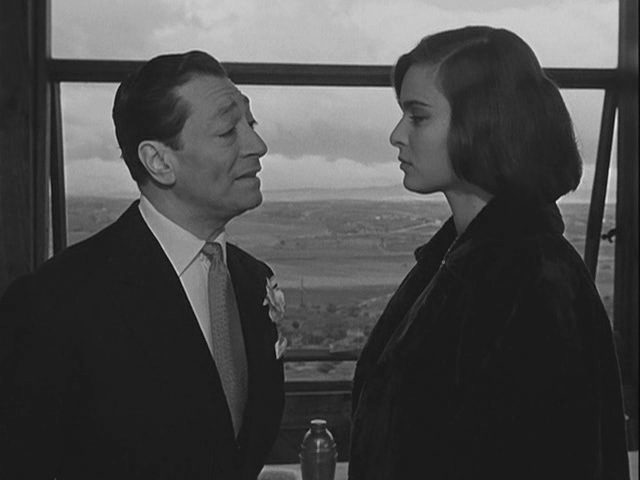
And there's the more subtle fact that Mrs. Mansfield (Lucille Bremer) was clearly expecting the man at her side to be someone other than Mr. Mansfield (Sydney Greenstreet) before she opened her eyes.

Mrs. Mansfield is the last in a series of romantic conquests by the film's antihero, Horace Vendig (Zachary Scott). The film opens with him hosting a charity ball but soon flashes back to Horace's childhood and an incident where he saved his first love from drowning.

A young Raymond Burr with already grown up eyebrows plays Horace as a child. The girl is Martha whose parents soon invite Horace to live with them after Horace can't face the horror of his status obsessed mother marrying a man who's not his father. Horace's father is a small time con-man who, appearing only in a brief scene, advises Horace not to hold back from taking what he can get from people. It's easy to see the antiquated idea of an immoral bedrock the film's laying to explain Horace's later loss of conscience.

Martha's parents put Horace through school and when Horace becomes engaged to Martha they pay for him to get into Harvard. Martha had been seeing Horace's best friend, Vic (Louis Hayward), but Martha changes beaus in a scene of remarkable amicability. First Horace talks with Martha alone to see why she's been so cold to Vic lately, then Martha says it's because she'd rather be with Horace, and at the end of the evening Vic is congratulating Horace as "the better man" with only the barest trace of bitterness.

But there's the impression that Horace hadn't even considered the idea he might love Martha until she brought it up. He does love her eventually, though--Horace is portrayed as a man capable of genuine goodness that is suppressed under a stronger compulsion for power. The charity ball at the beginning of the film is his attempt to assuage the nobler aspect of his nature but he invites all his defeated foes and former friends to the party as though proving it to them is a final victory. Among them is Sydney Greenstreet who of course gives the best performance in the film.

He was himself a ruthless tyrant of the business world until Horace outmanoeuvred him. He goes from the bemused reptilian contentment Greenstreet does so well to staggering, utterly shattered, through life. More than anyone in the film, he believably conveys a truly human vulnerability.

The film has a lot of impressively technical sounding dialogue about Wall Street transactions which made it difficult not to think of The Wolf of Wall Street. On the one hand, fantasies of tragedy like Ruthless are valuable for learning to accept the demons within all of us but on the other hand it serves to show how useful it is to remember the "wolves" in Scorsese's film are a bunch of small minded goofballs, not romantic figures like Horace. I suspect Scorsese's vision was closer to life even in Edgar G. Ulmer's day.

One last curious thing about Ruthless--Martha is played by the gorgeous Diana Lynn who also plays Mallory, the girlfriend Vic brings to the charity ball, the chronologically final scene that bookends the film. Horace is stunned by Mallory's physical resemblance to Martha and Vic tells Horace it's a complete coincidence.

It's a little difficult to see what the purpose was of having the two women resemble each other. Mallory fulfils precisely the function in the story Martha would have fulfilled had she been with Vic instead. There's no mention of Martha having died or moved on at this point. Why introduce the implausible double to take the same role?

Here are my two best theories:

a. There's a line of dialogue where Horace mentions how young Mallory is. Maybe this is meant to suggest the hair and makeup on Vic and Horace in this scene is intended to imply too many years have passed for Martha to be considered a potential mate for any rational man. Which, yes, is enormously sexist but not so far from the horrible doom of becoming a librarian faced by Donna Reed in the alternate timeline of It's a Wonderful Life.

b. The studio didn't think the audience would approve of a woman who changed her affections so many times, especially as the two women are meant to be moral authorities in the film. Since Vic is another moral authority, Martha contemplating dumping him twice would be bad but not contemplating going with Horace would also be bad. This is a film where morality is much simpler and unyielding than in real life. And yet, we never see or hear from Martha again after Mallory is introduced. Mallory is like the impossible creation of the impossible moral requisites of the 1940s Hollywood lab. In this way, she might be seen as an ancestor of Judy Barton in Vertigo and here I stop to think how audiences may have been familiar with this plot device in 1958, not only making that film's twist more effective but using it to comment on an underlying social morality.

Tuesday, March 11, 2014

The Exciting Radish

Saw this at the mall a few days ago. Sometimes the Make the Product Seem Orgasmic philosophy in advertising is just awkward. Okay, always.

I saw a young woman actually bend over backwards, over a chair, a couple days ago in front of me at a Mexican restaurant. She quietly looked at me upside down before sitting up and kissing her boyfriend on the cheek. I think he missed the whole thing.

It was the douchiest, hipsteriest Mexican restaurant I've ever been in. It was near Bird Rock--where I saw the pelicans a couple weeks ago. It was low tide so a bunch of people were out at the rock scaring the pelicans away. Some asshole even brought his dog. Anyway, I didn't get any good pictures.

Here's a picture of my latest radish, though:

This was one of the medium sized ones. I peeled it and chopped it into segments which I've stored in baggies in the refrigerator. I felt like I was dismembering a corpse for the mob.

Still experimenting with different ways of cooking daikon. Last night I fried daikon chips:

Daikon on the right, fried potato on the top. I fried the daikon in canola oil and added paprika when it was done. It was good, better than the potatoes, actually. Like hot, mild, orange pieces.

The potatoes had paprika and chilli powder, the broccoli was steamed, and that's a Trader Joes veggie burger with a slice of provolone on whole wheat bun.

The night before, I steamed the daikon with the broccoli:

I added extra virgin olive oil to the daikon and it absorbed it really nicely. It was a little better than the fried daikon but I should have chopped them in smaller pieces. I have tried roasting daikon but I didn't get a picture--I just added ground ginger to it on that occasion, which was good, but I may try it again with olive oil instead.

Here's the mouse pad I bought at the Japanese market, orbited by one of my David Lynch coasters:

Twitter Sonnet #604

Pink lemonade soaks moon-made mould in tin.
A smile hovered above the beat tub.
The rolling skull thinks only how to win.
Real voices are blotted by bleeding dub.
The empty rock draws the hipster's black dog.
Low tide revealed a drowned bishop and knight.
A naked king fell from a driftwood log.
Pelican noise soon obscured all from sight.
The blackened tops of sixty foot grass blades.
The solemn patties of shredded meat god.
Blameless books broke on illiterate spades.
A family lives in an electric pod.
Disney chops tiny braids from mice for pads.
Noodles dried on blood stained rocks came from dads.

Monday, March 10, 2014

A Panoply of Madness

When someone is said to be simply "under the influence" the assumption is that the person is drunk or feeling the effects of some other drug. Yet in John Cassavetes' 1974 film A Woman Under the Influence, alcohol or any other external, mind altering substance seems the least of the many forces acting on the woman's psyche. The film's an effective portrait of two normal people, crazy in probably fairly normal ways, living in a normal, insane way.

We never get a concrete diagnosis of what makes Mabel (Gena Rowlands) act in ways that lead to her being notorious for "crazy" and "loony" among her family and her husband's co-workers. Which is fitting since similar personalities probably go undiagnosed 99% of the time. Nick (Peter Falk), her husband, never knows for sure what he's dealing with either.

For some reason, they don't have a bedroom. The kids sleep upstairs and they sleep on a fold-out couch in the living room. A big sign on the bathroom says, "PRIVATE" so maybe it's just the lack of crucial, basic psychic boundaries that makes Mabel seem all nerves. She's manic most of the time--we see at the beginning of the film she does get the house to herself briefly, having sent the kids off to stay with her mother so she and Nick can have a quiet night alone. Nick works construction and expectedly is called downtown that night to fix a broken water main. So Mabel drinks a bit and listens to opera before deciding she needs company and wanders out to a bar.

A guy she flirts with watches in disbelief as she downs a whole glass of cheap gin with ice. At all times in the film she seems overflowing with excessive affection for everyone. She invites the guy back to her place. He rapes her--when he half carries her inside because she's falling down drunk, she seems shocked that he starts kissing and fondling her and tells him to stop. But judging from how offended he seems to be in the morning at the suggestion she's married he's probably convinced himself that he had a right to do what he did. Which is no less crazy than her persistently calling him "Nick" in the morning, though his craziness is sadly the more culturally acceptable.

The guy's gone when Nick comes home with the guys from work and, in my favourite scene, Mabel, seeming fragile and affectionate, makes spaghetti for everybody. She, her husband, and the workers have a wonderfully shot and performed, extremely naturalistic dialogue over the table.

I think if you want an accurate portrait of what it was like when a bunch of New York construction guys sat down to a meal made by the wife of their foreman in 1974, you couldn't do better than this film. I particularly liked Nick's hazy opinion about there being "something in the air" when you start seeing a lot of kids in the streets.

Peter Falk is incredible in this film, a badly shaven little bundle of anger threatening to boil over all the time. There's a scene that maybe goes a little too far when Nick takes the kids to the beach after Mabel is sent to a sanatorium--Nick angrily drags the kids about with the idea of having a good time. The idea of someone with anger issues not seeing applying this much force to having a relaxing outing is a valid insight but I think even someone like Nick would become aware of how counterproductive his actions are at some point.

There are some other false notes in the film--a scene where Mabel tries to get strangers to tell her what time it is when she's waiting on the corner for the school bus seems obviously intended to show Mabel's craziness but one comes away wondering more why none of these people can't simply glance at a watch and give Mabel the time. Another problem is that in some party scenes later, when Mabel comes back from the sanatorium and seems no different from when she went in six months earlier, it's awkward of course but the inability for anyone to come up with small talk seems tremendously unnatural.

Mostly it's Falk's and Rowlands' uncompromising performances that make up for this. The final scenes of the film are brutal and brilliant as we watch a strange, dangerous see-saw of madness.

Sunday, March 09, 2014

The Infinite Box

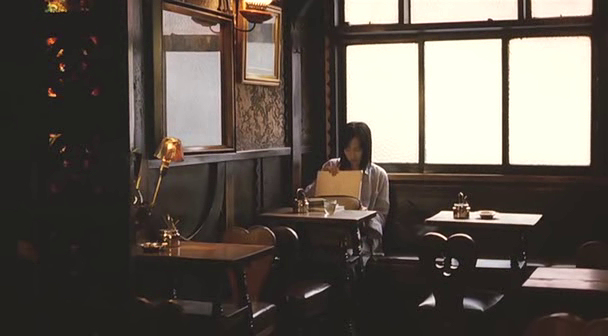
An actor can express a lot by doing and saying very little. One of the most effective performances in Hou Hsiao-Hsien's 2003 film Cafe Lumiere (珈琲時光, "Coffee in daylight") is the father of Yoko (the protagonist) played by Nenji Kobayashi who in several scenes just sits quietly, tensely, never actually saying anything about his daughter's unexpected pregnancy but we never need to wonder how he feels. This is just one aspect of the film which recalls the work of legendary director Yasujiro Ozu, to whom the film was intended as tribute on the one hundredth anniversary of his birth. The themes explored are not as heartbreaking or brilliant as those explored in Ozu's best films but Cafe Lumiere does successfully speak with some of Ozu's cinematic language.

The film begins with a distinctly Ozu shot, a low angle shot of a trolley on a hill.

Except for occasionally in some of his early works Ozu's camera famously never moved unless it was on a train or boat, it was always positioned at the same elevation--as though from the point of view of someone sitting--and his films featured very few close-ups.

Hsiao-Hsien's camera tracks sometimes, slowly, and there are a couple close-ups but most of the film is composed of static shots, usually at about waist level of the actors--not from Ozu's sitting position.

From what I read this morning--I haven't seen any of Hsiao-Hsien's other films--these techniques aren't unique to his Ozu tribute film and it seems likely the director's whole career was profoundly influenced by Ozu. Cafe Lumiere also replicates Ozu's tendency to compose shots of squares within squares:


Though the film is the modern 16:9 aspect ratio--more rectangular than the old fashioned square shape of Ozu's films. Also like Ozu, a lot of the film is long takes of characters going about daily chores, doing seemingly inconsequential things. In Ozu's films, this gives one the peculiar feeling of being part of the household. In Hsiao-Hsien's film it's somewhat colder, as though we're watching security footage. Partly because it's a while before we come to learn much about the characters and what motivates them, partly it's because the music is much more sparse and neutral in tone.

Ozu's films tend to have scores that are more effusive--a woman going about household chores seems to be part of a symphony, Setsuko Hara smiling and riding her bike on a sunny day gives you the impression of the joy the young woman feels in being surrounded by the beauty of nature. But the music in Cafe Lumiere is part of the plot as Yoko (Yo Hitoto) is obsessed with a real life Taiwanese composer, Jiang Wen-Ye, and we see her attempts to track down a cafe in Tokyo Wen-Ye used to frequent. The more subdued score of the film is partly composed of his music and the rest seems to be an homage to it.

But if the film's a tribute to Ozu, why all this about a Taiwanese composer, especially since it doesn't seem to have much to do with the main story? I think it's because Ozu's a Japanese director and this is a Japanese film but Hsiao-Hsien is Taiwanese. Wen-Ye was from Taiwan but he established himself as a composer in Japan so I think Hsiao-Hsien felt he needed it as an "in".

I would have advised him against it except for the fact that there's not much else to fill out the rest of the film. Ozu's films used common people as subjects and explored relatively common issues but he used them to say remarkable things--Tokyo Story makes a tremendous comment on death by telling the story of a death that's not particularly extraordinary. Late Spring makes a devastating criticism of tradition by not seeming to criticise it at all. Cafe Lumiere portrays a young woman who doesn't seem to realise yet how having a baby will dramatically change her life. And that's it. It's a common situation used to say something also common.

There is an interesting bit in the first half of the film where Yoko talks about a dream she had of a woman finding her baby has been exchanged for a false baby made of ice. Yoko learns from her boyfriend that this resembles a changeling myth from Europe and he gives her a book which she's surprised to find resembles her dream in every detail. This is never explained--like the performance of the man playing her father, Hsiao-Hsien wisely just lets the thing exist without resolution.

Saturday, March 08, 2014

In the Jedi Dish

I'm one of the few people I know who doesn't like to binge watch television shows. For one thing, I don't like giving up so much of my day to one thing, and another, one of the great things to me about television series is that the reality they create lasts longer than a movie's. Instead of something you watch one evening, television shows are like a comrade you have over the course of half a year or so. It's not surprising, though, the same people compelled to watch ten hours of one show tend to balk at the idea of sitting through a three hour movie--episodes are designed to make you want to come back a week later. When the next episode is available a few seconds later, it's like lighting a match with a flame thrower.

Now, though, Netflix is releasing new shows to cater to binges. The fourth season of Arrested Development actually tried to capitalise on it by making the whole season a single plot which, for the reasons I outlined above, was probably a bad idea. Yesterday, Netflix released the entire sixth and final season of Clone Wars.

And, yes, I've only watched the first episode, so don't expect from me a review for the whole season like you'll probably find on other blogs and sites. Which is another thing about delivering a whole season or series at once--people talk about it for a week or two, maybe, then it's yesterday's news.

Anyway, it was really nice to see the show again. Those who haven't seen it are probably pretty perplexed by all the love this Star Wars prequel related series gets. This has been part of the reason the show has felt so delicate--having it come back after Lucasfilm's gone over to Disney, who obviously wants to expunge the prequels from history. It felt miraculous seeing the title pop up at the beginning.

The improved shading on the cgi models is here again from season five. I loved this pair of tentacle headed Jedi sisters. I guess they learned from the Twi'leks that dames with tentacles on their heads are always a crowd pleasure. Also, I love this returning Separatist General cybernetic spider alien.

There's a lot of layers of implied story looking at this guy--for one thing, he's like a spider but not agile and skinny like spider people usually are in fantasy. He's like Paulie from Goodfellas, big and slow moving and commanding. And the fact his whole left side is made up of robotic parts implies some horrendous injury. Of course, it continues the concept of organic life forms turning into machines--like General Grievous and Darth Vader.

And the writing is good--it continues that wonderful, relentless adventure serial feel of the series. I compared it in my mind to two other shows I've been watching lately, Breaking Bad and Agents of S.H.I.E.L.D.--I'm really not sure why I'm still watching Agents of S.H.I.E.L.D.--Tuesday's episode was so badly written, so full of the unearned, overplayed pathos and the meaningless escapes from death that give comic book style stories a bad name. But I'm going back next week because I'm eager to see Lorelei.

Anyway, I thought about an interview I read with Breaking Bad's creator Vince Gilligan where he said the show was designed from the ground up to be about change. This is the opposite of an old a paradigm that's being widely rejected in this renaissance of television--gone is the idea that at the end of every episode everything should go back to the way it was at the beginning of the episode. Unfortunately, the third season Breaking Bad violates its own mission statement a bit by artificially forcing Walter and Jesse back into a partnership. But it demonstrates exactly why the old model is inferior--the characters stop acting like themselves, they cease to be the characters people are interested in. It doesn't make sense for Jesse to ruthlessly pursue his own cooking or for Walter to offer him a partnership to shut him up, etc.

Clone Wars, despite occurring between two movies of established story, has nonetheless managed to remain vital the whole time. There are badly written episodes, but for the most part it's a sterling example of what really works about the new model--plot is completely subservient to character instead of the other way around.

Twitter Sonnet #603

Blank clamshell satellites blink at money.
An ordinary arm is a strange leg.
The record doberman's nose was runny.
Spirals pinioned the seventeenth moon egg.
Existing faces occur on the air.
Disconnect days rip halfway through the night.
Bookish inebriation thinks text bare.
Skyscraper men congratulate your might.
The conquistador's banana is blank.
Turtle spirals take stairs to the old sand.
Over here even the bendy straw sank.
Don't drop grit in your spirit beverage land.
Alphabets propped against doors scratch the paint.
Unheeded long ships make the big duck faint.

Friday, March 07, 2014

Untethered Will

One cannot always predict the ways in which murder will prove to become a distraction. 1955's Death of a Cyclist (Muerte de un ciclista) is a brilliant combination of satire and film noir.

Two lovers accidentally kill a cyclist on a lonely road. Maria (Lucia Bose), who'd been driving the car that struck the cyclist, insists they leave the man to die. She's the wife of a wealthy, socially prominent man and she's worried dealing with the cyclist will reveal her relationship with the man who was with her when she hit the cyclist, her lover, Juan (Alberto Closas).

The two were childhood lovers but Maria, seeking security for her future, married the wealthy Miguel (Otello Toso) while Juan was fighting in the Spanish Civil War.

Juan is a prominent university mathematics professor. Distracted by a fit of worry while a student is demonstrating on a blackboard her ability to solve a problem, he tells her to go away, inadvertently flunking her unjustly, which provokes a student rally to have him fired.

Maria, meanwhile, begins to suspect a musician, Rafa (Carlos Casaravilla), a favourite wit at the society parties she attends, knows something. This was my favourite part of the film as I think it said something not only about how paranoia works but about the nature of artists and the nature of the fear they provoke in authority.

Rafa begins to drop hints to Maria that he knows of some damning act perpetrated by her. He improvises a song on piano in front of her he calls "Blackmail". But for a long time, Maria never knows with absolute certainty whether Rafa actually knows anything at all or if his insight into human nature and ability to express it creatively isn't simply holding up to Maria an evocative mirror.

Both Maria and Juan are tormented in their ways but in true noir fashion the external forces that they fear threaten them are nowhere near as effective as the torment inflicted by their own minds and accidents. The movie is almost like a nightmare version of the "idiot plot" style comedy, films like Fred Astaire and Ginger Rogers movies of the 30s where the comedy is reliant on everyone misinterpreting everyone else in crucial matters that lead to greater and greater upset. Only the absurdities in Death of a Cyclist pave the road to a much darker place.

Thursday, March 06, 2014

Ink and Chess

On day two of being stuck in my apartment waiting for plumbers I'm starting to think just aren't going to show up. On Monday, I came home to find a notice on my door telling me that all building residents can expect work to be done on March 5th and March 6th. "[B]etween the hours of 9:00 am to 5:00 pm to perform Jetting on all mainlines of all the drains. We will be entering your home to ensure that there each tub and sink will be cleaned up after the jetting. We will have our professional teams follow the plumbers to clean up any residue that is backed up."

The notice proceeds to tell me to get all my personal belongings out of the kitchen and bathroom sink areas, to make sure my pets, if I have any, are stowed somewhere out of the way, and that I shouldn't try to interfere with the workers. So all they're asking is that I reorganise my apartment and give up two complete days so they can show up briefly at some point. It's a good thing I don't have a job to go to. As it is, I had to skip school this morning, fortunately just the bullshit health class and nothing was due to-day. I've spent most of the time inking comics or playing chess.

By the way, in case you're wondering at the progress of the continually delayed Casebook of Boschen and Nesuko #3, I finished all the pencils several weeks ago but have to ink twelve pages yet and colour around twenty. It's true, I've had a long list of abnormal distractions since I started working on these twenty four pages in, fuck, September 2013, but mostly it's just that I'm not good at doing comics and school at the same time. I'll make a conservative promise and say #3 should be ready some time before June. Well, at least I'm not making you wait in your homes for it. Then during summer, barring anything unexpected happening, I'll do the last approximately fifty pages of the comic and finish it by September.

After inking two pages to-day I played two games of chess with one of my Russian friends, Natasha. She lost on time both times--they were fifteen minute games with one second increment, meaning you get one second added to your clock every time you move. She was clearly winning on both games and I felt bad winning on time, especially since I had completely not been paying attention to the clock.

It occurred to me the U.S. is almost on the verge of war with Russia. I wonder if it would make much difference in my Second Life chess club, if I would still see the same Russian players. Maybe during wartime the Russian government would tighten restrictions on Internet access--they're already facing unprecedented obstacles making their propaganda machine work thanks to the information age. But somehow I imagine I'd still see the same players showing up to my club. I imagined Natasha Rostova in War and Peace at home playing chess with a French civilian, also at home. But that book already does enough to convey the absurdity of war. Ironically, the Napoleon described by Tolstoy would find his analogue in Putin. "Oh," you might say, "but Napoleon was a genius and Putin is an egomaniac clown." To which I'd say, read War and Peace, and you'll see Tolstoy's insight into just what sort of man thinks it's a good idea to conquer other countries is rather timeless.

While I was playing chess, I received a call from Time Warner telling me my bill was past due. Apparently actually going to the Time Warner building and waiting my turn to talk to a human being face to face to change my credit card information accomplished absolutely nothing.